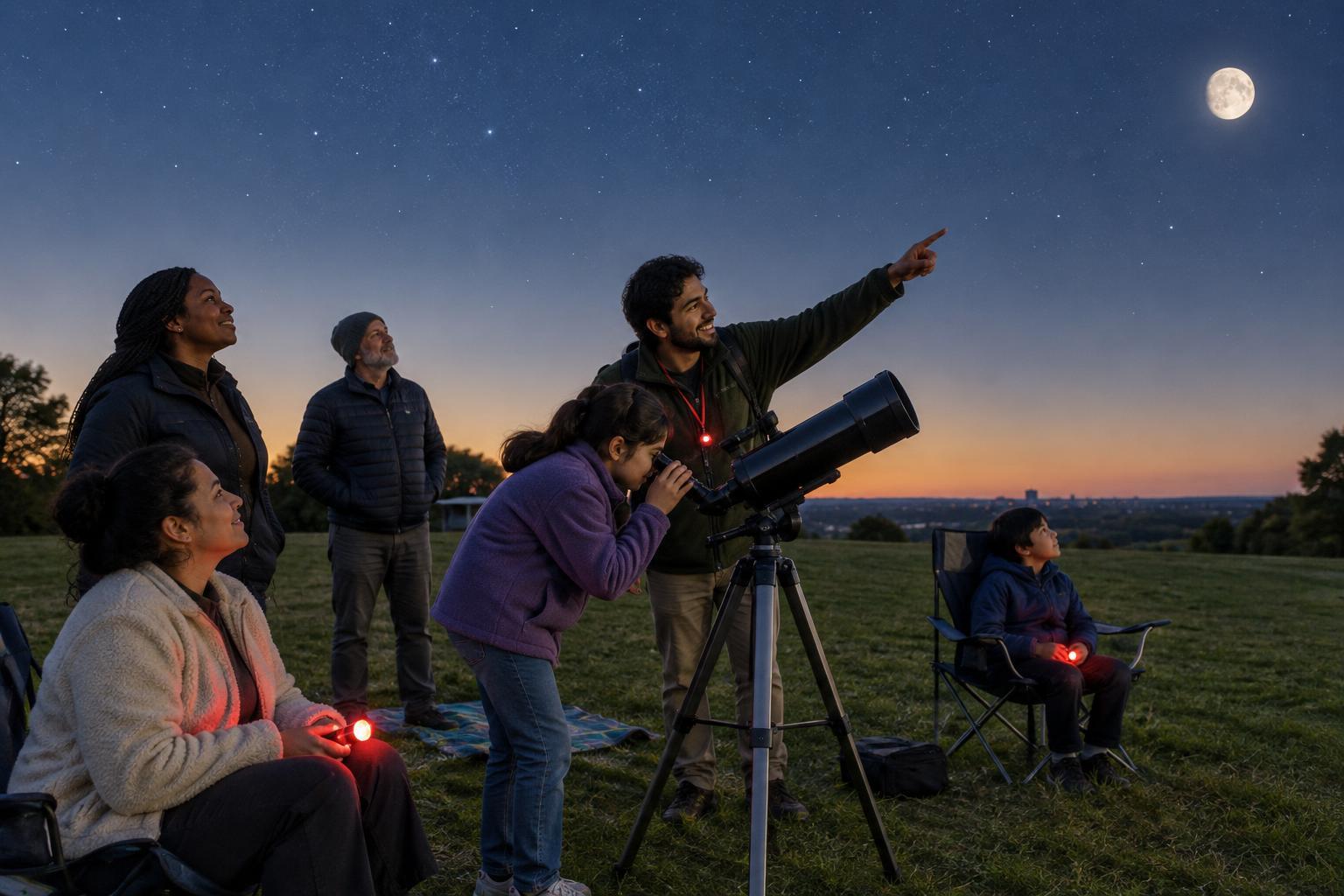
Start with the people and the place
A community stargazing night works best when newcomers can enjoy it without owning equipment or knowing the constellations. Decide who the event is for, how long visitors are likely to stay, and whether they can arrive at any point or should join at the start. A short, flexible session is often easier to host than a program that depends on everyone following the same schedule.
Choose a site with a clear view of at least part of the sky, safe walking routes and enough space around each telescope. A dark location can reveal fainter objects, but accessibility, permission to use the site and a straightforward journey home matter too. Visit beforehand if possible: a field that looks open on a map may have trees, bright lamps or uneven ground that change what visitors can see.
Tell people what to expect. Mention whether the event is outdoors, whether there are toilets or seating, and that clouds may limit the view. Encourage warm layers even if the day has been mild. If you are organizing volunteers, give someone responsibility for greeting arrivals and someone else for checking the observing area. For broader ideas about coordinating an outreach effort beyond the astronomy itself, readers can browse Organizacja marketingu · Sprytny Marketing.
Build an observing route, not a long target list
Pick a few targets that suit the season, viewing time and equipment available. The Moon, when visible, offers recognizable features through modest binoculars or a small telescope, though its glare can make nearby faint objects harder to notice. Bright planets can be rewarding when well placed, but what visitors see varies: a planet may appear much smaller in the eyepiece than it does in a photograph. A familiar constellation or bright star gives people something to find without waiting in a telescope queue.
Check when each target rises and how high it will be during the event. Objects close to the horizon are more likely to be blocked by buildings or trees, and their light passes through more atmosphere. If you have multiple instruments, point them at different targets and let visitors move between them. A simple route might begin with an unaided-eye landmark, continue to binoculars, and end at a telescope.
Have a backup that does not depend on a perfectly clear sky. Brief gaps in cloud may be enough for one bright target, while heavier cloud offers a chance to explain how a telescope gathers light or how to read a sky map. The aim is not to promise a particular sight; it is to make an encounter with the night sky understandable and enjoyable.
Make the eyepiece welcoming
Looking through a telescope takes practice. Before a visitor steps up, explain where to place their eye and ask them not to grab the instrument for balance. Adjust the eyepiece height where practical, and allow extra time for children or anyone who needs help reaching it. If the image seems to disappear, a small change in head position may be enough; it does not necessarily mean the telescope has moved off target.
Describe what visitors are likely to see before they look, without overselling it. A cluster may resemble a scattering of tiny points rather than a colorful space image. Invite people to say what they notice first, then offer a detail to look for. This gives them permission to observe carefully rather than feel they must recognize the object immediately.
Keep walkways visible without shining bright lights into people’s eyes. Dim, directed lighting can help visitors move safely while allowing their eyes to adapt to the dark. Avoid aiming lasers or other bright beams toward the sky, and never set up a telescope where someone could accidentally point it at the Sun. If your group also provides or sells observing materials, Doświadczenie zakupowe · Sprytny Marketing offers further browsing on the separate topic of how people experience that purchase process.
Let questions shape the night
Visitors may ask why stars twinkle, whether a bright point is a planet, or why the telescope image is upside down. You do not need a lecture prepared for every question. Give a short explanation connected to what people can see, and say when you are unsure. That approach models a useful part of astronomy: observing carefully, checking an idea and distinguishing a confident answer from a guess.
Leave room for simply looking up. A pause away from the telescope queue lets people notice patterns, compare colors and ask questions of their own. At the end, point out one object they might find again without equipment. A successful event is not measured by how many objects a group has viewed, but by whether visitors leave feeling able to look at the sky for themselves.