
How Science WorksScientific consensus is not a vote or a promise of certainty. It develops as evidence is tested, compared and challenged across a research community. Here is how that process works, why disagreements matter and what can cause a well-supported view to change.
Read article · 4 min↗
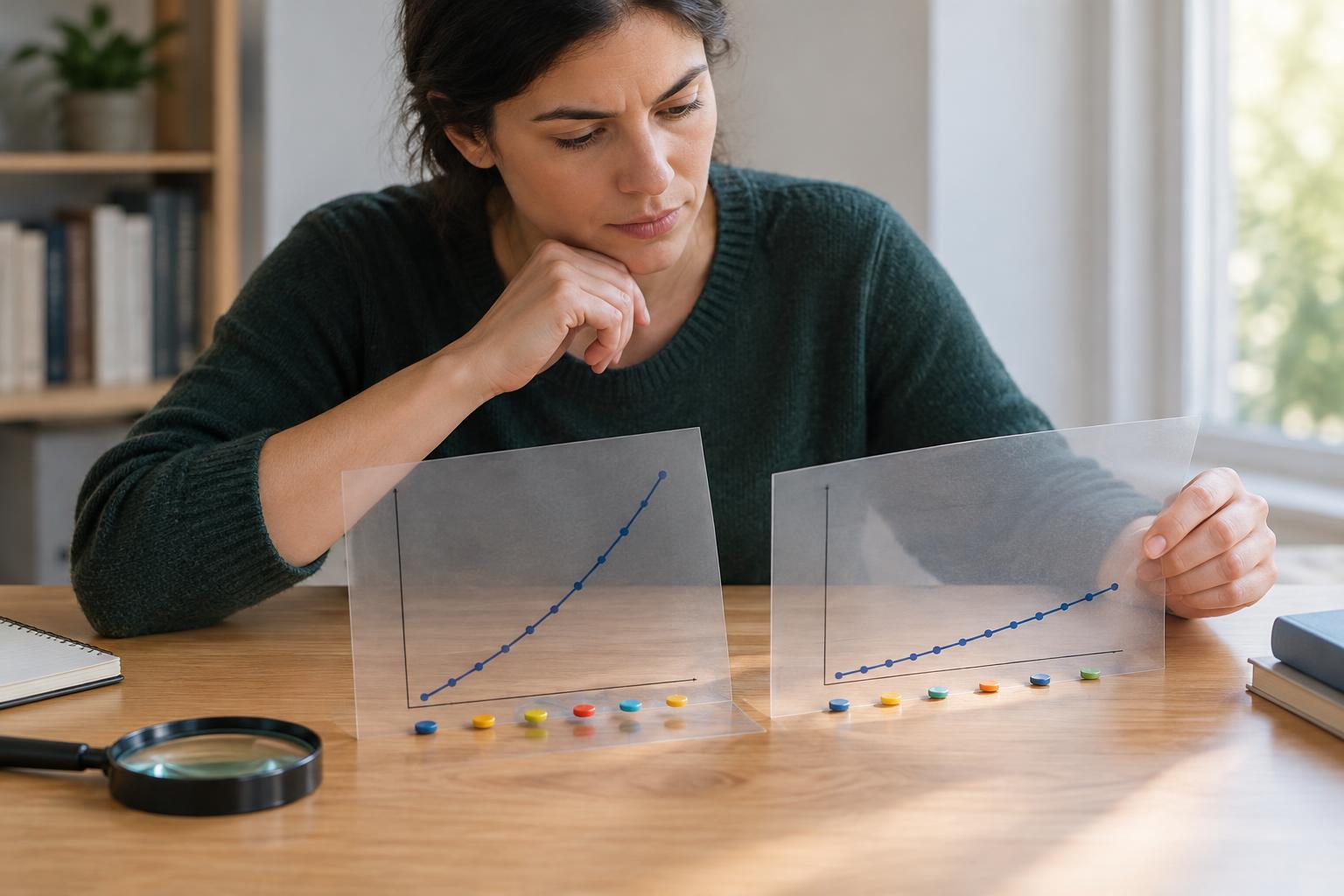
How Science WorksA graph can display accurate numbers and still leave a misleading impression. Learn how axis choices, missing context, grouped data and uncertainty affect what a scientific chart appears to show.
Read article · 4 min↗

How Science WorksA claim that something “cuts risk in half” can sound dramatic, but its meaning depends on the starting risk. Learn how absolute and relative risk describe the same numbers in different ways, and what to check before drawing conclusions from a health headline.
Read article · 3 min↗

How Science WorksWhen researchers can choose which results to highlight after seeing the data, a study may appear more convincing than it is. Preregistration records a research plan in advance, making it easier to distinguish planned tests from later discoveries.
Read article · 4 min↗

How Science WorksScientific models leave things out on purpose. Learn how assumptions make models useful, where they can fail, and what to ask when a model’s prediction seems convincing.
Read article · 4 min↗

How Science WorksOne study can offer a useful clue, but it rarely settles a scientific question. Systematic reviews use a planned process to find and assess relevant studies; meta-analyses can then combine compatible results. Here is how these tools work, what they reveal, and why a pooled answer still needs careful interpretation.
Read article · 4 min↗

How Science WorksAn abstract tells you what a study set out to do and what its authors think they found. To judge what the evidence actually supports, you need to look at the question, methods, results and limitations. Here is a practical way to read a paper without getting lost in every technical detail.
Read article · 4 min↗

How Science WorksPeer review asks other specialists to examine a research paper before publication. It can improve a study’s clarity and catch important problems, but it cannot guarantee that every result is correct. Here is what reviewers usually assess, what can slip through, and how readers can judge a paper in context.
Read article · 4 min↗

How Science WorksA result is easier to trust when others can check both how it was calculated and whether it appears again in a new study. Replication and reproducibility describe these related but different tests.
Read article · 4 min↗

How Science WorksA confidence interval shows a range of estimates produced by a statistical method. Learn why its “95%” label describes the method’s long-run performance, not the probability that one particular interval contains the answer.
Read article · 4 min↗

How Science WorksA statistically significant result is not necessarily a useful one, and a nonsignificant result is not necessarily evidence that nothing happened. Learn how sample size, effect size and uncertainty help put research findings in perspective.
Read article · 4 min↗

How Science WorksError bars show that measurements are not perfectly precise, but their meaning depends on how they were calculated. Learn to distinguish variation among observations from uncertainty in an estimate, and to spot what a graph may leave out.
Read article · 4 min↗

How Science WorksA measurement is more than a number on a display. Learn how accuracy, precision and calibration differ, why readings vary, and how scientists judge whether a result is fit for its purpose.
Read article · 4 min↗

How Science WorksWhen researchers compare treatments or other interventions, a convincing result depends on more than measuring an outcome. Random assignment helps create comparable groups, while blinding helps keep expectations from influencing what happens next. Here is how the two methods work, what each can and cannot do, and what to look for when reading a study.
Read article · 4 min↗

How Science WorksA study can collect accurate answers and still reach a misleading conclusion if the people, objects or events it examines do not reflect the group it hopes to describe. Learn how sampling bias arises and what to look for when judging a result.
Read article · 4 min↗

How Science WorksWhen two things change together, it is tempting to assume that one causes the other. Learn why that leap can be misleading, what else might explain a pattern, and how scientists build a stronger case for cause and effect.
Read article · 4 min↗

How Science WorksA study can reveal a pattern without proving what caused it. Learn how observational studies and experiments answer different questions, why both matter, and what to look for when reading a scientific claim.
Read article · 4 min↗

How Science WorksA controlled experiment changes one factor while keeping other relevant conditions as comparable as possible. Learn how comparison groups, random assignment and careful measurement help researchers identify causes—and why no experiment controls everything.
Read article · 4 min↗

How Science WorksA hypothesis, a theory and a law do different jobs in science. Learn how each helps researchers ask questions, explain evidence and describe patterns—and why a theory does not become a law when enough evidence accumulates.
Read article · 4 min↗

How Science WorksA scientific question becomes testable when observations could help distinguish among possible answers. Learn how clear definitions, measurable predictions, fair comparisons and uncertainty turn a broad curiosity into a question that evidence can address.
Read article · 4 min↗