Start with the question, not the conclusion
A scientific abstract is a useful map, but it is not the whole journey. It compresses a paper’s purpose, approach and main findings into a small space. That makes it a good place to decide whether a paper is relevant to you, but a poor place to stop if you want to understand how strongly its conclusion is supported.
After reading the abstract, find the question the researchers were trying to answer. The introduction should explain why they asked it and what was already uncertain. Try putting the question in your own words. Is the study testing whether one factor causes a change, looking for an association, describing something previously unmeasured or evaluating a new method? These are different tasks, and they support different kinds of conclusions.
Find out what the researchers actually did
The methods section turns a broad question into specific measurements. Look for what was studied, how observations were collected and what was compared. In a laboratory experiment, that might mean checking the experimental conditions and the control group. In an observational study, it might mean asking how participants or samples were selected and which other factors the researchers tried to account for. A study’s design matters more than a confident-sounding sentence in its abstract.
You do not need to master every instrument or statistical technique to notice important boundaries. Did the researchers measure the thing you care about directly, or use a substitute? Was the work done with people, animals, cells, simulations or distant astronomical objects? Each approach can answer useful questions, but its findings may not transfer automatically to another setting. If a methods term is unfamiliar, first work out its role in the study rather than trying to decode every detail at once.
Let the figures and tables do some talking
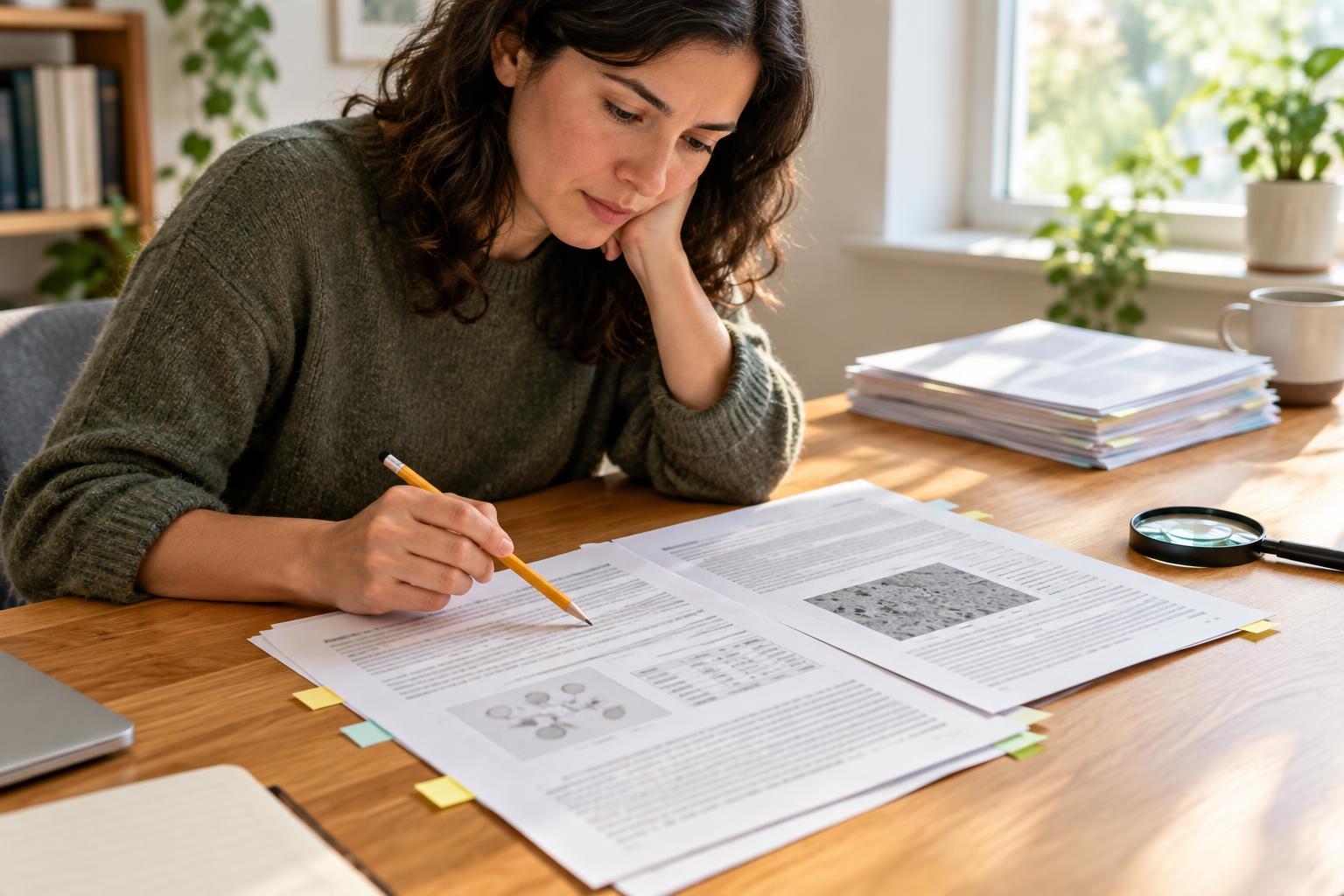
The results section presents what the researchers observed or calculated. Figures and tables often make the central comparison easier to see than the surrounding prose. Read each caption, then check the axes, units and labels. Ask what is being compared, whether the display shows individual observations or summaries, and how much the values vary. A graph can show a clear pattern, a small difference or considerable overlap; the caption and methods help explain which interpretation is reasonable.
Pay attention to the size of an effect as well as whether the authors describe it as statistically significant. Statistical significance addresses a particular test under particular assumptions; it does not, by itself, tell you whether a difference is large or useful. Likewise, uncertainty ranges help show how precise an estimate may be. If a figure seems to tell a different story from the headline conclusion, slow down and check what each is describing before deciding they conflict.
Separate the finding from its interpretation
The discussion is where authors explain what they think their results mean. Compare those explanations with the original question, the study design and the results you have just examined. For example, if a study found that two things tend to occur together, does the discussion carefully describe an association, or does it sound as though one thing has been shown to cause the other? Other explanations may still be possible, especially when researchers could not control the conditions they observed.
Look for limitations the authors identify, then consider whether there are others relevant to your question. A narrow sample, an indirect measurement or a short observation period may limit how widely a conclusion applies without making the study worthless. You can also check whether the paper reports funding or potential conflicts of interest. Those details are context for evaluating the work, not an automatic reason to accept or reject it.
Put one paper in perspective
A paper is one contribution to an ongoing investigation, not a final verdict. Its references can help you see which earlier work shaped the question, while later studies may test the same idea under different conditions. Also check what kind of document you are reading. A preprint can make research available before journal peer review; a peer-reviewed paper has undergone review, but that process does not guarantee that every claim is correct.
A useful final exercise is to write three short statements for yourself: what the researchers did, what they found and what remains uncertain. If you cannot separate those three, return to the methods or results rather than relying on the abstract’s summary. You do not have to understand every equation or technical term to read a paper thoughtfully. The goal is to see both the value of the evidence and the limits of what it can tell you.


