The surprising part of a sip
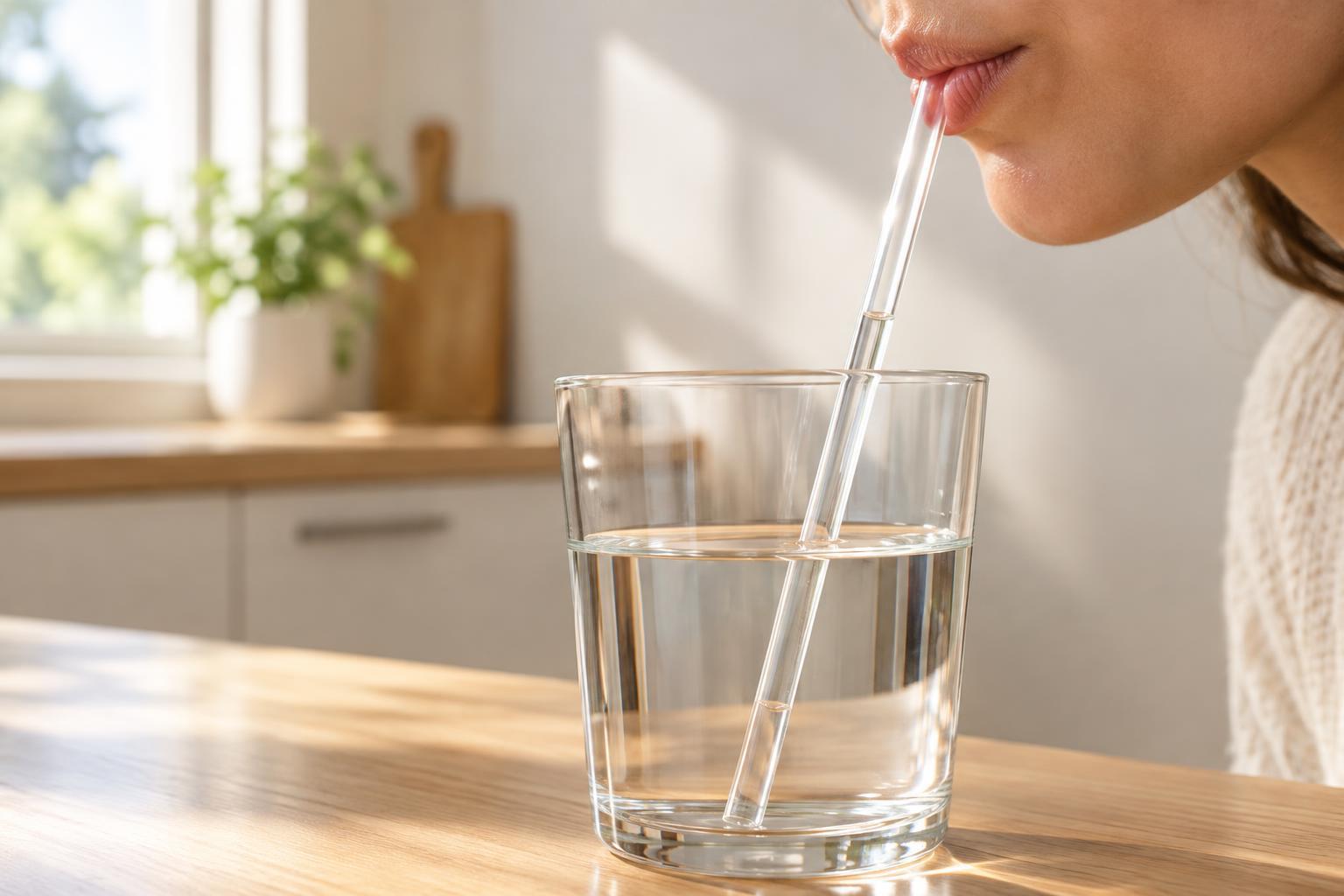
A straw makes it feel as though you are pulling liquid upward. That description is useful in everyday conversation, but it leaves out the force that moves the drink. When you sip, you lower the air pressure in your mouth and in the connected space inside the straw. Air pressing on the drink’s exposed surface then pushes the liquid up the straw toward the lower-pressure region.
The air around us presses on surfaces in every direction. Usually, we do not notice because air also presses from the other side of many surfaces. A straw works when those pressures become unequal. It is the difference between the pressure at the drink’s surface and the pressure inside the straw—not a mysterious upward pull—that makes the liquid move.
Following the pressure difference
Imagine a straw resting in a glass before anyone sips. Liquid enters its lower end and settles at roughly the same height as the liquid outside it. At that point, the pressures balance. When you sip, you remove some air from the straw’s upper end. The pressure above the liquid inside the straw falls, while air continues to press on the drink in the glass. The imbalance pushes liquid into the straw and upward.
As the liquid rises, its weight matters. The taller the column of liquid in the straw, the more pressure is needed at its base to support it. A steady sip is a balance: the pressure difference must be sufficient to hold the liquid at the height of your mouth. If you stop sipping and let air back in, the pressure difference disappears and the liquid usually falls.
Why an open drink matters
A drink in an open glass has a ready supply of air pressing on its surface. In a rigid, tightly sealed container, that supply is missing. As liquid leaves, the pressure in the space above it can drop, making it harder for more liquid to flow. A vent or an opening that admits air allows the pressure at the surface to recover. A flexible container can behave differently because its walls may collapse as the drink leaves.
You can see another pressure balance with a straw and a little water. Place a finger firmly over the top of a straw while its lower end is in water, then lift it out. Some water may remain in the straw because air cannot readily enter from above. Remove your finger, and air enters; the water can fall. This observation does not exactly reproduce sipping, but it shows how changing access to air changes what the liquid does.
Why a straw cannot be arbitrarily tall
Sipping can lower the pressure inside a straw, but it cannot lower it indefinitely. The air pressing on an ordinary open drink therefore has a limited ability to support a rising column of liquid. Gravity works against the rise, and a taller column requires a greater pressure difference. For a straw of ordinary length, this limit is rarely noticeable. For an extremely tall straw, it becomes decisive.
The liquid itself also matters. A denser liquid weighs more for the same height, so a given pressure difference supports a shorter column of it. Narrow straws can introduce other effects, including greater resistance to flow, which may make a thick drink feel difficult to sip even when the required height is modest. The height a liquid can be supported and how easily it flows are related questions, but they are not the same question.
A small example of a broad principle
The straw illustrates a general way fluids move: a pressure difference can drive flow from one place to another. Gravity, the fluid’s properties and the shape of its path influence the result. Describing a sip in terms of these factors makes it easier to predict what will happen if you raise the cup, seal its lid or change the liquid.
The next time you use a straw, notice where the exposed surface of the drink is. Your mouth lowers the pressure at one end of the path, while air presses on the drink at the other. Together, those conditions explain why the liquid rises—and why it stops when the pressures balance again.