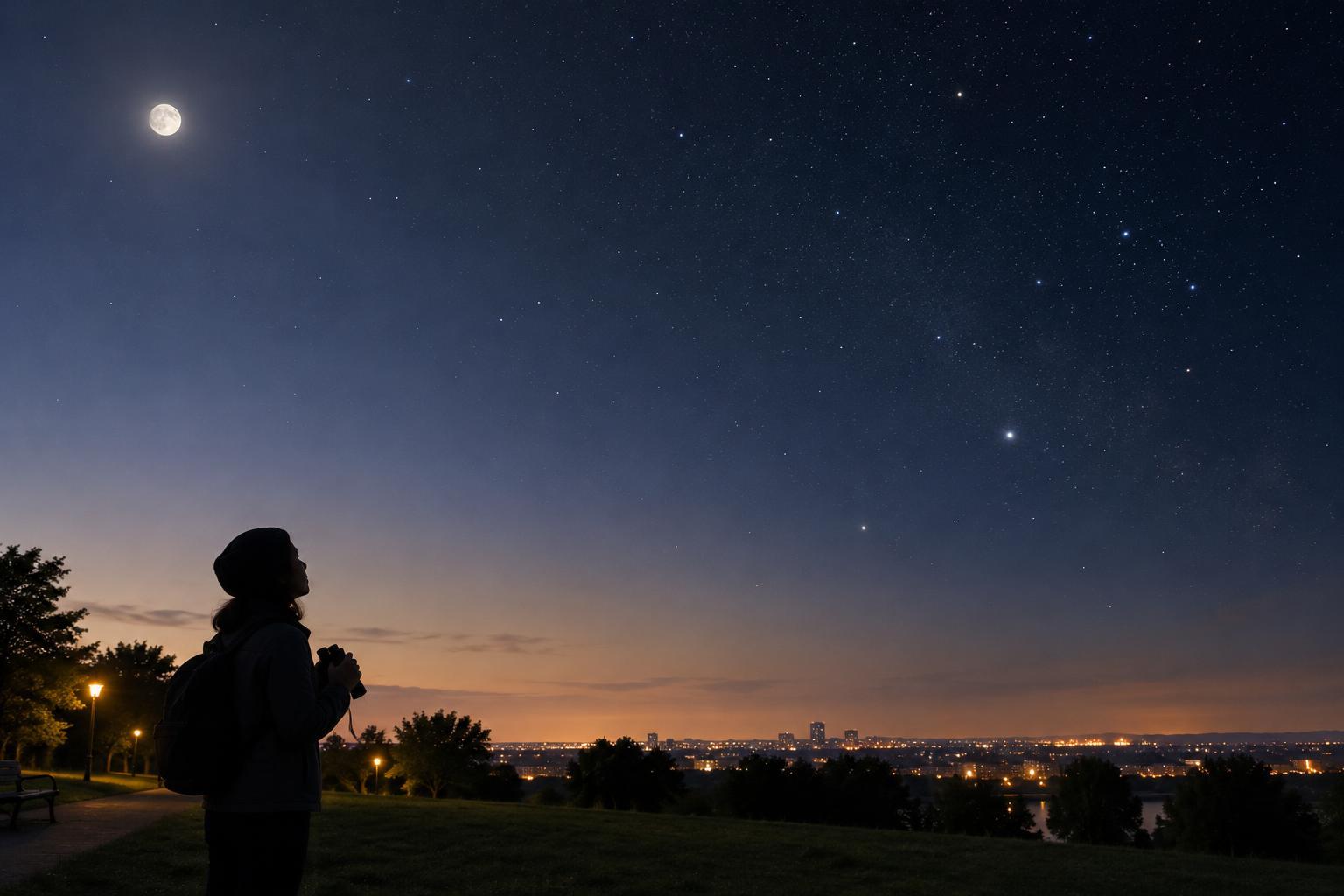
The shimmer begins between you and the sky
On a clear night, some stars seem to flicker, shift slightly, or flash different colors. The stars themselves are not switching on and off. Their light has traveled through space before reaching Earth, and the visible shimmer arises mainly during the final part of that journey: its passage through our atmosphere.
Air is not perfectly still or uniform. Pockets of air at different temperatures and densities bend light by slightly different amounts. As those pockets move, the path of starlight changes from moment to moment. Your eye receives a varying amount of light, sometimes from a slightly different direction. Astronomers call these rapid changes scintillation. Ordinary clouds can also dim a star, but the quick, restless sparkle of a star in an otherwise clear sky is a different effect.
Why a planet often looks calmer
To our eyes, even a large star appears to come from an almost single point in the sky. When atmospheric motion redirects light from that tiny apparent point, there is little neighboring light to balance the change. The result is an obvious flicker.
A planet is much closer to us than a star and has a small but measurable apparent disk. Your unaided eye usually cannot resolve that disk, yet light reaches you from many points across it. The atmosphere may disturb the light from each point differently. When your eye combines those contributions, some of the changes average out, making a bright planet look comparatively steady. This is a useful clue, not a foolproof identification test: planets can shimmer too, especially when they are low in the sky or the air is unsettled.
Why objects near the horizon sparkle more
A star high overhead sends its light through a shorter stretch of atmosphere before it reaches you. Near the horizon, its light travels through a much longer slanting path. There are more opportunities for changing layers of air to bend it, so low stars often twinkle strongly. A planet near the horizon may also lose its characteristic steadiness.
Those changing paths can separate colors enough for a bright, low star to appear to flash red, blue, or green. It can be striking, but it does not mean the star is rapidly changing its color. To test the effect, watch the same bright object at different heights during an evening, if its position allows. It may look less restless once it climbs higher. Haze and nearby lights can make the comparison harder, so look for a clear view and give your eyes time to adjust.
What twinkling means for a telescope view
Atmospheric motion affects more than naked-eye observations. Through a telescope, a planet’s edge or the fine details on the Moon may seem to ripple. A star may dance or blur rather than forming a stable point. Observers often use the word seeing for how steadily the atmosphere lets them view fine detail. A transparent sky can show many faint objects yet still have poor seeing; darkness, clarity, and steadiness are related observing concerns, but they are not the same thing.
Looking above rooftops or sun-warmed pavement can introduce additional wavering because rising warm air bends light. Letting a telescope adjust to the outdoor temperature can also help prevent air inside or around it from spoiling the view. Even with careful setup, some nights are steadier than others. If a planet looks soft at high magnification, trying a lower magnification may give you a more satisfying image than simply enlarging the blur.
A simple way to observe the difference
On a clear evening, choose a bright star and a bright planet that are both visible, preferably at similar heights above the horizon. Watch each for a minute without a telescope. Does one appear to sparkle or change color while the other shines more steadily? Comparing them at similar heights helps because the amount of atmosphere their light crosses strongly affects the result.
Do not rely on steadiness alone to decide what an object is. Brightness, altitude, and changing air conditions can make a planet twinkle or a star seem calm. Instead, treat the comparison as a small experiment: note what you see, check again later, and consider what changed. That familiar sparkle is a reminder that observing the sky always involves two places at once—the distant object and the moving atmosphere right above you.