Sunlight meets the atmosphere
Sunlight may look white, but it contains a range of visible colors. Those colors correspond to different wavelengths of light: violet and blue have shorter wavelengths than orange and red. On its way to the ground, sunlight passes through air made mostly of molecules that are much smaller than the wavelengths of visible light.
When light encounters those molecules, some of it is scattered, meaning it changes direction. This is not equally likely for every color. In clear air, shorter-wavelength visible light is scattered much more strongly than longer-wavelength light. The effect is called Rayleigh scattering, but the key idea does not require a formula: air redirects blue light more readily than red light.
Why the daytime sky looks blue
Imagine looking at a patch of clear sky away from the Sun. You are not looking straight into the main beam of sunlight. Instead, much of the light reaching your eyes from that direction has been redirected by air molecules. Because shorter wavelengths scatter especially well, that light contains plenty of blue. The sky appears blue even though the air itself does not have a blue pigment.
You might wonder why the sky is not violet, since violet has an even shorter wavelength and scatters strongly too. The visible colors arriving from the sky depend on the mix of wavelengths in sunlight, how they travel through the atmosphere, and how sensitive our eyes are to them. Together, those factors make the clear sky appear blue rather than violet.
The color is not identical everywhere you look. Near the horizon, light generally travels through more atmosphere before reaching you than light from high overhead. Haze and other particles can also make the horizon look paler or whitish. On a very clear day, the sky overhead often appears a deeper blue.
What changes when the Sun is low
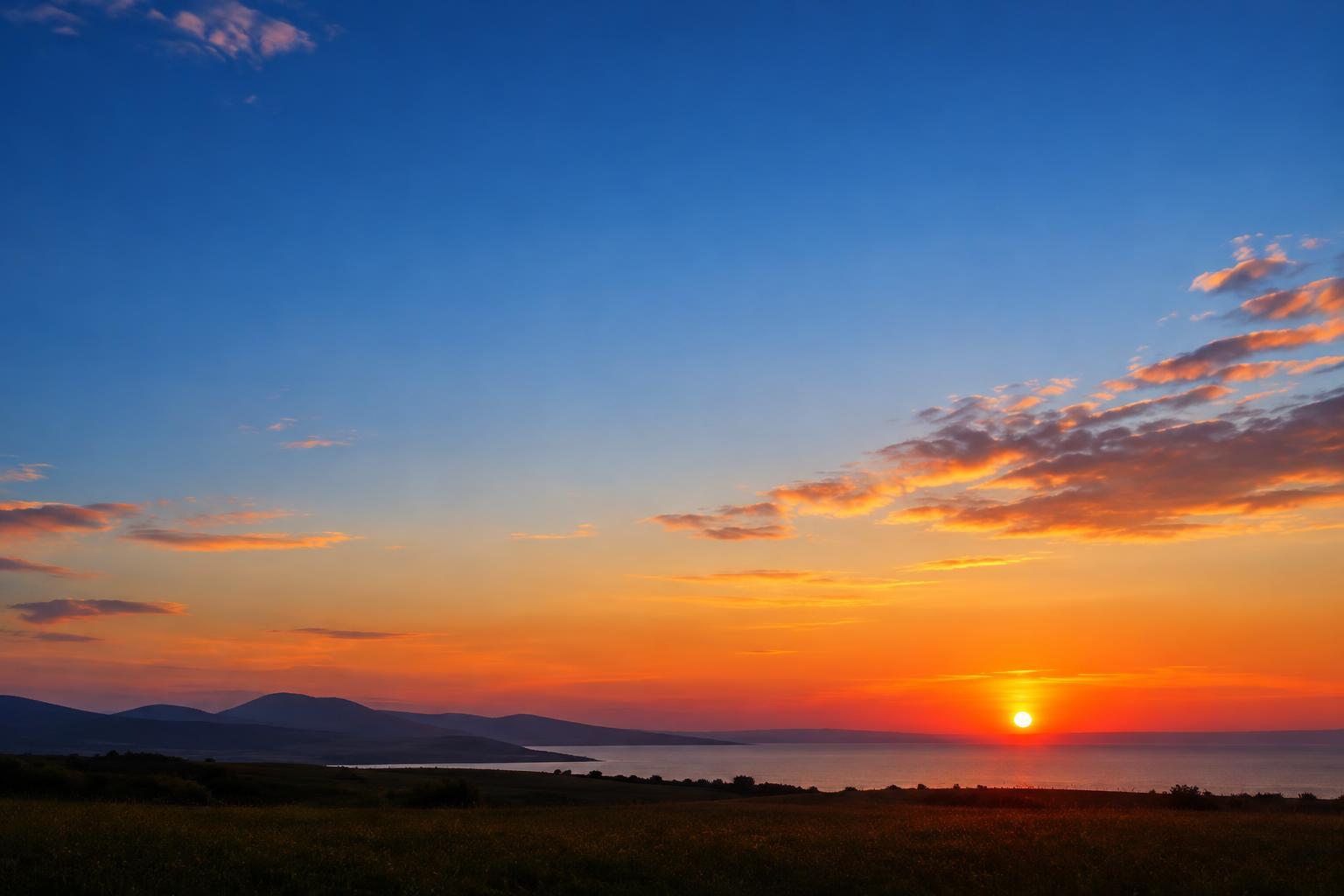
At midday, sunlight takes a relatively short route through the atmosphere to reach an observer. Around sunrise or sunset, the Sun is near the horizon, so its light travels along a longer route through the air. Along that route, more of the shorter-wavelength light is scattered out of the beam coming directly from the Sun. The light that remains in that direction is often richer in orange and red wavelengths.
That explains why a low Sun can look warm-colored without having changed its own color. It also helps explain why clouds sometimes glow pink or orange: sunlight reaching and illuminating them may already be depleted of some shorter wavelengths. The exact appearance depends on the position of the Sun and clouds, the clarity of the air, and where you are standing. Not every sunset is bright red.
A simple way to picture the difference is to compare where you look. In the daytime, you see blue light that has been scattered into your line of sight from many directions. When you look toward a low Sun, you see a beam from which much of that blue light has been scattered away. Both views arise from the same process.
Why clouds and haze can look different
Air molecules are not the only things sunlight meets. Water droplets in clouds are much larger than molecules. They scatter visible colors more evenly, which is one reason a sunlit cloud can look white. A thick cloud can look gray from below when less sunlight reaches or emerges from its lower parts. Its color is not a sign that the water itself has turned gray.
Dust, smoke, and tiny liquid particles can change the colors and clarity of the sky as well. Their effects depend on particle size and amount, so it is too simple to say that a red sunset always means dusty air. Airborne particles can sometimes intensify warm colors, but the longer path through ordinary air is already enough to explain why many sunsets appear orange or red.
The next time you see a clear blue sky turning warm near the horizon, compare the view overhead with the view toward the Sun. You are seeing different portions of sunlight after different journeys through the atmosphere. The familiar shift in color is a visible reminder that even apparently transparent air interacts with light.