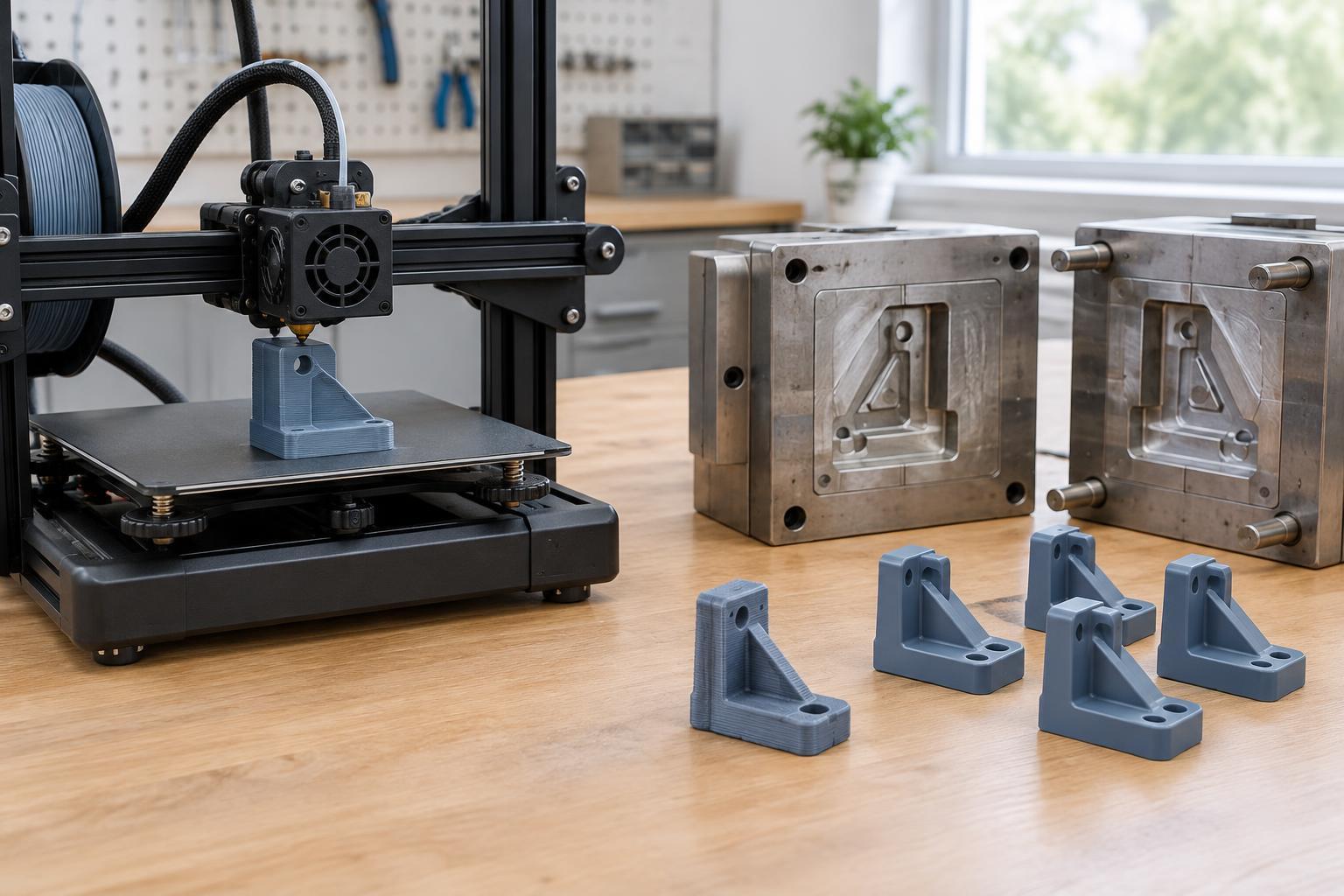
Two ways to make a plastic part
Imagine you need a custom clip for a bicycle light. You could build it one layer at a time with a 3D printer, or inject molten plastic into a mold shaped like the finished clip. Either method might work, but they demand different preparations and become useful at different stages of a project.
3D printing is a family of additive processes: a machine forms an object from a digital model by placing or solidifying material where it is needed. A common desktop printer extrudes melted filament, while other machines cure liquid resin or fuse powder. Injection molding instead forces heated material into a mold cavity, lets it cool, and releases the part. The mold is a substantial piece of tooling, but once it is ready, it can be used repeatedly.
Quantity changes the calculation
For a first prototype or a small run, 3D printing often has the simpler starting point. You can revise a model, print another version and test whether the clip fits before committing to a production tool. Printing still takes machine time, material and often hands-on cleanup, so the cost of each additional part does not necessarily fall much as the order grows.
Injection molding usually requires more work before the first usable part appears. Someone must design and make the mold, then adjust the process until parts come out as intended. That upfront effort can be difficult to justify for a handful of clips. When many identical parts are needed, however, spreading the tooling cost across them can make molding attractive. There is no universal break-even quantity: it depends on the part, the tooling, the material and the available equipment.
Shape and design freedom have limits
Printing can make shapes that would be awkward to release from a conventional mold, including enclosed passages and customized internal structures. It also suits parts that differ from one another, because changing the digital file may be easier than changing a physical tool. Yet printable does not mean effortless: overhangs may need temporary supports, and enclosed spaces can trap support material or uncured resin.
A molded part must usually be able to leave its mold. Designers therefore think about where the mold separates, which way the part will be pulled out, and whether features might catch on the tooling. Extra mold components can create some otherwise difficult features, but they add complexity. Small changes to wall thickness and shape also matter because material must flow into the cavity and cool without causing avoidable defects. Good design considers the manufacturing method early, rather than treating it as a final detail.
Check the material and the part's job
The label “plastic” covers materials with very different behavior. A clip that bends repeatedly, a transparent cover and a heat-resistant bracket may each call for a different material. Both printing and molding offer choices, but not every material works with every machine or process. A prototype printed in one plastic should not be assumed to behave exactly like a molded version made from another.
How a part is made can affect its performance, too. Some printed parts are weaker along boundaries between layers, particularly when a force pulls those layers apart. Print orientation can therefore be as important as the outer shape. Molded parts avoid that particular layer-by-layer structure, but they can have their own weak points or defects related to flow and cooling. If failure would matter, test parts made by the intended process under conditions that resemble actual use.
Choose for the whole workflow
Surface finish, precision and cleanup belong in the decision alongside cost. Printed parts may show layers, need supports removed or require further finishing. Molded parts can reproduce a prepared tool surface consistently, but may need trimming where material entered the cavity or where mold halves met. Either process can make accurate parts when it is planned and controlled appropriately; neither guarantees a perfect fit straight from the machine.
For the bicycle-light clip, a sensible path might be to print several versions to check fit and handling, then consider molding if demand for one settled design grows. If each clip needs a different shape, printing may remain the better fit. The practical question is not which technology is superior in general. It is which one meets this part’s requirements, in the needed quantity, while leaving room for the changes you expect to make.