What makes something a wave?
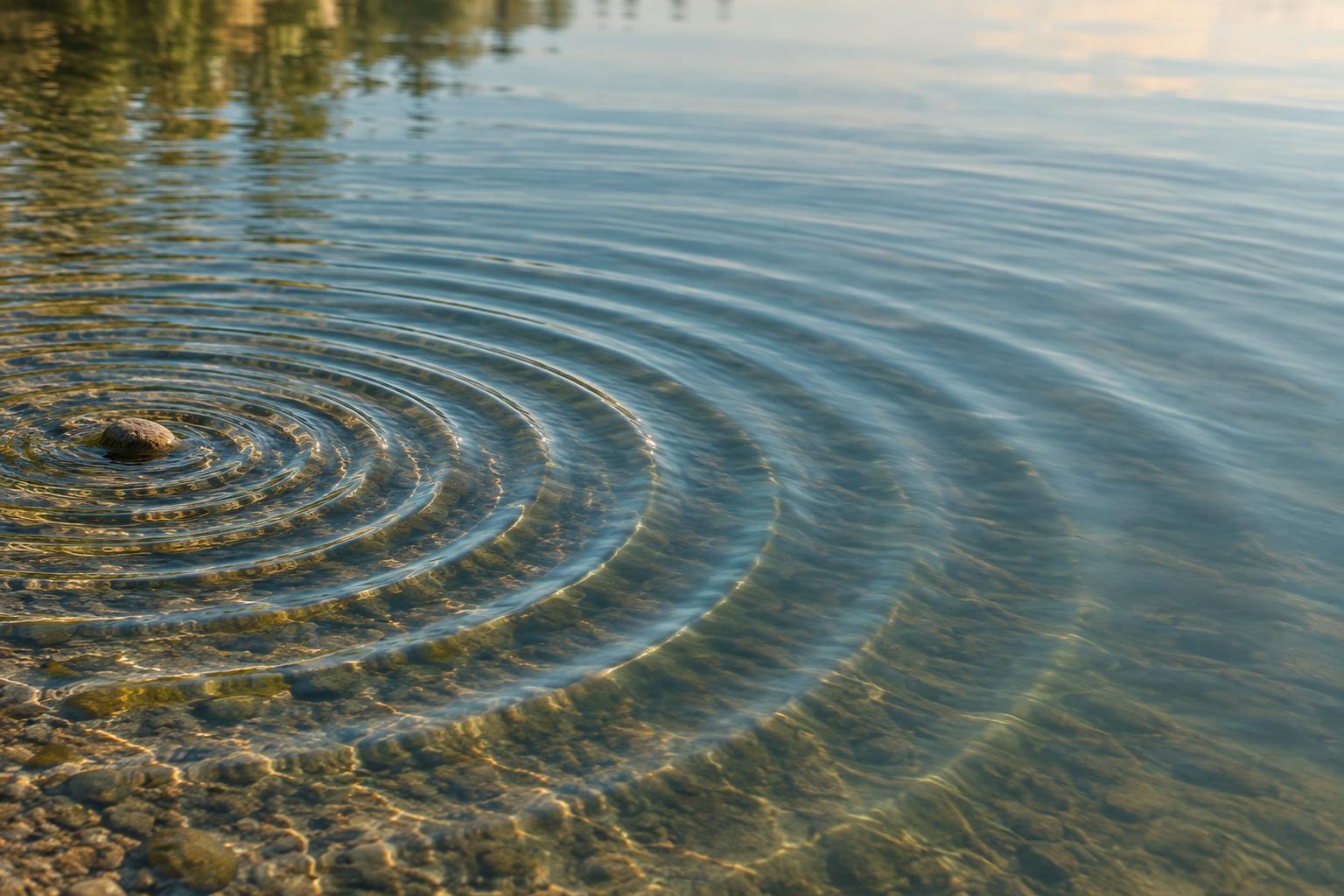
Drop a pebble into still water and ripples spread outward. The water rises and falls, yet the disturbance travels much farther than any one patch of water. That distinction is central to a wave: it carries energy through a system without requiring the material in that system to travel along with it. A floating leaf may bob as ripples pass rather than ride all the way to shore.
Sound is also a wave, though air behaves differently from the surface of a pond. A vibrating speaker creates alternating regions where air is compressed and spread out. Light is different again: it is an electromagnetic wave and does not need air or water to travel through space. Despite these differences, amplitude, frequency and wavelength give us a common way to describe repeating waves.
Amplitude: How large is the disturbance?
Amplitude measures the size of a wave’s variation from its usual, undisturbed state. For a simple water ripple, it can be pictured as the height from the normal water level to a crest, not the full distance from crest to trough. Turn up the motion that creates the ripple, and its amplitude may increase. How amplitude is measured depends on the wave: for sound in air, it can be described using the size of the pressure variation.
Amplitude often affects how strongly we experience a wave, but it should not be confused with frequency. A sound with a larger pressure variation will generally seem louder under comparable conditions; it does not automatically have a higher pitch. Likewise, increasing the amplitude of light can increase its intensity without changing its color. These comparisons have limits: our senses respond differently to different frequencies, and real-world waves can contain many frequencies at once.
Frequency: How often does the pattern repeat?
Frequency tells us how many complete cycles pass a point in a given time. Its unit, the hertz (Hz), means cycles per second. Imagine watching one spot on a pond as evenly spaced ripples pass. If crests arrive more often, the wave has a higher frequency. The time for one complete cycle is called the period; a shorter period means a higher frequency.
Frequency helps explain familiar differences between waves. For sound, higher-frequency vibrations usually correspond to higher pitch. A low note and a high note can have similar amplitudes while differing in frequency. For visible light, frequency is related to color: different frequencies within the visible range are perceived as different colors. Neither example means that every experience depends on frequency alone. A musical instrument’s sound, for instance, also reflects a mixture of frequencies and how they change over time.
Wavelength: How far apart are repeats?
Wavelength is the distance between matching points on successive cycles. On water, you might measure from one crest to the next. For sound, you could measure from one region of greatest compression to the next. Wavelength is a distance, not a duration: it describes the wave’s pattern across space at a particular moment.
Frequency and wavelength connect through wave speed: speed = frequency × wavelength. If a wave travels at a fixed speed, increasing its frequency shortens its wavelength. Picture a machine sending one ripple across a pond every second. If it begins sending ripples more often while their travel speed stays the same, the ripples will be closer together. The equation works for many kinds of waves, but it does not say that all waves travel at the same speed.
Putting the three measurements together
These three properties answer different questions. Amplitude describes the size of the variation. Frequency describes how often it repeats in time. Wavelength describes the spacing of repeats in space. If you see closely spaced ripples, you know their wavelength is short; you would still need their speed to determine how frequently they pass a point. Tall ripples, meanwhile, do not have to be closely spaced.
A change of medium shows why the distinctions matter. When light enters a different material, its speed and wavelength can change, while its frequency remains the same at the boundary. Sound traveling through different materials can likewise have different speeds and wavelengths. Keeping track of what is changing—and what is not—makes it easier to understand everything from the pitch of a voice to the bending of light through a lens.