Two meanings of brightness
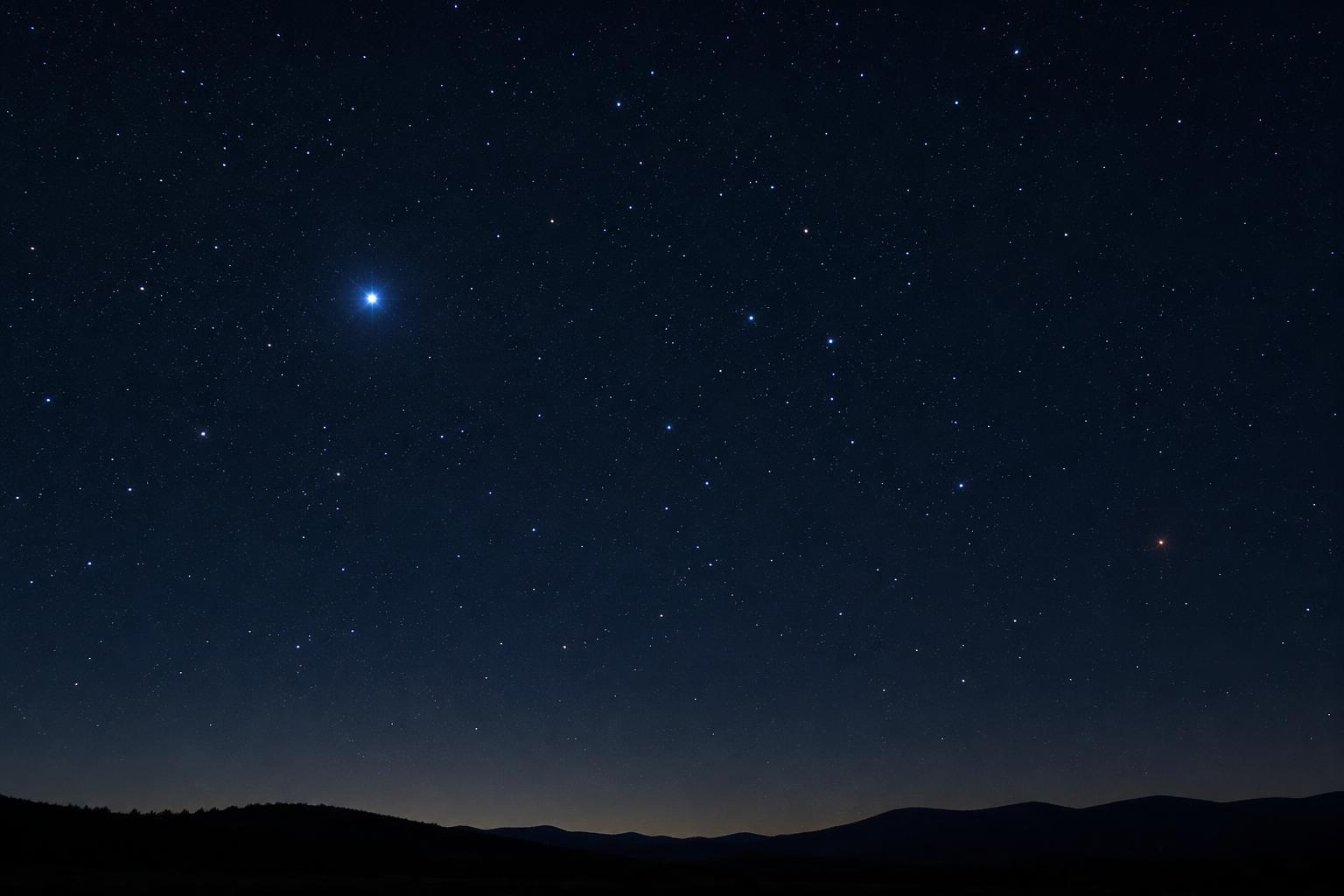
On a clear night, Sirius stands out as the brightest star in the sky. It is not, however, the closest star beyond the Sun. That distinction belongs to Proxima Centauri, which is too faint to see with the unaided eye. If closeness were the only thing that mattered, Proxima would be the more conspicuous of the two. Their different appearances show why astronomers distinguish between apparent and intrinsic brightness.
Apparent brightness describes how much light from an object reaches an observer. It is what you experience when you look at the sky. A star’s intrinsic light output, called its luminosity, describes how much energy it emits per unit of time. A star can look bright because it produces a great deal of light, because it is nearby, or both. Conversely, a nearby star that emits little light may look dim.
Why distance changes what we see
Imagine two identical lamps, one across a room and one far down a street. The distant lamp looks dimmer even though both produce the same amount of light. Light spreads outward as it travels, so a smaller share of it reaches your eye from the more distant lamp. Stars behave similarly: for an unobstructed source, doubling the distance reduces the light received per unit area to one-quarter.
Sirius is farther away than Proxima Centauri, but it emits much more light. That greater output more than compensates for the extra distance, making Sirius prominent in our nighttime sky while Proxima remains inconspicuous. This is also why a list of the brightest stars as seen from Earth is not a list of our nearest stellar neighbors.
Distance is not always the only complication. Dust between stars can absorb and scatter some of their light, making a star appear dimmer than its distance and luminosity alone would suggest. For nearby stars such as Sirius and Proxima, the central lesson remains straightforward: what reaches us depends both on how much light a star produces and on the journey that light takes.
How astronomers make a fair comparison
To compare stars without giving nearby ones an automatic advantage, astronomers use absolute magnitude. It describes how bright a star would appear if it were placed at a standard distance of 10 parsecs, or about 32.6 light-years. Apparent magnitude, by contrast, records how bright it looks from Earth. Putting stars at the same imagined distance helps reveal differences in their intrinsic output.
The magnitude scale has an unfamiliar feature: smaller numbers mean brighter objects. It is also logarithmic, so a difference of five magnitudes corresponds to a hundredfold difference in brightness. Magnitudes may refer to light measured through a particular filter, such as visible light, or across a broader range. When comparing figures, it helps to check that they describe the same kind of light.
Absolute magnitude is a way of expressing intrinsic brightness, but it is not identical to luminosity. Luminosity is the amount of energy a star emits over time; a magnitude is a number on a defined brightness scale. Both help astronomers answer questions that a glance at the night sky cannot settle.
What the sky can—and cannot—tell you
Looking up is a good way to notice apparent brightness, not a reliable way to judge distance. A faint point of light could be a modest star nearby or a luminous star much farther away. Its color may offer clues about its temperature, but it does not, by itself, tell you how far away it is. Astronomers need other measurements, including ways to determine distance, before they can work out a star’s intrinsic brightness.
There is one useful qualification to the question of the “brightest star.” The Sun is both Earth’s closest star and, by far, the brightest star in our sky. Sirius takes the title only when we mean the nighttime sky. Planets can also look exceptionally bright, but they are not stars: they are visible mainly because they reflect sunlight.
The next time one star catches your eye, think of its brightness as the result of two stories at once. One is about the star itself—how much light it sends out. The other is about your viewpoint—how far that light has traveled before reaching you. Separating those stories turns a simple observation into a more useful picture of the universe.


