Why space needs more than one unit
A distance can be written in kilometres whether it spans a city or a galaxy. But a number with many digits is not always easy to understand. Astronomers use larger units to make space distances easier to compare, much as we switch from centimetres to kilometres for a long journey.
Three common units are the astronomical unit, the light-year and the parsec. Each is a unit of distance, not a different kind of measurement. They grew out of different ways of thinking about space: the scale of Earth’s orbit, the distance light travels, and a geometric method for measuring nearby stars.
Astronomical units: the scale of the solar system
One astronomical unit, abbreviated AU, is about 150 million kilometres. It represents roughly the distance between Earth and the Sun. More precisely, the AU has a fixed definition of 149,597,870,700 metres; Earth’s actual distance from the Sun changes slightly as it travels around its orbit.
The AU is useful for describing distances within the solar system. For example, an object 2 AU from the Sun is about twice as far from it as Earth is on average. This does not mean it is always 2 AU from Earth: the distance between two moving objects depends on where they are in their orbits.
Thinking in AU makes the solar system easier to map. Instead of comparing enormous kilometre figures, you can picture Earth’s orbit as a reference scale and ask how many times that scale fits between the Sun and another object.
Light-years: distance expressed through light’s journey
A light-year is the distance light travels through a vacuum in one year: about 9.46 trillion kilometres. Despite its name, it measures distance, not time. If a star is four light-years away, the light reaching us from it has spent about four years travelling through space.
That travel time gives distance a second meaning. Looking farther into space generally means seeing light that began its journey longer ago. The Sun’s light, for instance, takes a little over eight minutes to reach Earth. We therefore see the Sun as it was a little over eight minutes ago, not at precisely this instant.
Light-years are convenient for describing distances between stars because the AU becomes too small a unit for that job. They also help connect a distance with the delay involved in receiving light or a radio signal. A light-year does not, however, imply that a spacecraft could make the same journey in one year.
Parsecs: distance from a change in viewpoint
A parsec is about 3.26 light-years, or roughly 206,265 AU. Its name comes from “parallax” and “arcsecond.” Parallax is the apparent shift of an object against a distant background when you view it from two positions. Hold a finger in front of your face and alternate which eye is open: your finger seems to move, even though it stays put.
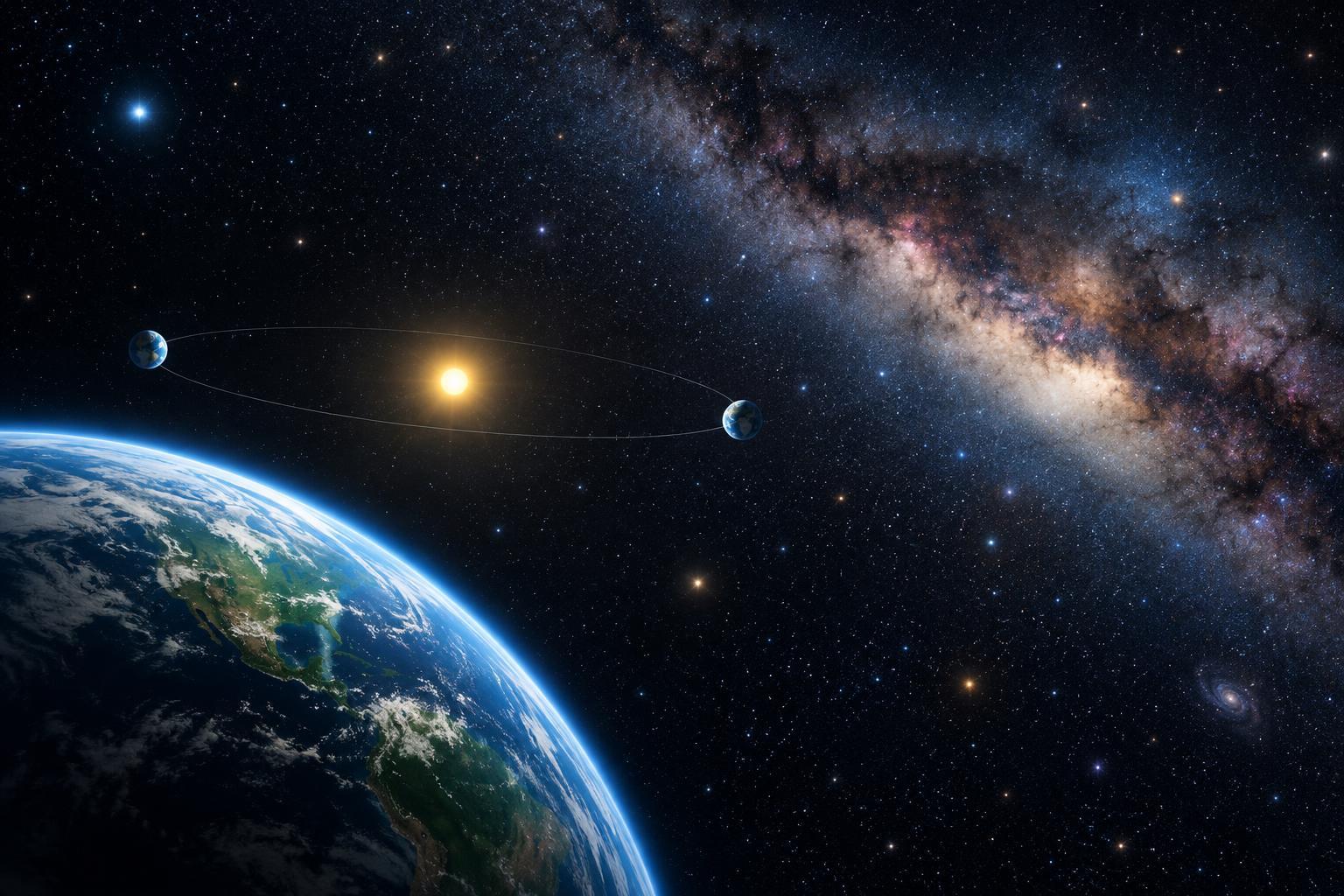
Astronomers can use Earth’s changing position as it orbits the Sun to look for a similar shift in a nearby star. They compare the star’s apparent position at different times against much more distant objects. A star is one parsec away if the angle called its annual parallax is one arcsecond. An arcsecond is a very small angle: one 3,600th of a degree.
The larger a star’s parallax angle, the closer it is. For more distant stars, the shift gets harder to measure. A parsec is therefore more than a convenient large number: its definition preserves a link to a way of measuring distance. You may also encounter kiloparsecs and megaparsecs, which mean thousands and millions of parsecs.
Choosing the right scale
Use AU when discussing the layout of the solar system, light-years when you want an intuitive sense of interstellar distance or light-travel time, and parsecs when reading about parallax or distances across larger regions of space. None is inherently more accurate than the others; choosing a unit changes how a distance is expressed, not the distance itself.
Conversions provide a useful reality check: one light-year is about 63,000 AU, while one parsec is about 3.26 light-years. The figures are rounded, but they show why a unit that feels natural for planetary orbits soon becomes cumbersome for stars. Understanding the scale behind each unit makes astronomical distances less like strings of zeros and more like positions on a map.


