A cell and a particle are not the same thing
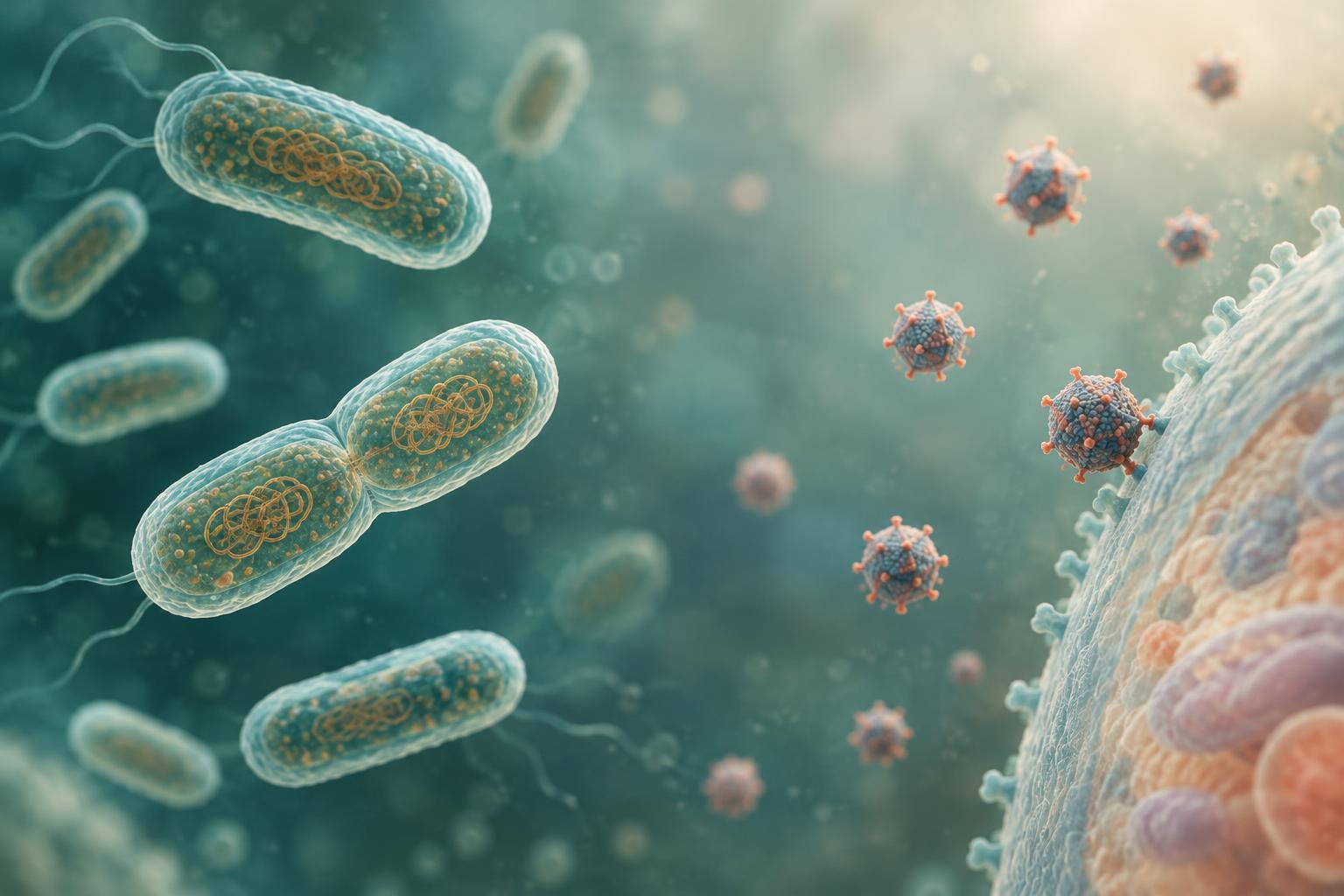
A bacterium is a living cell. It has a membrane that separates its interior from its surroundings, genetic material that carries instructions, and machinery for making proteins. Many bacteria also have a protective cell wall. Given suitable nutrients and conditions, a bacterium can take in materials, carry out chemical reactions and divide to produce new cells.
A virus is different. At its simplest, it consists of genetic material packaged in a protein shell; some viruses also have an outer envelope made partly from lipids. A virus does not have the cellular machinery needed to make proteins or generate copies of itself independently. To multiply, it must enter a suitable host cell and use that cell’s machinery.
Both can be too small to see without specialized equipment, but size alone is a poor way to tell them apart. Viruses are generally smaller than bacteria, yet the defining distinction is how they are built and how they reproduce.
How they make more of themselves
Most bacteria reproduce by growing and then splitting into two cells, a process called binary fission. Each new cell receives genetic material and can, in suitable conditions, continue living on its own. Bacteria can also exchange genetic material in ways that introduce new traits, including traits that help them survive particular environments.
A virus cannot divide like a cell. Its genetic material contains instructions that can direct a host cell to make viral components. Those components are assembled into new virus particles, which may then leave the cell and spread. The details vary widely among viruses: different types enter cells, copy their genetic material and exit in different ways.
This dependence on a host helps explain why a virus may infect one kind of cell but not another. To get started, it must be able to interact with the cell and make use of its internal processes. Bacteria, by contrast, are themselves cells, although where a particular species can grow still depends on its surroundings.
Different kinds of genetic instructions
Bacteria store their main genetic instructions in DNA. They typically have a chromosome in a region of the cell that is not enclosed by a nucleus. Some also carry smaller pieces of DNA called plasmids. Like other cells, bacteria use RNA as an intermediate when making proteins.
A virus has a genome made of either DNA or RNA, depending on the virus. Its genome may be arranged in one piece or several, and it may be single-stranded or double-stranded. These variations affect how a virus copies its instructions inside a host cell. They do not change the central point: a virus relies on a cell to turn those instructions into new virus particles.
Names such as “bacterium” and “virus” each cover enormous variety. Learning that two microbes belong to the same broad group tells us something important about their biology, but not everything about how either one behaves.
Why the distinction matters when illness is involved
Some bacteria cause disease by growing where they do not belong, damaging tissue or producing harmful substances. Some viruses cause disease as they infect cells and spread through the body. The resulting symptoms can overlap, so symptoms alone do not always reveal whether an infection is bacterial or viral.
Antibiotics target features of bacteria, such as parts of their cell walls or protein-making machinery. Viruses lack those bacterial targets, so antibiotics do not treat viral infections. Antiviral medicines work differently: where available, they interfere with particular steps in a virus’s life cycle. Vaccines can help the immune system recognize certain infectious agents before an encounter, and vaccines exist for diseases caused by both viruses and bacteria.
Treatment and prevention depend on the specific organism and situation, not just its broad label. The biological distinction explains why approaches that work against one type of infection may not work against the other.
Not merely two kinds of germs
It is easy to meet bacteria and viruses first as causes of illness, but that is only part of the picture. Many bacteria live in soil, water and in or on other organisms without causing disease. Some help break down organic matter or participate in processes that make nutrients available to living things. Bacteria are also used in making foods such as yogurt.
Viruses occur wherever suitable hosts are found. Some infect animals or plants, while others infect bacteria; these are called bacteriophages. By infecting cells, viruses can influence populations within ecosystems, though their effects depend on the particular virus and its host.
The most useful comparison is therefore not “which one is worse?” Bacteria are cells capable of independent activity under suitable conditions. Viruses are infectious particles that depend on host cells to reproduce. Keeping that distinction in mind makes it easier to understand both the infections that affect us and the much wider microbial world.


