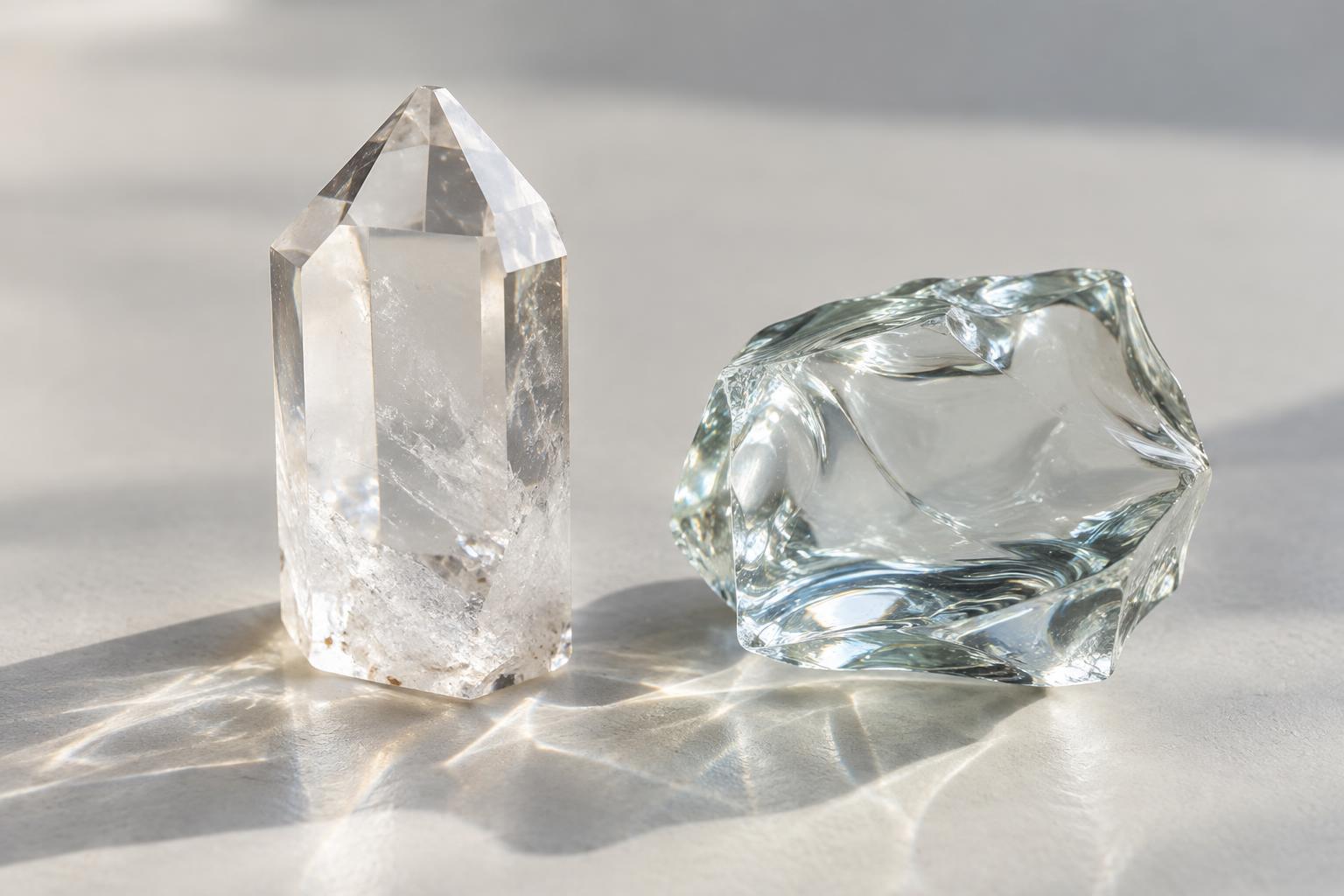
Two ways to build a solid
A grain of table salt and a glass drinking cup are both solids: they keep their shape under ordinary conditions. But their atoms do not follow the same pattern. In a crystal, atoms, ions or molecules occupy positions that repeat in an orderly arrangement over long distances. Salt has this kind of repeating structure. In an amorphous solid, there is no comparable long-range repeating pattern. Window glass is a familiar example.
Amorphous does not mean completely random. An atom in glass still has nearby neighbors arranged according to the material’s chemistry. The distinction is between this local order and a pattern that repeats throughout a crystal. A useful analogy is a tiled floor versus a floor covered with irregularly fitted stones: both have a structure, but only the tiles repeat predictably. Real materials are more complicated than either picture, and even well-formed crystals contain imperfections.
How a material gets its arrangement
Atomic arrangement depends partly on how a solid forms. As a liquid cools, its particles may have time to move into a repeating pattern and form crystals. If their movement slows before that pattern can develop, the material may instead become amorphous. Composition matters too: some mixtures make it difficult for particles to organize into a crystal, while others crystallize readily.
Cooling speed is therefore important, but it is not a universal switch. The result also depends on ingredients and processing conditions. Many objects contain both kinds of structure. A metal tool may consist of numerous tiny crystals, called grains, rather than one uninterrupted crystal. Some plastics contain crystalline regions alongside amorphous ones. Calling an entire object “crystalline” or “amorphous” can hide this useful detail.
Why melting and softening feel different
When a relatively pure crystal is heated under steady conditions, its repeating structure typically breaks down at a characteristic melting temperature. Ice turning to liquid water is a familiar example. An amorphous solid such as ordinary glass generally does not have the same single, sharply defined melting event. Instead, it can become progressively softer across a range of temperatures, eventually flowing readily enough to be shaped.
This contrast helps explain why glassmakers can heat and form glass without treating it like a block of crystalline ice. It does not mean that room-temperature window glass is a liquid slowly flowing before our eyes. On everyday timescales, it behaves as a solid. Nor does every crystalline material melt in a simple, observable way: some materials change chemically or decompose when heated. Atomic structure provides a starting point for understanding heating behavior, not a complete prediction by itself.
What arrangement changes—and what it does not
A repeating crystal structure can make a material’s properties depend on direction. In some single crystals, light, heat or mechanical stress behaves differently along different paths through the structure. That directional dependence is called anisotropy. In an amorphous material, there is no repeating crystal direction to follow, so its properties are often more similar in different directions. A polycrystalline object with many differently oriented grains may also appear roughly uniform when viewed as a whole.
Atomic arrangement also influences how a solid bends, fractures or carries an electrical current. But structure is only part of the explanation. Chemical bonds, defects, grain boundaries and manufacturing methods matter greatly. It would be misleading to say that all crystals are strong or that all amorphous solids are brittle. Likewise, glass’s transparency cannot be explained by its lack of long-range order alone: composition and the presence or absence of features that absorb or scatter visible light also matter.
How scientists tell the difference
One way to investigate a solid is to direct X-rays at it and measure how they scatter. A repeating crystal structure tends to produce distinct diffraction peaks because many layers of atoms contribute to a coordinated pattern. An amorphous solid usually produces broader features instead. Those broad features still contain information about how nearby atoms are arranged; they are not a sign that the material has no structure.
Scientists can combine scattering measurements with observations of how a sample responds to heating and with other tests suited to the material. This matters in practice because a change in processing can change the balance between crystalline and amorphous regions, even when the ingredients stay the same. The next time you handle a salt crystal, a glass cup or a plastic container, you are seeing the effects of particles arranged at scales far too small to observe directly.