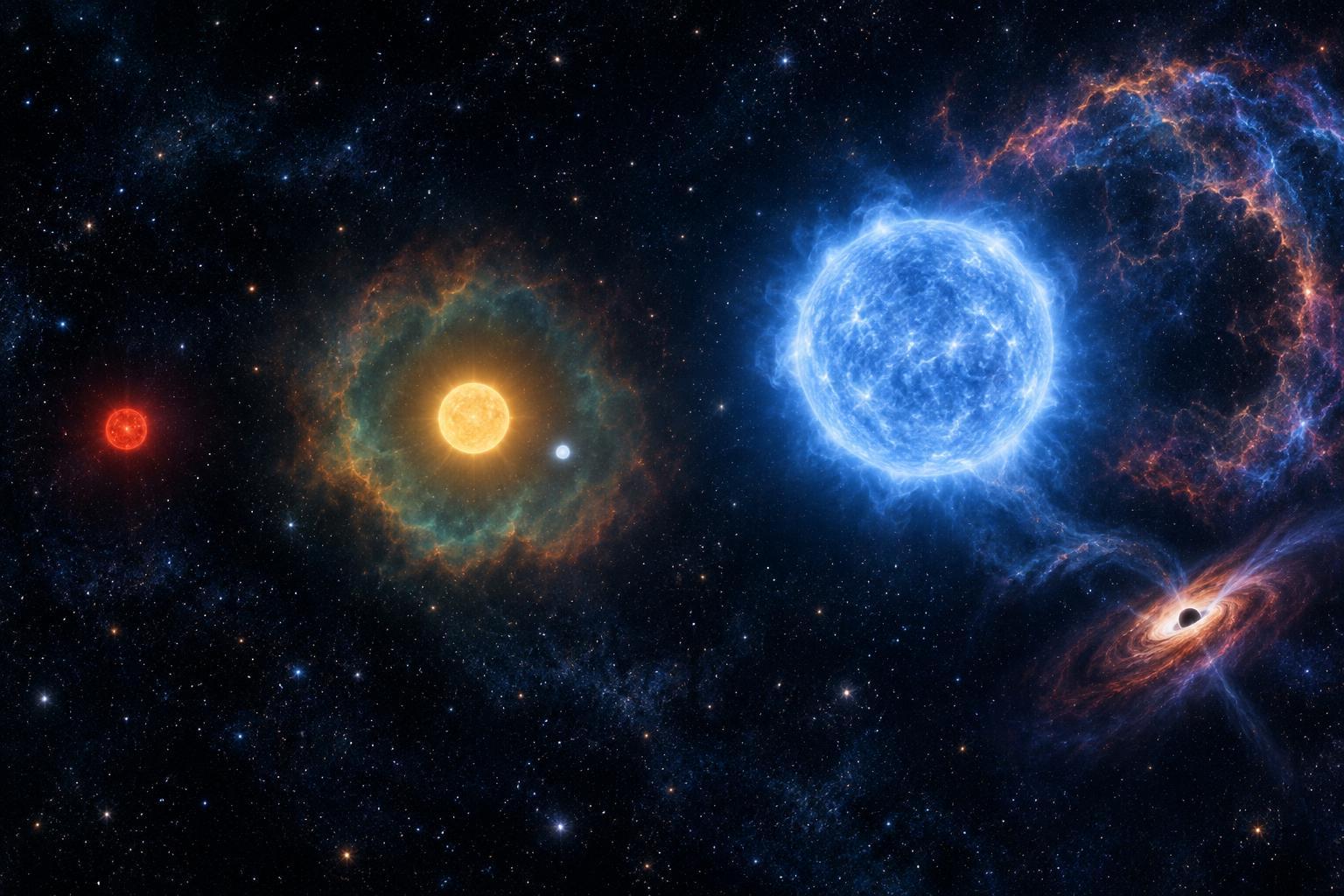
Mass sets the pace
Stars begin when regions of a gas cloud contract under gravity. As a forming star’s center grows hotter and denser, hydrogen fusion can begin. For much of a star’s life, the energy produced in its core helps support it against gravity. A star’s mass is the main factor setting the conditions in that core.
More massive stars have stronger gravity and hotter cores. They can shine far more brightly than smaller stars, but they also consume their available fuel much faster. It is a little like comparing two lamps when the brighter one uses energy at a much higher rate: having more fuel does not necessarily mean lasting longer. Low-mass stars can persist for extraordinarily long periods, while the most massive stars live comparatively brief lives.
The long lives of small stars
At the low-mass end are red dwarfs: small, relatively cool stars that shine faintly. Their modest rate of fusion lets them use hydrogen slowly. Many can also mix material through much of their interiors, giving them access to a larger share of their hydrogen than stars whose cores are more separate from their outer layers.
The smallest red dwarfs are expected to keep shining for far longer than the universe has existed so far. That means astronomers cannot simply observe one completing its life; descriptions of its distant future rely on models of how stars work. A star too small to sustain ordinary hydrogen fusion is instead called a brown dwarf, so it does not follow the same stellar life story.
A Sun-like star’s quieter ending
A star with a mass roughly like the Sun’s spends most of its lifetime fusing hydrogen into helium in its core. Eventually, the core’s usable hydrogen runs low. Fusion continues in a surrounding shell, while the star’s outer layers expand and cool. The star becomes a red giant: large in size, though cooler at its visible surface than before.
Later, helium fusion can produce carbon and oxygen in the core. A Sun-like star does not reach the conditions needed to keep building heavier elements through a long sequence of core-fusion stages. It sheds much of its outer material, which may briefly glow as a planetary nebula. The exposed core remains as a white dwarf: a dense, Earth-sized remnant that no longer generates energy through sustained fusion. It gradually cools, a process that takes an immense amount of time.
When a massive star runs out of options
Massive stars can reach higher core temperatures and fuse progressively heavier elements. Their interiors can develop layers where different fusion reactions occur, somewhat like an onion. This does not mean every layer lasts equally long: later stages can be much shorter than the star’s earlier hydrogen-burning life.
In a sufficiently massive star, fusion can eventually build an iron-rich core. Fusing iron into heavier nuclei does not provide the energy that earlier fusion stages supplied. When the core can no longer support itself, it collapses. The collapse can lead to a core-collapse supernova, ejecting material into space and leaving behind an extraordinarily compact object.
That remnant may be a neutron star, in which matter is compressed to extreme density, or a black hole, whose gravity is strong enough that light cannot escape from within its boundary. The dividing line is not a single fixed birth mass. Mass lost during the star’s life, its composition, and interactions with a companion can all affect the outcome. Some massive stars may also collapse without producing a bright supernova.
A guide, not a guaranteed script
Birth mass gives astronomers a powerful starting point for predicting a star’s brightness, lifetime, and likely ending. But stars do not always evolve alone. In a binary system, one star can pull material from the other or lose its outer layers to its companion. Such exchanges can change both stars’ paths. Composition matters too, because the elements present in a star can influence how readily it loses mass.
The broad pattern remains useful: smaller stars burn fuel slowly; Sun-like stars eventually leave white dwarfs; and sufficiently massive stars can undergo core collapse and leave neutron stars or black holes. The next time you see stars of different brightness in the night sky, remember that apparent brightness also depends on distance. Behind each point of light is a physical story shaped in large part by how much matter the star began with.


