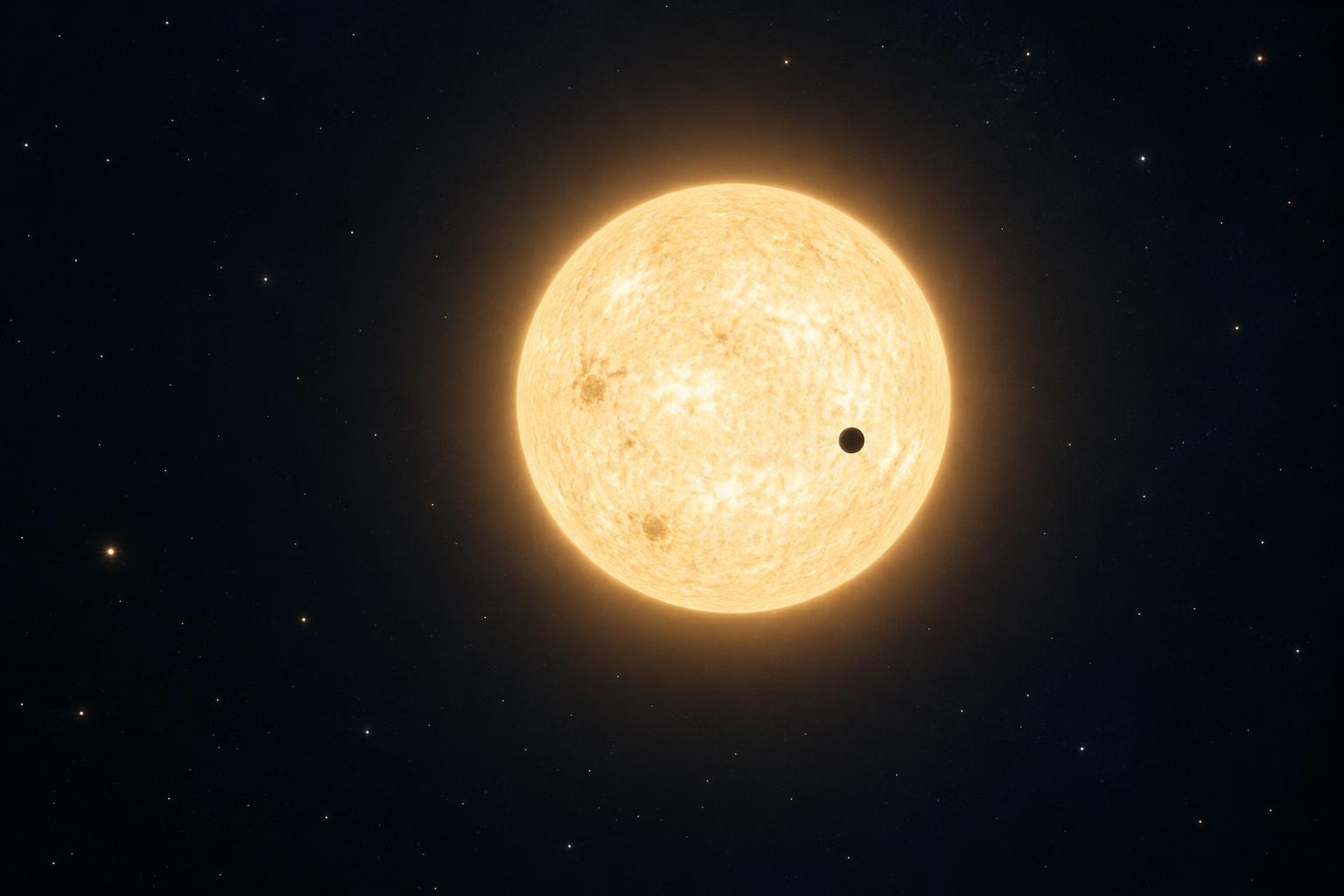
A distant eclipse
Imagine watching a lamp while a small bead passes between it and your eyes. The lamp appears slightly dimmer until the bead moves away. Astronomers look for a similar effect when searching for planets around other stars. If a planet’s orbit carries it across the face of its star from our viewpoint, it blocks a small fraction of the starlight. This crossing is called a transit.
The change is usually too subtle to notice by looking at an image of the star. Instead, instruments measure its brightness repeatedly. Astronomers plot those measurements against time to make a light curve. A transiting planet may leave a recognizable pattern: the light dims, remains lower for a while, then returns to its usual level. If the planet completes another orbit and crosses again, the pattern repeats.
Finding a pattern in the light
A single dip is a clue, not a discovery on its own. Astronomers look for dips with consistent spacing and a similar shape and depth. The time between crossings gives the planet’s orbital period: how long it takes to go around the star. A planet on a short-period orbit offers more chances to observe repeated transits during a given observing campaign than one that takes years to complete an orbit.
The depth of the dip offers another clue. Roughly speaking, a larger planet covers more of the star and produces a deeper transit. If astronomers know the star’s size, they can estimate the planet’s size from how much light it blocks. For a simple transit across a uniformly bright star, the fraction of light lost is approximately the planet’s area divided by the star’s area. Real stars are not uniformly bright, so detailed analyses account for effects such as their dimmer-looking edges.
The length and shape of a transit can also help describe the crossing. A planet passing near the middle of a star’s visible face may spend a different amount of time in front of it than one that clips the edge. Astronomers interpret these details together with what they know about the star, rather than reading a complete orbit from a dip alone.
Why most planets do not transit from Earth
A planet can orbit a star without ever passing in front of it as seen from Earth. The orbital path must be aligned closely enough with our line of sight. Think of a coin circling a lamp: viewed from one side, the coin might cross the lamp; viewed from above, it never would. Whether we see a transit depends on the viewing angle, not on whether the planet exists.
This geometry shapes what transit searches tend to find. Planets close to their stars have more opportunities to cross during an observing campaign, and their alignment is more likely to produce a visible transit than that of a planet on a wide orbit. Large planets can also be easier to detect because they block more light. These preferences mean a collection of transit discoveries is not a simple inventory of every kind of planet in the galaxy.
When a dip is not a planet
Stars can change brightness for reasons unrelated to planets. Darker regions on a rotating star may alter the light we receive, while measurement noise can create misleading patterns. A pair of stars orbiting one another can also produce repeating dips when one star passes in front of the other. If that pair is close to another star in the telescope’s view, its light can be mixed with the target star’s light, making the event look shallower and more planet-like.
To test a promising signal, astronomers examine whether the dips repeat as expected and compare observations made at different times or with different instruments. They may study nearby stars in the image to identify sources of blended light. In some cases, they can measure the star’s slight back-and-forth motion caused by an orbiting companion. No single check works for every system, but follow-up observations help distinguish planets from other explanations.
What a transit can—and cannot—tell us
The transit method is powerful because it turns a small change in light into information about a distant system. Repeated crossings can establish an orbital period, while the dip’s depth helps estimate a planet’s size. Other measurements may add to that picture. If astronomers can also estimate the planet’s mass from its effect on the star, they can calculate an average density, which offers a broad clue about its composition.
During some transits, a tiny portion of starlight passes through a planet’s atmosphere before reaching us. Comparing light at different wavelengths can sometimes reveal features associated with atmospheric gases or clouds, though such measurements are difficult and their interpretation requires care. A transit by itself does not show what a planet’s surface is like—or whether it supports life. It is a starting point: a brief shadow that invites a closer look.


