A boundary with a difficult job
Every cell must exchange materials with its surroundings. It needs supplies, such as water and nutrients, and it must release wastes. At the same time, its internal conditions cannot simply become identical to those outside. The cell membrane makes this balancing act possible by separating the cell’s interior from its environment while allowing selected substances to cross.
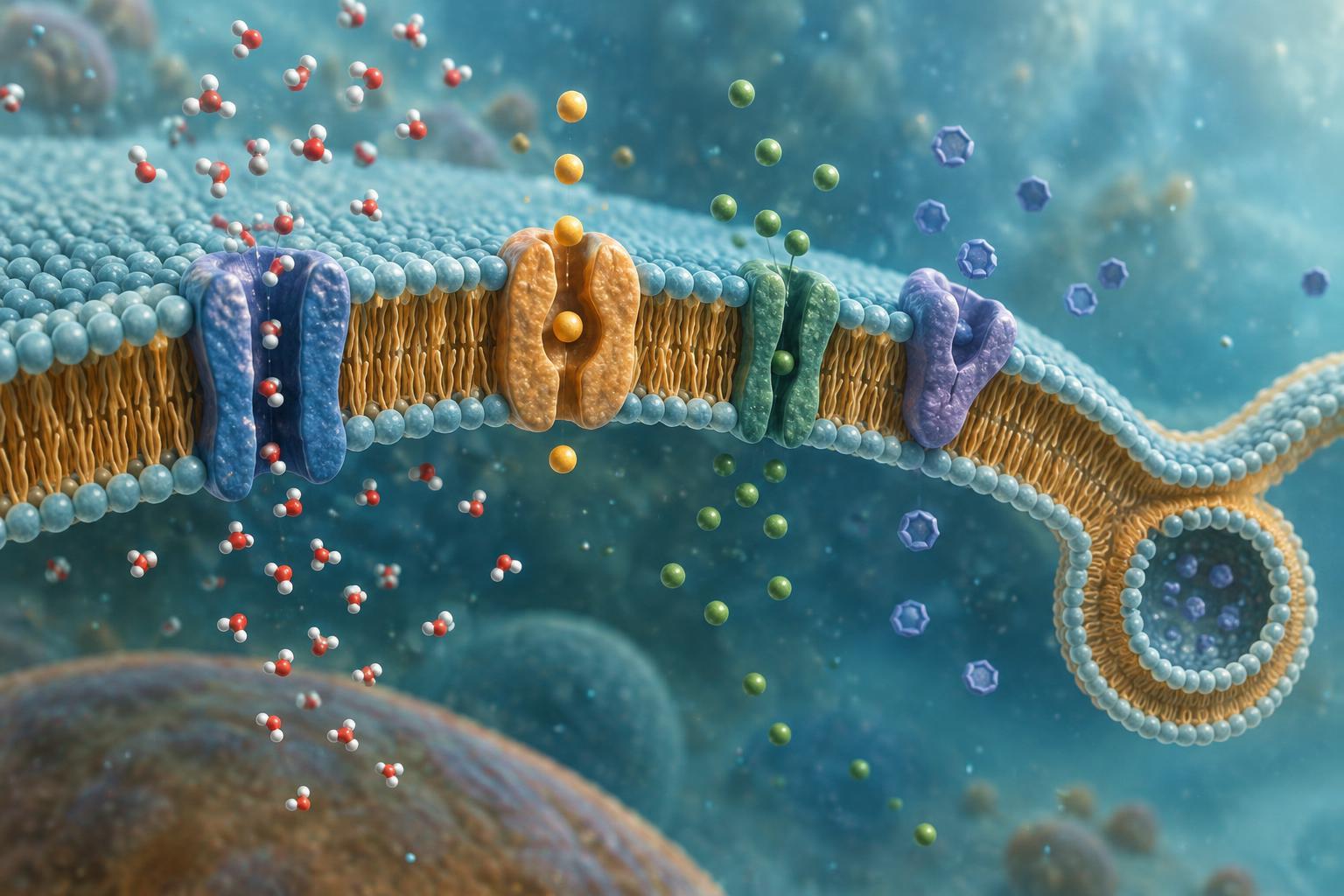
The membrane is built mainly from a double layer of phospholipids. Each phospholipid has a water-attracting head and water-repelling tails. In water, the molecules arrange themselves so that their heads face outward and their tails point toward one another. This creates an oily interior between the cell’s watery inside and outside. Proteins embedded in or attached to the membrane provide many of its more specialized transport functions.
What can pass through the lipid layer?
The membrane’s oily interior is not equally welcoming to everything. Small, uncharged molecules such as oxygen and carbon dioxide can move through the lipid layer relatively easily. Ions, which carry an electrical charge, cross it poorly on their own. Many larger or strongly water-attracting molecules also need another route. This is one reason a membrane can admit some substances while limiting others.
A substance that can pass through the membrane may spread from an area where it is more concentrated to one where it is less concentrated. This movement is called diffusion, and it does not require the cell to spend energy directly. For example, when the conditions on either side favor oxygen moving into a cell, oxygen can diffuse across the membrane. Diffusion does not mean that molecules travel only one way: they move in both directions, but the overall flow tends to follow the concentration difference.
Water also moves across membranes, a process called osmosis. It can pass through the lipid layer to some extent, while protein channels called aquaporins provide faster routes in many cells. If the fluid outside a cell has a different concentration of dissolved substances from the fluid inside, the resulting water movement can cause the cell to swell or shrink. Which way water moves depends on the conditions on both sides of the membrane.
Proteins provide selective routes
Membrane proteins help substances cross when the lipid layer presents a barrier. Channel proteins form passageways that allow particular ions or other substances to pass. Some channels can open or close in response to a signal, changing how readily a substance moves across the membrane. Transporter proteins work differently: they bind a substance and change shape to carry it to the other side.
A protein-assisted route does not always require an energy supply. In facilitated diffusion, a channel or transporter lets a substance move in the direction favored by its concentration difference. Cells use transporters, for instance, to move glucose across membranes where it cannot readily pass through the lipid layer alone. A transporter’s presence matters: two cells exposed to the same surroundings may take up a substance at different rates because they have different transport proteins.
Some transport proteins do require energy to move substances against the direction they would otherwise tend to go. These pumps help cells maintain differences in ion concentrations across their membranes. Such differences are important for processes including nerve signaling and the movement of other substances. The membrane therefore does more than block or admit molecules; with the help of proteins, it can preserve useful internal conditions.
When cargo is too large for a passageway
Not everything a cell exchanges can fit through a channel or transporter. Cells can bring in larger particles or portions of surrounding fluid by bending their membrane inward and pinching off a small, membrane-bound compartment. This general process is called endocytosis. It allows material to enter the cell without passing directly through the lipid layer.
The reverse process, exocytosis, moves material out. An internal membrane-bound compartment joins with the cell membrane and releases its contents outside. Cells use exocytosis to release substances they have made, including some signaling molecules. These processes also show that a cell membrane is flexible and continually changing, rather than a rigid shell.
Selective does not mean all-knowing
It is tempting to describe the membrane as deciding what a cell needs, but its selectivity comes from physical properties and the proteins the cell has produced. A molecule’s size, charge and attraction to water matter, as do available transport routes and the conditions on either side. These factors determine whether it crosses easily, needs assistance or is largely kept out.
This combination of a lipid barrier and controlled routes lets cells exchange materials without surrendering control of their interiors. The same basic principle helps explain familiar observations, from water moving into or out of cells to the way nerve cells maintain electrical differences. A cell remains open to its surroundings—but not indiscriminately.


