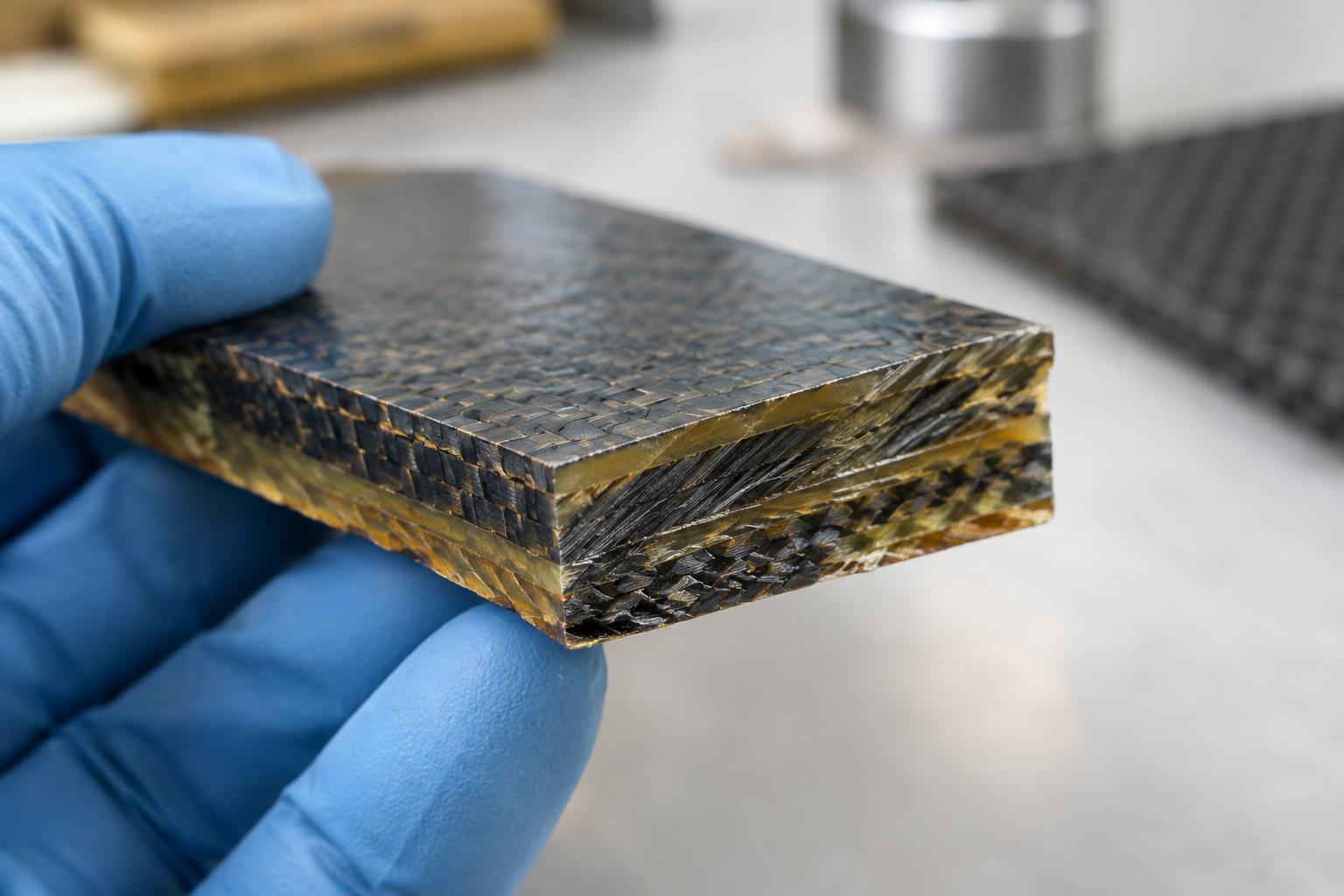
Two materials, one working structure
A composite combines distinct materials so that the finished part can do something neither ingredient does as well alone. In a fiber-reinforced composite, long or short fibers sit inside a continuous material called the matrix. The fibers might be glass, carbon or aramid. The matrix is often a polymer, such as an epoxy resin or a thermoplastic. Unlike an alloy, the ingredients remain identifiable within the finished material.
Picture a bundle of dry threads. You may be able to pull hard along its length, but it is difficult to make the bundle hold a useful shape. Now imagine those threads held in place by a hardened substance. The result can be formed into a panel, tube or curved shell. This picture captures the basic partnership, although real composite performance depends on the fiber, the matrix and how carefully they are brought together.
What each ingredient contributes
Fibers are commonly chosen to carry much of the load when a part is pulled along their length. They can also add stiffness, meaning resistance to bending or stretching. The matrix holds the fibers in position, helps the part keep its shape and transfers force between fibers. It can protect them from abrasion and some environmental exposure. A fiber with impressive properties cannot contribute fully if force cannot pass effectively from the matrix into it.
That transfer depends partly on the interface where fiber and matrix meet. If their bond is too weak for the intended use, fibers may slip or pull away under load. The matrix itself can also crack. Some composites are designed to tolerate limited damage rather than prevent every tiny crack, but damage that grows between layers can substantially weaken a part. Engineers therefore consider the ingredients and their connection as one system.
Why direction changes strength
A wooden board is easier to split along its grain than across it. Fiber-reinforced composites also behave differently in different directions. A sheet of fibers aligned from one end of a part to the other may be especially effective against pulling in that direction, yet less effective against a force applied across the fibers. Short, randomly oriented fibers can give a more even response in a flat part, though they may not deliver the same performance along one chosen direction as well-aligned continuous fibers.
Designers often stack thin fiber layers, sometimes called plies, at different angles. One layer may help carry a lengthwise load while another helps with a crosswise load or twisting. The arrangement is called a layup. It can be tailored to the expected forces, but adding layers does not automatically make a design better: their directions, thicknesses and connections all matter. A part built for one loading pattern may perform poorly when subjected to a different one.
From ingredients to a finished part
One common route begins with fibers arranged in a fabric or sheet. They are combined with a liquid resin, placed in a mold and allowed or made to harden. Other methods use fibers already combined with polymer, or force molten polymer around shorter fibers. The choice of process affects the possible shapes, the placement of fibers and the consistency of the finished material.
Manufacturing quality matters because gaps, trapped air, uneven fiber placement or poorly bonded layers can interrupt the intended path of a load. Inspecting a composite is not always as simple as looking at its surface: damage can sometimes be hidden inside or between layers. That is why the way a part is made and checked is as important as the advertised properties of its raw ingredients.
Useful advantages, real trade-offs
Fiber-reinforced composites can offer high stiffness or strength for their weight, and their fibers can be placed where a design needs them most. Those qualities help explain their use in items ranging from sporting equipment to vehicle parts. The best choice still depends on the job. Metals, wood and unreinforced plastics may be easier to shape, join, repair or reuse in a particular application.
Composites also present challenges. Impacts can cause internal damage that is not immediately obvious, and some layered parts are vulnerable to separation between plies, known as delamination. Separating fibers from a hardened polymer for recycling can be difficult, although options vary by material and process. Thinking of a composite as a carefully arranged partnership—not simply a stronger plastic—makes both its possibilities and its limits easier to understand.