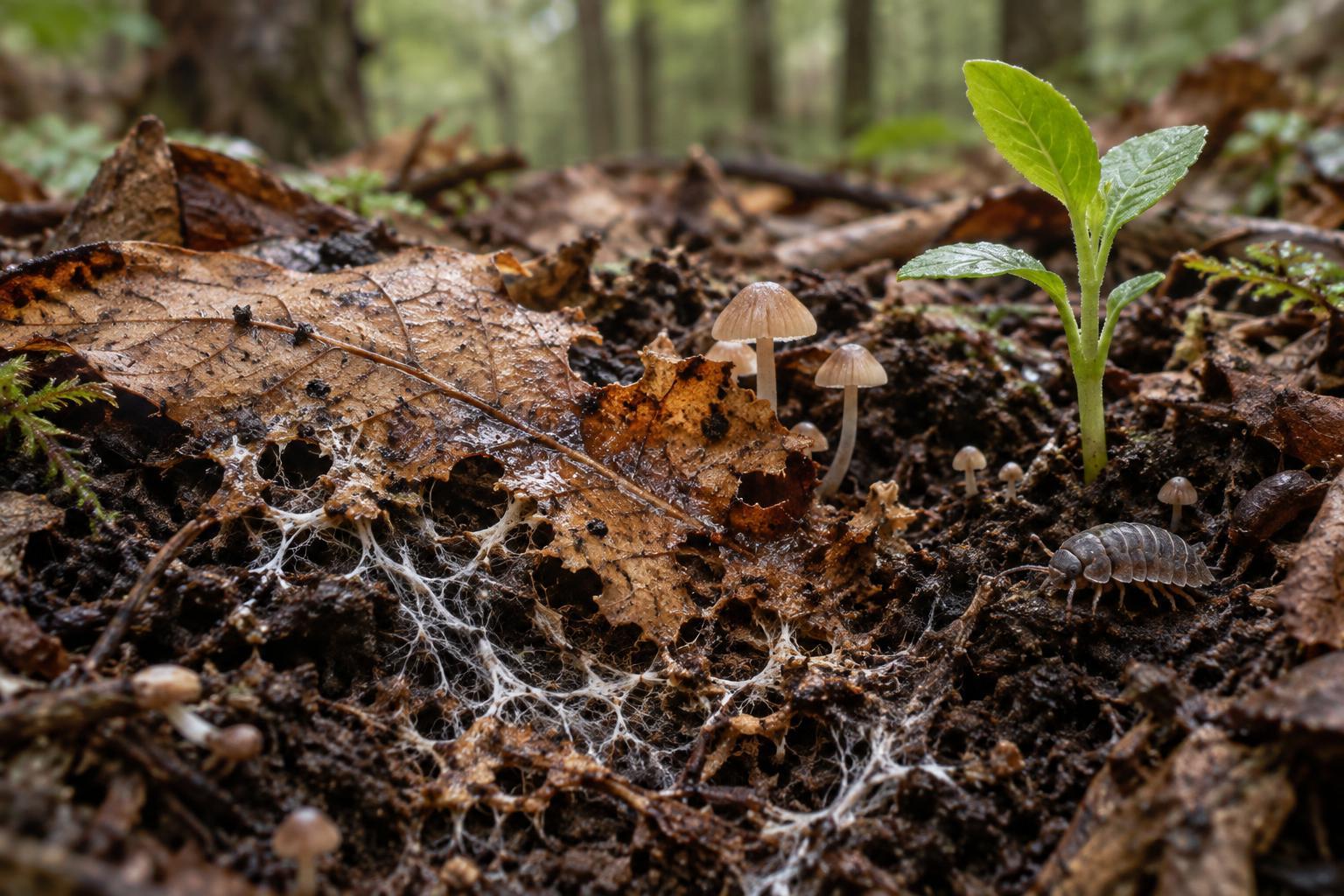
A fallen leaf is the start of a new process
When a leaf falls from a tree, it still contains materials the tree used to grow: carbon-rich compounds, nitrogen, phosphorus and other elements. Those elements do not vanish when the leaf turns brown. They become part of a food supply for organisms living on and within the leaf litter. Decomposition is the collection of processes that break dead material into smaller pieces and simpler substances.
This is one way ecosystems reuse matter. A plant may take up nutrients from soil, an animal may eat the plant, and decomposers may later process material from both. The route is rarely a tidy circle: nutrients can move through many organisms, enter water or remain stored in soil for a time. Still, without decomposition, much more plant and animal material would remain locked in forms that living plants could not readily use.
The organisms doing the work
Bacteria and fungi are central decomposers. Many fungi grow through dead material and release enzymes that break down complex molecules outside their bodies. They then absorb some of the resulting smaller molecules. Bacteria also use enzymes and chemical reactions to obtain food from dead tissues and waste. Different organisms can work on different components, so decomposition is often a shared effort rather than the work of a single species.
Small animals help too. Earthworms, woodlice and other detritivores eat or shred dead material, increasing the surface area available to microbes. Their movement can mix organic matter into soil. These animals do not replace bacteria and fungi: what they leave behind can still be broken down further. In a handful of leaf litter, chewing, mixing and microbial activity may all be happening at once.
How nutrients become available again
A dead leaf contains nutrients, but many are bound within molecules that a living root cannot take up directly. As decomposers feed, they use some of those nutrients to build their own cells. They also release simpler compounds into their surroundings. This release is often called mineralization when nutrients in organic matter are converted to inorganic forms. Plants can absorb certain forms of nitrogen and phosphorus dissolved in soil water, though availability also depends on soil conditions and the needs of nearby organisms.
Carbon follows a related but distinct path. Decomposers use carbon compounds for energy and growth, and many release carbon dioxide as they respire. Some carbon remains in microbial bodies or in soil organic matter, sometimes for a long time. Nutrients such as nitrogen and phosphorus can be reused, but energy does not cycle in the same way: organisms use it, and much of it ultimately leaves the food web as heat. Keeping matter and energy separate makes the ecosystem story clearer.
Why decomposition is faster in some places
The speed of breakdown depends on both the material and its surroundings. Soft, nutrient-rich tissues generally offer decomposers easier access than tough, woody material. Moisture matters because microbes need water to function, but waterlogged ground may have little oxygen. Temperature can affect how quickly organisms grow and enzymes work, although each decomposer has limits. A dry leaf on a path may change slowly while a damp leaf in sheltered litter breaks down more visibly.
Low-oxygen settings do not stop all decomposition. Different microbes can operate there, and the products of their activity may differ from those formed where oxygen is plentiful. Nutrients can also travel away from the place where a leaf fell, carried by water or taken up by organisms. For these reasons, there is no single timetable for decomposition that fits every forest floor, garden bed or pond.
What to notice in everyday ecosystems
A layer of fallen leaves offers a simple way to observe the process without disturbing much. Look for leaves at different stages: intact near the top, softer or fragmented beneath, and harder to recognize closer to the soil. Fungal threads, small invertebrates and darker organic material may be present, though much of the microbial work is invisible. The change in appearance shows breakdown in progress; it does not, by itself, tell you exactly which nutrients are available to roots.
Decomposition matters beyond woodland leaf litter. In gardens, composting relies on many of the same organisms and conditions. In streams and ponds, dead plants and other organic matter also feed decomposer communities, while moving water can carry the resulting materials elsewhere. Across these settings, decomposers connect past growth to future growth by transforming remains into materials that can re-enter living systems.


