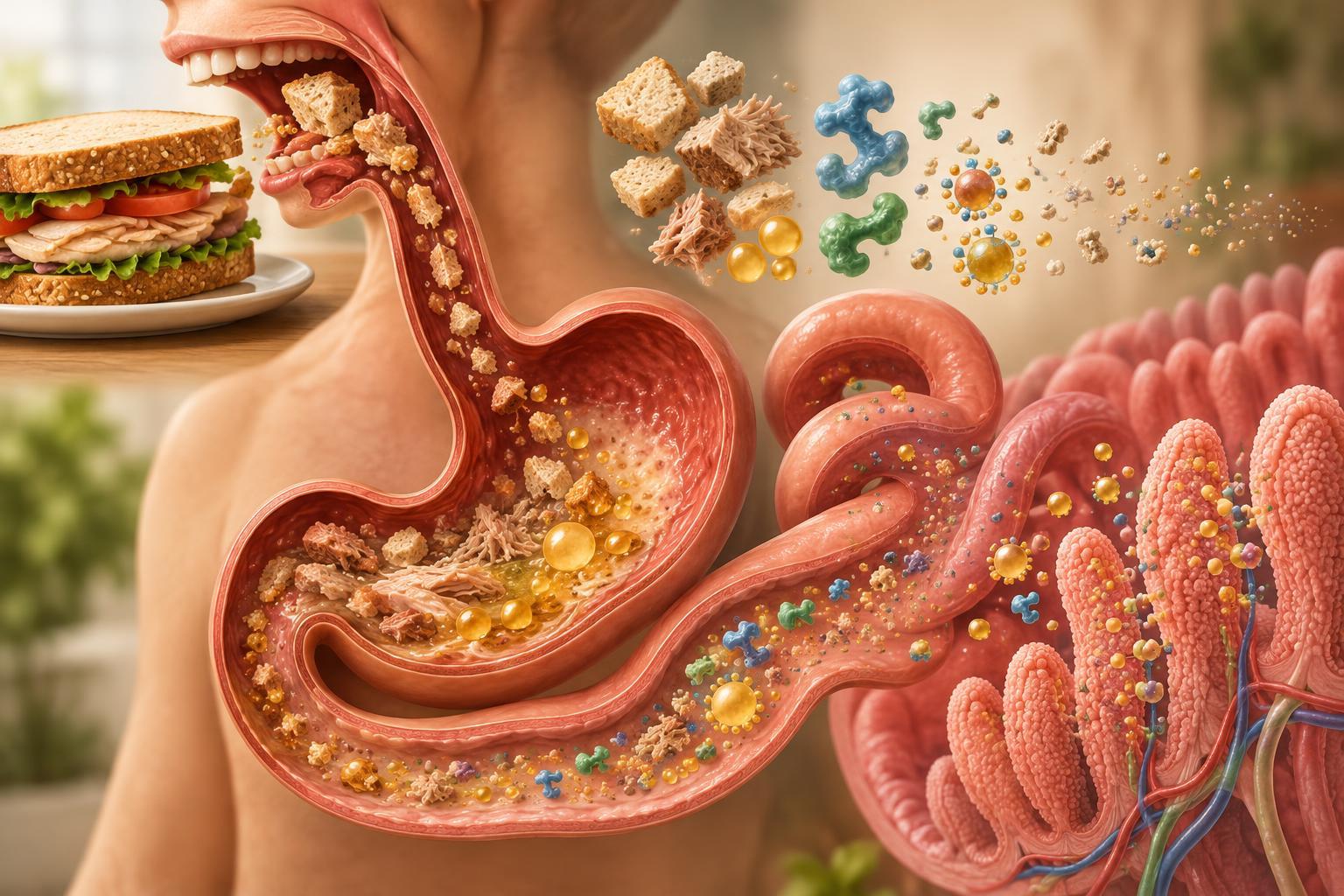
Why food needs to be taken apart
Food contains nutrients, but many arrive as molecules too large to pass through the lining of the small intestine. Starch is a long chain of sugar units, proteins are chains of amino acids, and most dietary fats are triglycerides made from fatty acids joined to glycerol. Digestion reduces these larger structures to pieces the body can absorb and use.
Enzymes make much of this possible. Each digestive enzyme helps a particular kind of chemical bond break in the presence of water. It acts like a specialized tool: an enzyme that cuts starch does not do the same job as one that cuts protein. Digestion is therefore a coordinated sequence, not a single reaction. Chewing, stomach mixing and the movement of food through the gut help enzymes reach their targets.
The mouth and stomach begin the work
Chewing breaks food into smaller pieces and mixes it with saliva. Salivary amylase starts cutting starch into shorter carbohydrate chains and sugars. Its work begins before a bite reaches the stomach, although it does not finish starch digestion. The acidic conditions in the stomach eventually limit its activity.
The stomach churns food into a mixture that can move into the small intestine. Stomach acid helps unfold proteins, exposing parts of their chains to enzymes. Pepsin, a protein-cutting enzyme that works in acidic conditions, then breaks some of those chains into shorter fragments called peptides. The stomach starts this task, but most protein digestion and nutrient absorption happen farther along the digestive tract.
The small intestine does most of the cutting
As food leaves the stomach, it enters the small intestine, where secretions from the pancreas supply several important enzymes. Pancreatic amylase continues breaking down starch. Pancreatic proteases cut protein fragments into smaller peptides. Other pancreatic enzymes, called nucleases, break down the DNA and RNA present in food. The pancreas also supplies bicarbonate, which helps neutralize stomach acid and creates conditions in which many intestinal enzymes can work.
The lining of the small intestine carries enzymes that complete key steps close to the point of absorption. Some turn short carbohydrate chains and double sugars into single sugars, such as glucose. Others cut small peptides into amino acids or pieces that intestinal cells can take up and finish processing. Different enzymes are needed because food contains different bonds; no one enzyme can handle the entire meal.
Fat needs an extra step
Fat poses a physical challenge: it does not mix well with the watery contents of the intestine. Bile, made by the liver and released into the small intestine, helps disperse fat into small droplets. Bile is not an enzyme and does not itself cut the fat molecules. Instead, dispersing the fat gives pancreatic lipase more surface to work on.
Lipase breaks triglycerides into smaller components, including fatty acids and monoglycerides. Bile components help these products travel through the watery intestinal contents toward the cells lining the gut. After absorption, intestinal cells reassemble many of the fat components and package them for transport, largely through the lymphatic system before they enter the bloodstream. This route differs from that of many absorbed sugars and amino acids, which enter the blood more directly.
Digestion is not the same as absorption
Enzymes prepare nutrients for absorption; the intestinal lining then moves them into the body. Its folds and tiny projections provide a large contact area. Transport processes carry many sugars and amino acids into intestinal cells and onward into the blood. The resulting molecules can be used for energy, growth, repair and other functions.
Not everything in food is broken down by human digestive enzymes. Many types of dietary fiber pass through the small intestine largely intact. Microbes in the large intestine can ferment some of that fiber, producing smaller compounds that the body may absorb. This is a useful reminder that digestion depends on both chemistry and location: the outcome for any food component depends on its structure, the enzymes available and where it travels in the gut.


