A current is moving electric charge
An electric current is the movement of electric charge. In a metal wire, electrons carry that charge through the material. When current flows, a magnetic field forms in the space around the wire. The field is not something the wire releases like a stream of particles; it is a way of describing how magnetic forces could act at different locations.
A useful picture is a straight wire passing through the center of a set of circles. The magnetic field follows circular paths around the wire, rather than pointing along it. A small compass placed near the wire can turn because its needle responds to the combined magnetic fields of Earth and the current. Reverse the current, and the wire’s field reverses too.
The direction of the circles follows a convention called the right-hand rule: point your right thumb in the direction of conventional current, and your curled fingers show the field’s direction. Conventional current is defined as flowing from positive to negative. In a metal wire, the electrons move the other way, so keeping that distinction in mind helps avoid a common mix-up.
What changes the field’s strength?
More current generally means a stronger magnetic field around a given wire. Distance matters as well: for a long, straight wire, the field weakens as you move farther away. This helps explain why a compass close to a current-carrying wire may move noticeably while one much farther away may show little change.
The material surrounding the wire can also affect the resulting field. Some materials respond to magnetic fields much more strongly than air does. But the basic effect does not require a special wire or a magnetic material: current flowing through a conductor creates a magnetic field around it.
A steady current produces a steady magnetic field, provided the arrangement stays the same. If the current changes, the field changes too. That distinction matters in devices that use changing magnetic fields to transfer energy or produce another electric current.
Why winding a wire into a coil helps
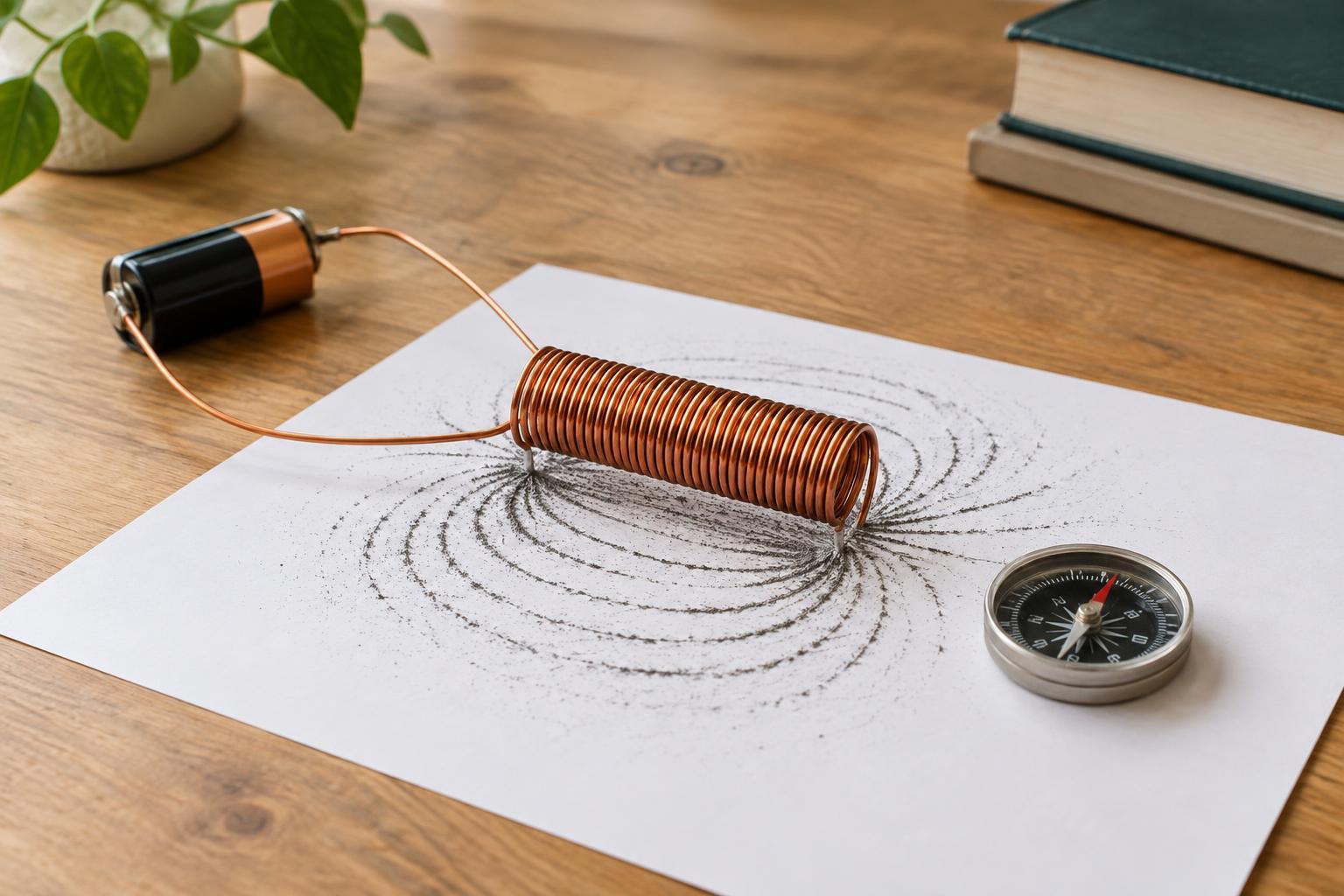
Bend a wire into a loop, and the magnetic fields produced by different parts of that loop reinforce one another through its center. Wind many loops into a coil, often called a solenoid, and the combined field becomes more concentrated inside it. The coil behaves in some ways like a bar magnet, with two ends that can be described as north and south magnetic poles. Reversing the current swaps those poles.
Placing a suitable iron core inside a coil can strengthen its magnetic effect because the core responds to the field. This is the basic idea behind many electromagnets. Unlike a permanent magnet, an electromagnet can be controlled by changing its current. It may still retain some magnetism after the current is switched off, depending on its core material.
Adding turns or increasing current can strengthen a coil’s field, but neither is a free improvement. Extra wire adds electrical resistance, and higher current can cause more heating. Practical designs balance magnetic strength with power use, temperature and the task the coil needs to perform.
From magnetic fields to motion and electricity
The connection between currents and magnetic fields makes electric motors possible. A current-carrying part inside a motor experiences a force in the presence of another magnetic field. By arranging those forces to turn a shaft, a motor converts electrical energy into motion. The details vary by motor design, but the interaction between current and magnetic field is central.
Changing magnetic fields also connect magnetism back to electricity. In a transformer, changing current in one coil produces a changing magnetic field that can induce a voltage in a second coil. This is why transformers work with changing current rather than an unchanging direct current. Many other devices, including speakers and some doorbells, use coils to turn electrical signals into controlled movement.
These examples show that a magnetic field is more than a diagram drawn around a wire. Its direction and strength help determine what forces a device can produce and how energy can pass between its parts.
A careful way to picture the effect
If you want to observe the effect directly, a small compass can reveal how a current affects its surroundings. A low-voltage battery, an insulated wire and a suitable component that limits current can form a simple circuit. Place the compass near the wire and briefly switch the circuit on and off; the needle may shift if the wire’s field is strong enough relative to Earth’s field. Its response will depend on the compass position and the circuit layout.
Avoid connecting a wire directly across a battery: a short circuit can heat the wire or battery. Never try this with a wall outlet or household wiring. Even without building a circuit, the compass thought experiment captures the central idea: moving charge changes the magnetic conditions around it. Coils and magnetic cores then shape that basic effect into useful tools.