Start with the source
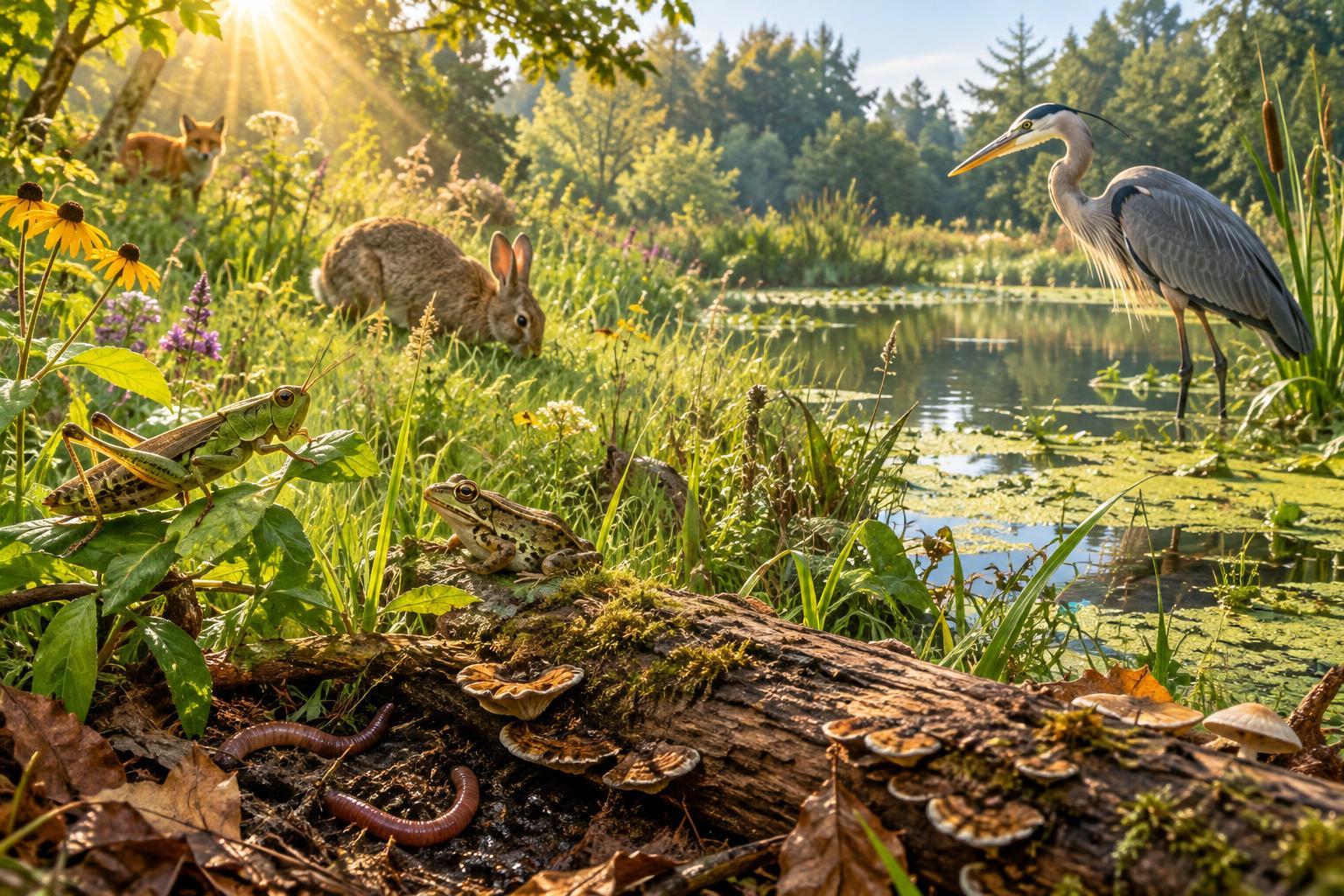
Look at a patch of grass, a grazing rabbit and a nearby fox. It is tempting to describe their relationship as a straight line: grass feeds rabbit, rabbit feeds fox. That line captures one possible path for energy, but a real ecosystem has many such paths. Rabbits may eat several kinds of plants, and foxes may eat other animals too. Together, the overlapping paths form a food web.
In most familiar food webs, energy enters as sunlight. Plants, algae and some bacteria use photosynthesis to capture some of that light energy and store it in molecules they build. These organisms are called producers because they make energy-rich food from simpler materials. Not every food web depends on sunlight: in some environments, microbes use energy from chemical reactions instead. In either case, the web needs an energy source before animals can feed.
Follow the many paths through consumers
A consumer gets energy by eating other organisms or their remains. An animal that eats a plant draws on energy stored by a producer. A predator that eats that animal obtains some of the energy that passed through its prey. Food-web diagrams often use arrows to show this direction of transfer: an arrow points from the food toward the organism eating it.
Labels such as herbivore, carnivore and omnivore are useful, but they do not make a food web tidy. A bird might eat seeds, insects and fruit. An insect might feed on a living leaf as a larva and different food as an adult. Because an organism can have several food sources, it may connect paths that a single food chain would leave separate. That is why a web gives a better picture of feeding relationships than one line does.
Why less energy is available at each step
Energy does not disappear when one organism eats another, but only some of it becomes part of the eater’s body. Organisms use energy to maintain their cells, move, grow and reproduce. As they carry out these activities, much of the energy they use is released as heat. Some potential food energy also remains in parts that are not eaten, or leaves the body as waste.
This helps explain why an ecosystem generally supports far less animal biomass at high feeding levels than plant or algal biomass near its base. The exact amount transferred from one level to the next varies with the organisms and conditions involved; it is not a fixed rule for every web. The practical point is simpler: each transfer leaves less stored energy available to feed the next set of consumers.
The overlooked routes: waste and dead material
A food web does not end when an organism dies or produces waste. Fallen leaves, animal droppings and dead bodies can feed organisms such as fungi and bacteria. These decomposers break down organic material and obtain energy from it. Other animals, including many worms and insects, also feed on dead material or the organisms living in it. These routes connect living and nonliving parts of an ecosystem.
Energy and matter behave differently here. Decomposers release nutrients from remains, making them available to producers again under suitable conditions. Those nutrients can be reused within the ecosystem. Energy, however, flows through: after it has been used and released as heat, it is not recycled back into food by decomposers. A continuing input of sunlight, or another energy source, is needed to sustain the web.
What a food web can—and cannot—tell us
Food webs help explain why a change in one population may affect others. If a plant becomes scarce, several plant-eaters might lose a food source; predators could then encounter fewer of those prey. But the outcome is not automatic. Some consumers can switch foods, and changes in habitat, seasons or competition may also matter. A diagram shows possible feeding links, not a complete prediction of what will happen.
The next time you notice a flowering plant, an insect and a bird, try tracing more than one route between them. Ask where the energy entered, which organisms might eat each other, and what happens to leaves or bodies that are not eaten by a predator. Thinking in paths rather than a single chain reveals the central idea: energy supports life as it moves through a network of organisms, with less available after each transfer.