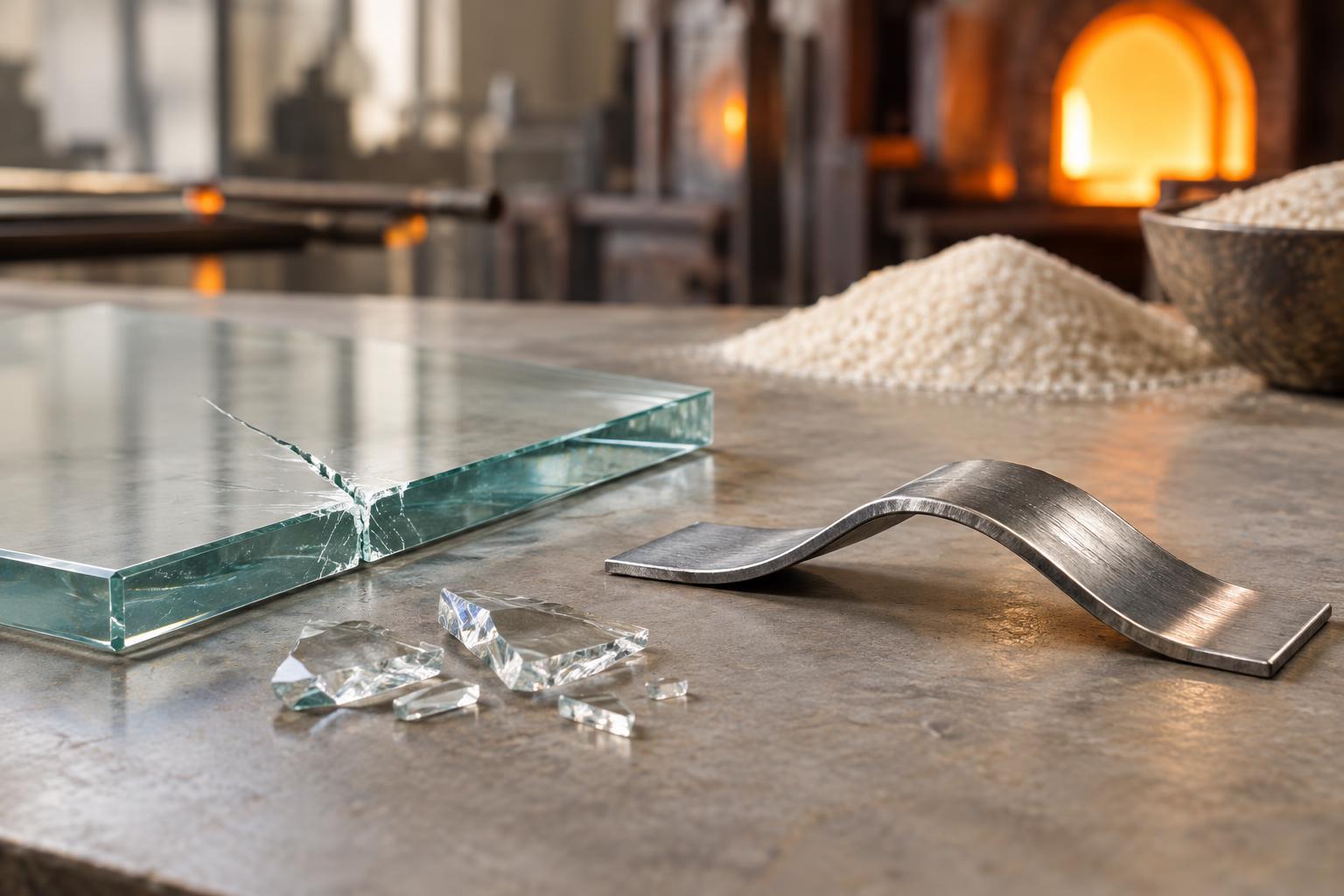
From raw materials to a glass sheet
Most ordinary window and bottle glass is soda-lime glass. Its main ingredient is silica, commonly supplied by sand. Manufacturers add materials that help the mixture melt at a workable temperature and make the finished glass more resistant to water. The ingredients are heated until they form a liquid that can be shaped, then cooled into a solid.
The shaping method depends on the product. In the float-glass process used for many flat panes, molten glass spreads across a bath of molten tin. The glass is then cooled under controlled conditions to make a smooth sheet. Bottles and other containers are shaped in molds instead. In either case, cooling matters: if one part contracts much faster than another, stresses can remain inside the object. Annealing—cooling the glass in a controlled way—helps reduce those stresses.
A solid without an orderly crystal pattern
Many solid metals contain crystals: their atoms are arranged in repeating patterns, although a metal object may contain many differently oriented crystals. Everyday glass is different. Its atoms form a connected network without the same long-range repeating pattern. This structure is called amorphous.
Glass is unquestionably solid at room temperature. The familiar claim that old windows slowly flow and become thicker at the bottom is not a useful explanation for their unevenness; differences in how older panes were made offer a better explanation. Glass can soften and be reshaped when heated sufficiently, but an everyday pane keeps its shape under ordinary conditions.
Why a small scratch can become a big crack
A pane can carry a substantial load when forces are distributed in a favorable way. Trouble often starts at a flaw: a tiny surface scratch, chip or crack. A pulling force, called tension, can concentrate at the sharp tip of that flaw. If the force there becomes great enough, the crack advances through the glass. That is why damage at an edge can matter even when the rest of a pane looks sound.
Glass generally resists compression better than tension. Pressing its surfaces together tends to close small cracks, while pulling them apart can open those cracks. The exact point at which a glass object fails depends on its shape, the forces applied and the flaws it contains. Two apparently identical glasses may therefore break under different loads. Hardness—the ability to resist scratching—and resistance to cracking are also different properties; a hard material is not necessarily a tough one.
What many metals do before they fail
In many metals, defects in the crystal structure called dislocations can move when the material is stressed. Their movement lets the metal change shape permanently rather than snapping as soon as a local stress becomes high. Bend a paper clip, and you can see this plastic deformation: it stays bent after you let go. Bending it back and forth can eventually cause it to break, but the visible change in shape comes first.
This contrast is a useful guide, not an absolute rule. Different metals behave differently, and conditions such as temperature and repeated loading affect how they fail. Likewise, glass may flex slightly under load before breaking; it usually returns to its original shape if the load is removed in time. The key distinction is that ordinary glass has little capacity for permanent reshaping at room temperature, so a growing crack often produces a sudden break.
Designing how glass breaks
Manufacturers can change glass’s behavior without turning it into a metal. Tempered glass is heated and then cooled rapidly at its surfaces. This treatment leaves the surfaces in compression, making it harder for a crack to open there. If tempered glass does fail, it typically breaks into many small pieces rather than long, sharp shards. It is still breakable, and damage to an edge can be especially important.
Laminated glass takes another approach: it joins glass layers with a plastic interlayer. The glass can crack, but the interlayer helps hold the pieces together. These treatments solve different problems, which is why the right choice depends on how an object will be used. The next time a clear pane and a metal frame sit side by side, remember that their different responses to a bump begin at a scale too small to see: in how their structures accommodate force and how easily a crack can travel.