An orbit is a fall that keeps missing
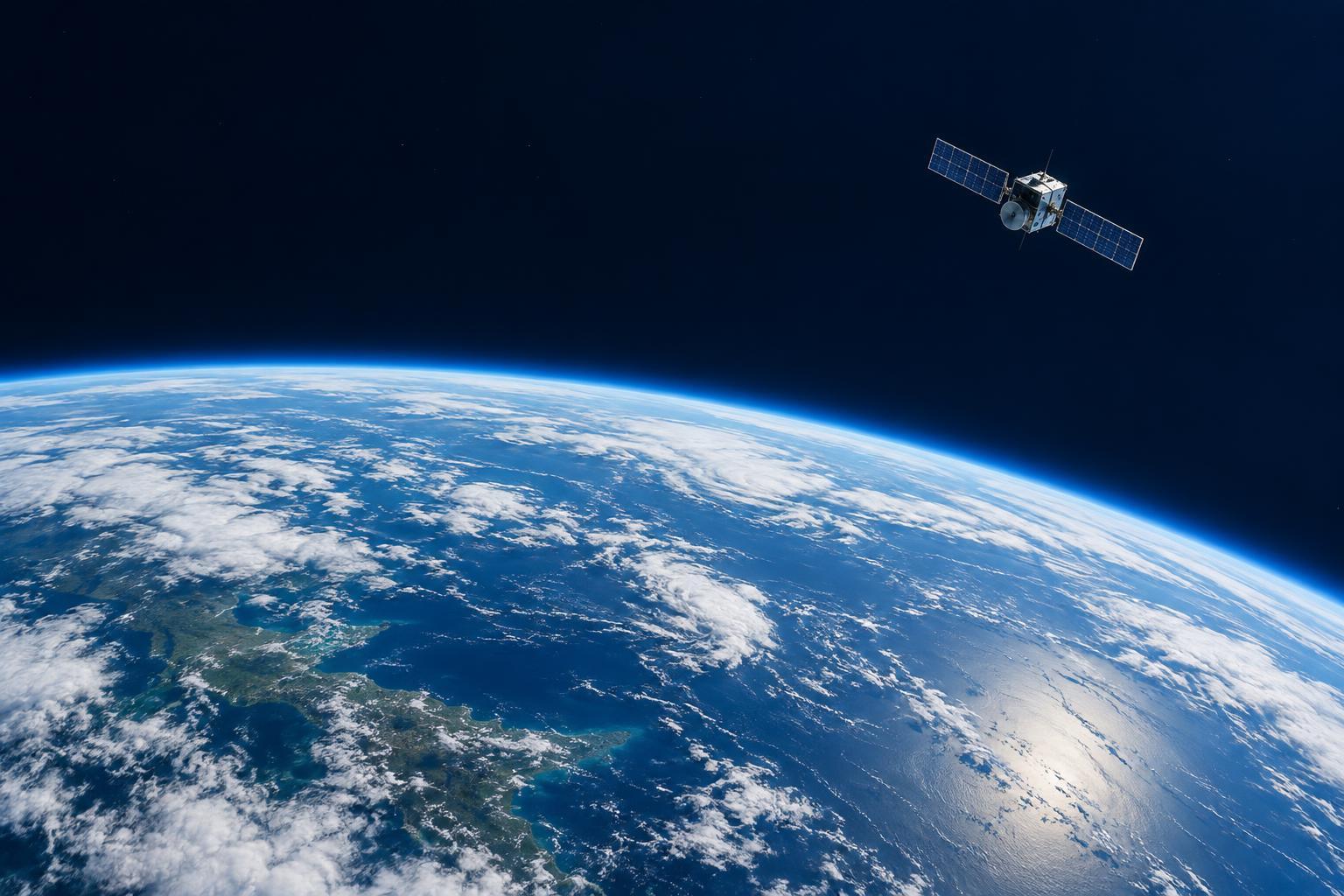
Drop a ball and gravity pulls it toward the ground. Give it a sideways push, and it travels forward while it falls. A satellite follows the same basic pattern: Earth’s gravity continually pulls it inward, while its sideways motion carries it forward. If its path curves around Earth rather than meeting the surface or atmosphere, it is in orbit.
This is why astronauts in an orbiting spacecraft can feel weightless even though Earth’s gravity still acts on them. The spacecraft and everything inside it are falling together. There is little support force from a floor pressing against the astronauts, so objects appear to float. The feeling does not mean they have escaped gravity.
Gravity bends the path
Without a force changing its motion, an object would continue in a straight line at a steady speed. Gravity changes the direction of an orbiting object’s motion at every moment, turning what would have been a straight path into a curved one. For a nearly circular orbit, that inward pull keeps the object circling its larger neighbor.
Speed matters as much as gravity. Move too slowly at a given height, and an object may descend into an atmosphere or strike the body below. With enough sideways speed, it can keep missing. If it moves fast enough, it may leave that body’s gravitational neighborhood rather than remain in a bound orbit. The outcome also depends on its starting position and on the gravitational pull of other bodies.
Why orbits are not all circles
A circle is a useful first picture, but many orbits are elliptical: they have a closest point and a farthest point from the body being orbited. In an ideal two-body orbit, the larger body lies at one focus of the ellipse, not at its center. The orbiting object moves faster when it is closer and slower when it is farther away.
The Moon’s path around Earth and Earth’s path around the Sun are both close enough to circular that sketches often show them as circles, but neither is a perfect circle. Real paths are also affected by other gravitational pulls. The Sun, planets, and moons tug on one another, so a simple ellipse is a helpful model rather than a complete description of every motion.
What determines a satellite’s orbit?
A satellite’s orbit depends on where it is and how fast it is moving, including the direction of that motion. Satellites in lower, nearly circular Earth orbits travel faster and complete a circuit in less time than satellites in higher circular orbits. Gravity weakens with distance, but it does not suddenly switch off above the atmosphere.
To change an orbit, a spacecraft fires an engine to change its velocity. A brief push in the direction of travel can raise the far side of its orbit; another carefully timed push can reshape the path further. This can seem surprising because a satellite in a higher circular orbit ultimately moves more slowly than one in a lower circular orbit. The first push adds energy, but the resulting path carries the spacecraft into a region where a stable circular orbit has a lower speed.
Why some orbits need upkeep
In a simple model with only gravity acting, a satellite could continue along its orbit without an engine running. Actual satellites face additional influences. Thin traces of atmosphere can slow low-orbit spacecraft, causing their orbits to shrink. The uneven distribution of Earth’s mass and the pulls of the Sun and Moon can gradually alter a satellite’s path.
Operators may use small engine burns to keep a spacecraft in a useful position, avoid a predicted close approach, or move it at the end of its working life. These adjustments do not create the orbit from scratch each time. They refine the ongoing balance between motion and gravity—the same balance that guides natural moons around planets and planets around stars.


