One material, many possible properties
A kitchen knife, a spring and a structural beam can all be made from steel, yet they need different properties. A knife edge should resist wear; a spring must flex without taking a permanent bend; a beam must carry loads without breaking unexpectedly. Steel’s composition matters, but so does its thermal history: how it was heated and cooled during manufacture.
Steel is primarily iron with a relatively small amount of carbon. Its atoms form arrangements called crystal structures, and those structures can change when the metal is heated. Carbon atoms can also move through steel, particularly at elevated temperatures. By controlling temperature, time and cooling rate, a manufacturer can influence the arrangement of the metal and, in turn, how it behaves under force.
Why cooling rate makes a difference
For many steels, heating to a suitable temperature creates a structure called austenite. What forms next depends partly on how quickly the steel cools. Slow cooling allows atoms more time to rearrange, often producing structures that are comparatively soft and easy to machine or shape. Faster cooling can produce different structures, with different combinations of hardness, strength and toughness.
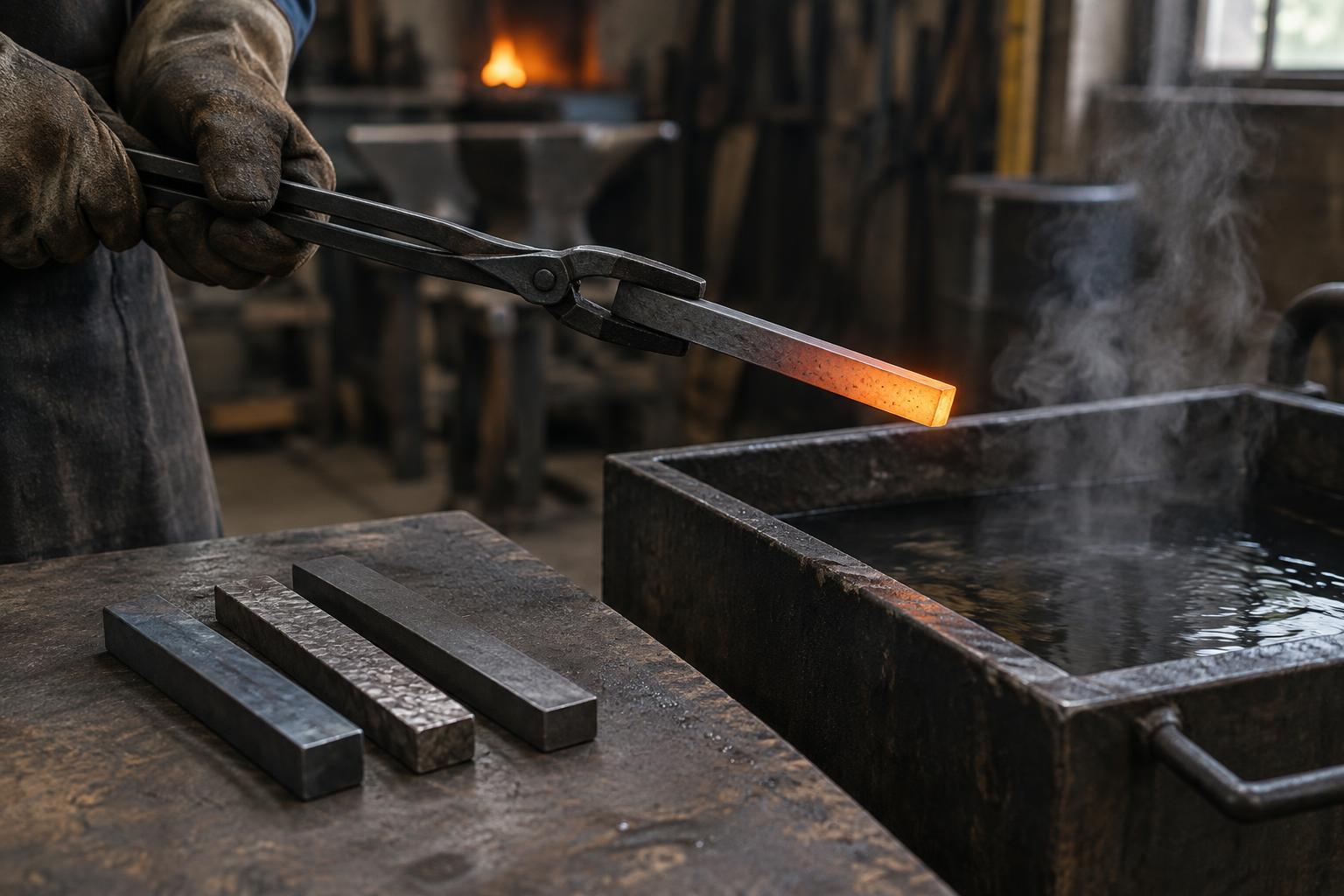
Quenching means cooling hot steel rapidly, often in a liquid or gas chosen for the job. In suitable carbon steels, a rapid quench can turn much of the austenite into martensite. Martensite is hard because carbon becomes trapped in a distorted crystal structure that resists deformation. That hardness can be useful for a cutting edge, but freshly quenched steel may also be brittle and contain internal stresses.
The result is not determined by cooling speed alone. Carbon content, other alloying elements, the thickness and shape of the part, and the temperature reached before cooling all matter. A thick part, for example, may cool more slowly at its center than at its surface. A treatment that works for one grade and shape of steel may therefore produce a different result in another.
Tempering, annealing and normalizing
Tempering commonly follows quenching. The steel is reheated to a temperature below the range used to form austenite, held there and cooled again. This lets some of the stresses and structural features created by quenching change. Tempering usually sacrifices some hardness in exchange for improved toughness, making the part less likely to crack or chip in service. The desired balance depends on the task: a blade and a spring do not need identical treatment.
Annealing takes a different approach. Although the details vary, it generally involves heating steel and allowing it to cool slowly under controlled conditions. This can soften the material, make it easier to machine or form, and reduce stresses left by earlier processing. Softness is not always a drawback; it can be valuable while a part is being shaped, before a later treatment gives it its working properties.
Normalizing also involves heating steel and then cooling it, commonly in air rather than through the slower cooling associated with many annealing processes. It can help produce a more uniform structure after operations such as casting or hot working. Neither annealing nor normalizing is a universal reset button: their effects depend on the steel and on the treatment used.
Choosing properties for the whole part
A useful steel component rarely needs maximum hardness everywhere. A very hard gear tooth surface can resist wear, while a tougher interior helps the tooth withstand repeated loading. Some treatments are designed to create such a contrast between surface and core; others treat a part more uniformly. The choice begins with a practical question: what kinds of forces, wear and working conditions will this component face?
Heat treatment also involves trade-offs beyond hardness and toughness. Rapid or uneven cooling can distort a part, and severe internal stresses can contribute to cracking. Manufacturers therefore consider the steel grade, the part’s dimensions and the intended use when selecting a heating and cooling process.
The central idea is that steel’s properties are not fixed when its ingredients are chosen. Its internal structure records part of its heating and cooling history. Heat treatment uses that fact to turn a versatile material into components suited to very different jobs.