A filter that does more than remove waste
Your kidneys receive a steady flow of blood. From it, they remove wastes produced by normal metabolism and help regulate the amounts of water and dissolved substances that remain in the body. This is not simply a matter of straining out unwanted material. The kidneys first move a large amount of fluid out of the blood, then selectively return most of its water and useful contents. What remains becomes urine.
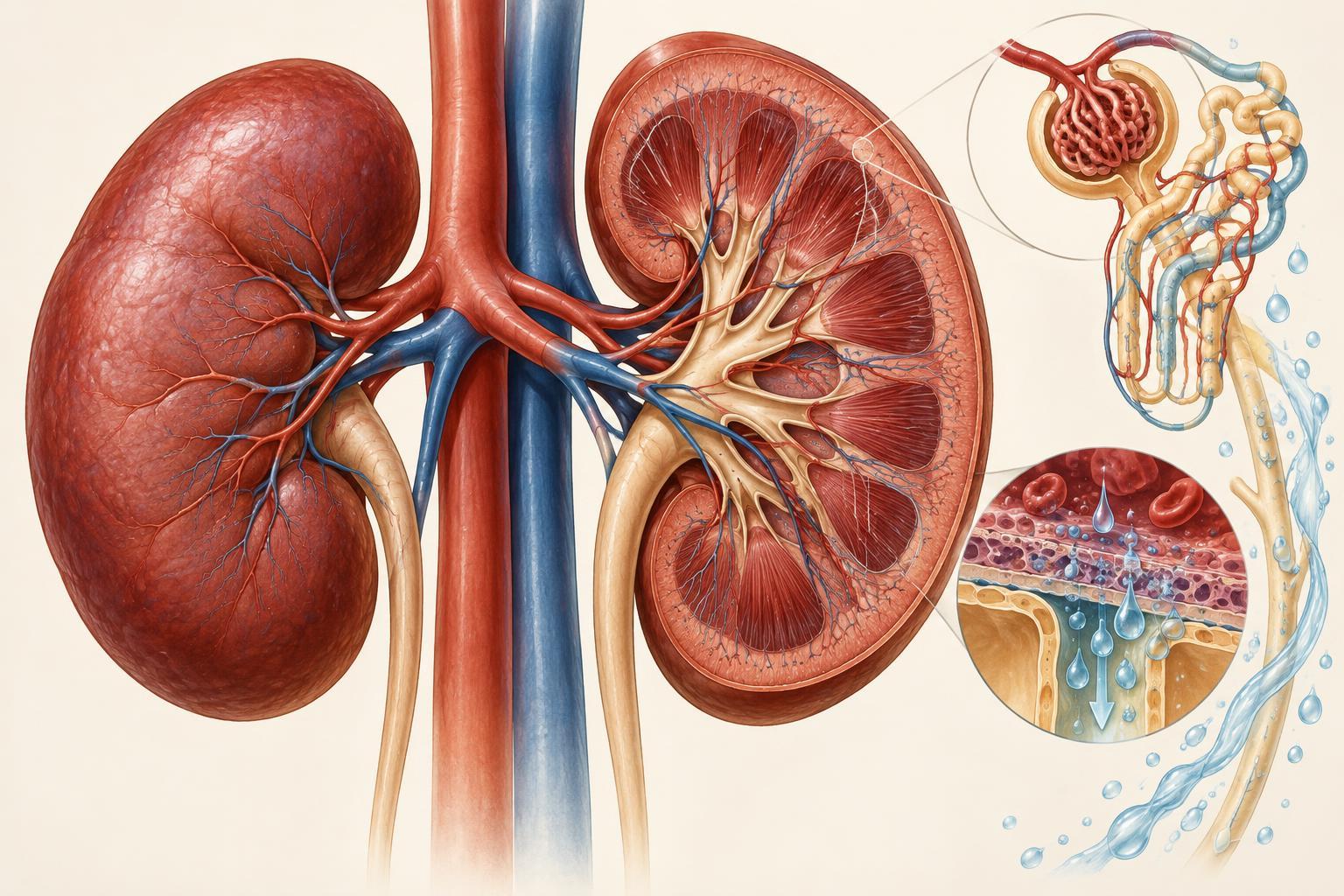
Each kidney contains many tiny working units called nephrons. A nephron begins with a bundle of small blood vessels, the glomerulus, enclosed by a cup-shaped structure. Blood pressure pushes water and small dissolved substances through the filtering barrier into that cup. Blood cells and most large proteins normally stay in the bloodstream. The resulting fluid then travels through a long tubule, where the kidneys can change its composition before it leaves the body.
What happens to the filtered fluid
The first stretch of the tubule, called the proximal tubule, returns much of the filtered water and many dissolved substances to the blood. These include substances the body can use, such as glucose and amino acids, as well as important ions such as sodium. Tubule cells also move certain substances from the blood into the fluid destined to become urine. Filtration is therefore only the opening step: reabsorption and secretion determine much of what is ultimately excreted.
As the fluid moves through later parts of the nephron, its contents are adjusted further. Different sections allow different substances to cross their walls. This division of labor lets the kidneys conserve materials the body needs while removing excess amounts and metabolic waste. It also gives them a way to change urine volume without treating every dissolved substance in exactly the same way.
How kidneys conserve water
A key part of water regulation is the loop of Henle, a U-shaped section of the nephron that dips into the kidney’s inner region. Its two limbs handle water and salts differently. Together with surrounding blood vessels and other parts of the kidney, the loop helps establish a concentration gradient: the deeper inner tissue is relatively rich in dissolved substances. That gradient makes it possible for water to leave the fluid later in its journey, when the body needs to conserve it.
The final collecting ducts carry fluid through this inner region. Their permeability to water can change. When they allow more water through, water moves back into the body and a smaller volume of more concentrated urine is produced. When they allow less through, more water remains in the ducts and urine is more dilute. In this way, the kidneys can respond to changing water needs rather than producing urine of one fixed concentration.
Signals that adjust the balance
The brain helps coordinate this process. When the blood becomes more concentrated, specialized sensors can prompt the release of antidiuretic hormone, also called ADH or vasopressin. ADH makes the collecting ducts more permeable to water, increasing water recovery. Thirst often rises alongside this response, encouraging water intake. If the body has more water than it needs, less ADH is generally released, allowing more water to pass into urine.
Water balance is also connected to salt balance. The hormone aldosterone encourages the kidneys to retain sodium in later parts of the nephron; water can follow sodium under appropriate conditions. These controls respond to different signals, so urine volume depends on more than how much someone has recently drunk. Salt intake, sweating and other changes in the body can also affect the kidneys’ work.
What urine can—and cannot—tell you
Urine offers an everyday glimpse of this regulation. Pale urine often means it contains more water relative to dissolved substances, while darker yellow urine is usually more concentrated. But color alone is an imperfect guide: foods, medicines and other factors can change its appearance. A single observation does not reveal exactly how the kidneys are functioning.
The larger lesson is that kidney filtration is a carefully controlled exchange, not a one-way drain. Blood is filtered, useful materials are reclaimed, and the remaining fluid is adjusted in response to the body’s needs. Every trip through the nephron helps maintain the internal conditions that cells depend on, even as water intake and water loss vary from day to day.