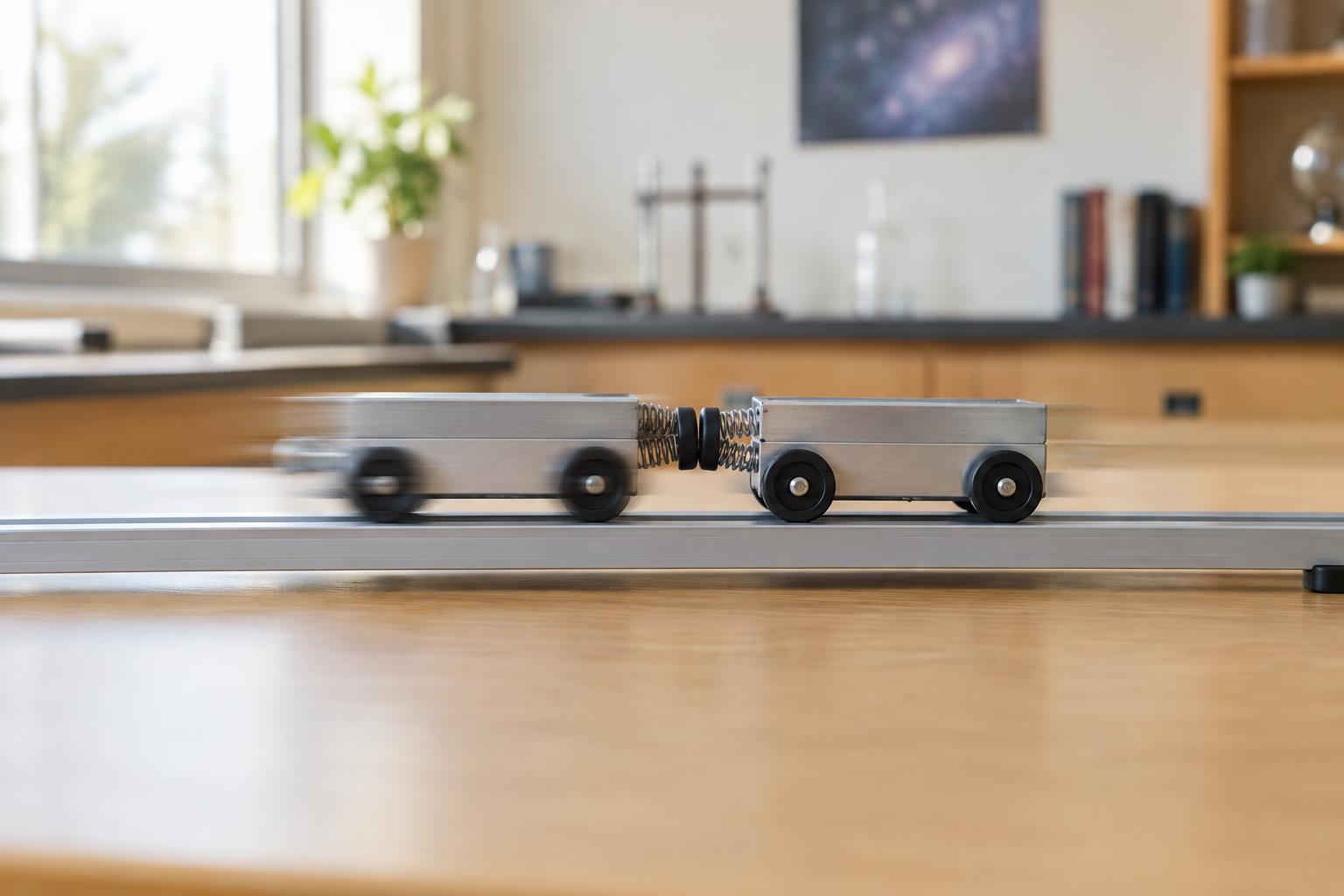
What momentum measures
A moving object has momentum equal to its mass multiplied by its velocity. Velocity includes direction as well as speed, so momentum does too. A ball rolling to the right and an identical ball rolling just as fast to the left have equal amounts of momentum in opposite directions. If both are included in one system, their momenta add to zero.
This makes momentum a useful way to describe a collision. An object may stop, rebound or send another object moving, but the momentum lost by one part of a system can be gained by another. Conservation of momentum means that the total momentum before an interaction equals the total afterward, provided the system has no significant net push from outside during that interaction. The rule applies separately in each direction: horizontal momentum and vertical momentum must each be accounted for.
Why a collision redistributes momentum
Imagine two carts on a nearly level track. When they meet, each pushes on the other. The forces they exert are equal in strength and opposite in direction, and they act for the same length of time. A force acting over time changes momentum; this change is called an impulse. Because the two impulses are opposite, one cart’s change in momentum balances the other’s.
For example, suppose two identical carts approach each other at equal speeds and stick together. Their momenta initially cancel. After the collision, the joined carts remain at rest, so their total momentum is still zero. If one cart had approached faster, the pair would move in the direction of that cart’s initial momentum. To predict their motion, add the carts’ signed momenta before impact and divide by their combined mass.
Bouncing, sticking and kinetic energy
Momentum conservation does not require objects to bounce. In an elastic collision, kinetic energy—the energy of motion—is conserved as well as momentum. In an inelastic collision, momentum is still conserved for an isolated system, but some kinetic energy becomes other forms of energy, such as internal motion, sound or heat. Objects that stick together provide a particularly clear example of an inelastic collision.
This is why knowing only the total momentum does not usually tell you the final motion of every object. Two carts might bounce apart or latch together, with different final velocities in each case. Both outcomes can satisfy momentum conservation. Details such as how the objects deform and whether they stick or rebound help determine which outcome occurs. Energy is not destroyed in an inelastic collision, but less of it remains as the objects’ large-scale motion.
Choosing the system and noticing outside forces
The phrase “total momentum” raises an important question: total for what? If you consider just one ball that strikes a wall, the ball’s momentum is not conserved. The wall pushes on it, acting as an external force on the ball. Include the wall and Earth in the system, however, and the ball’s momentum change is balanced by a change elsewhere. Earth’s huge mass makes its resulting motion imperceptibly small in everyday circumstances.
In practice, it is often enough to choose a smaller system and examine a short time interval. During a brief collision between two carts, friction from the track may have little effect compared with the forces the carts exert on each other. Their combined momentum is then approximately conserved over that interval. Over a longer period, friction can noticeably slow them, so the same approximation may no longer work. Clear system boundaries are essential to applying the rule correctly.
A way to reason through any collision
Start by naming the objects in your system and choosing positive directions. Write down each object’s momentum before the collision, including a minus sign for motion in a negative direction. Add those momenta, then do the same for the motion afterward. If external forces have a negligible combined effect during the interval, the two totals must match.
The method works beyond straight-line impacts. When objects collide at an angle, add their momentum components separately along two chosen axes. An object may leave in a surprising direction while the total momentum in each direction remains unchanged. Whether you picture rolling carts, colliding balls or an object breaking into pieces, the central question is the same: where did each part of the system’s momentum go?


