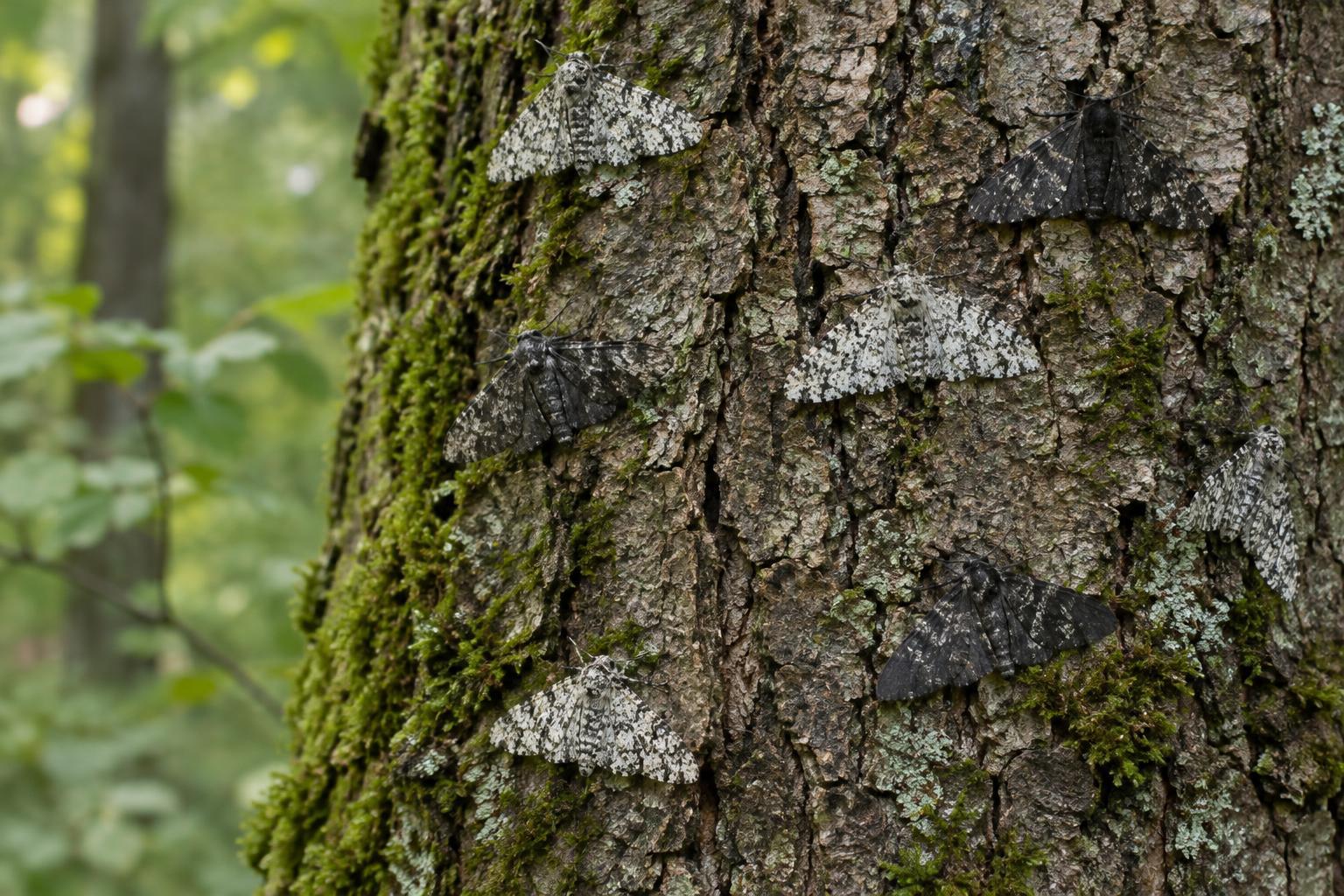
The starting point: individuals vary
Picture a population of insects living among green leaves. Some are lighter, some darker, and they may differ in many other ways. Variation like this is the raw material for natural selection. Without differences among individuals, there is no particular trait for selection to make more or less common.
Some variation comes from inherited differences in DNA. New genetic variants can arise through mutation, and sexual reproduction reshuffles existing variants into new combinations. Other differences come from conditions an organism experiences, such as available food. A well-fed insect might grow larger than a poorly fed one without passing that extra size directly to its offspring. To understand natural selection, it helps to ask not just whether individuals differ, but whether the differences can be inherited.
What the environment selects
Suppose birds hunting among those leaves more often spot the lighter insects. If darker insects survive long enough to produce more offspring, and their coloring is heritable, darker coloring may become more common in later generations. The birds do not create dark insects because the population needs them. They affect which existing variants are more likely to leave descendants.
Biologists use fitness to describe an organism’s reproductive success in a particular environment. It does not simply mean strength, speed or long life. A trait can help its bearer survive yet have little evolutionary effect if it does not also contribute to leaving offspring. Nor is a trait useful in every setting: darker coloring that helps conceal an insect on one background might make it easier to spot on another.
Why change takes generations
Natural selection acts on individuals, but a population is what evolves. An insect cannot choose to change its inherited coloring during its lifetime and then pass that chosen change along. Instead, individuals with certain inherited traits may leave different numbers of offspring. Over generations, the proportions of those traits in the population can shift.
The rate of change depends on circumstances, including how much heritable variation exists and how strongly a trait affects reproduction. A changing environment may alter which traits are advantageous. Selection also need not produce a perfect solution: organisms inherit versions of traits from earlier generations, and a trait that offers one benefit may carry a cost elsewhere.
A familiar example: resistance in bacteria
Bacterial resistance to an antibiotic illustrates the same basic process. A bacterial population may contain cells with inherited differences that affect how well they survive exposure to a particular drug. When the drug kills susceptible cells, resistant cells may be more likely to survive and multiply. As their descendants increase, resistance can become more common in that population.
This does not mean every bacterium deliberately develops resistance when it encounters an antibiotic. Resistance can involve several mechanisms, and bacteria can sometimes acquire resistance genes from other bacteria as well as inherit them from a parent cell. The central point remains: differences that affect survival and reproduction can change the makeup of future generations.
Selection is not the whole story
A population can also change for reasons other than natural selection. Chance alone can make an inherited variant more or less common, especially in a small population; this is called genetic drift. Movement between populations can introduce variants through gene flow. Mutation supplies new variants, though it does not arise because an organism anticipates what will be useful.
These processes can operate at the same time. If a trait becomes common, its frequency alone does not prove that it is beneficial: chance, migration or a connection to another trait might help explain the pattern. Natural selection is a powerful explanation when a heritable difference consistently affects reproductive success in a given environment. It is not a plan for improvement, but a process through which populations can become better suited to some conditions over generations.


