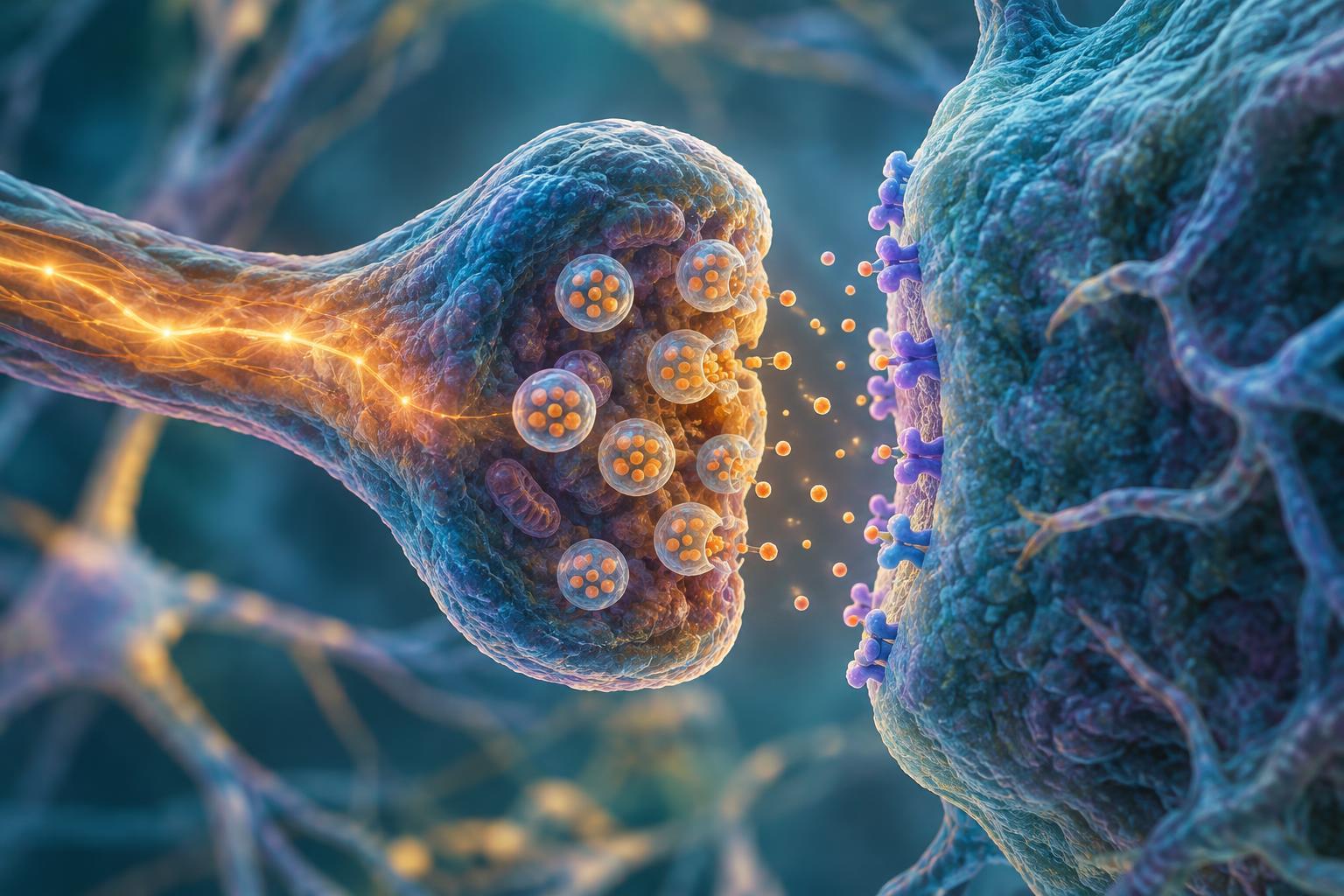
A gap between two cells
Nerve cells, or neurons, help carry information through the brain and the rest of the nervous system. A neuron can receive signals through its branching dendrites and send a signal along a long projection called an axon. Yet the axon usually does not merge with the next cell. At a chemical synapse, a tiny gap separates the sending cell from the receiving cell. Getting a message across that gap takes a change in signaling method: an electrical impulse triggers the release of chemical messengers.
This handoff helps explain how a simple observation can lead to an action. Touch something unexpectedly hot, and signals travel through connected nerve cells involved in sensing and responding. The cells do not pass one unchanging electrical current down the entire route. Each connection is a place where the message can be passed on, reduced or influenced by other incoming signals.
An electrical impulse reaches the axon tip
A neuron maintains a difference in electrical charge across its cell membrane, partly by controlling the movement of charged particles called ions. When conditions at one part of the membrane change enough, channels in that membrane open in sequence. The resulting wave of changing voltage, called an action potential, travels along the axon. It is a brief event, not a permanent flow of electricity.
When an action potential reaches an axon ending, it opens channels that allow calcium ions to enter. That calcium entry prompts small membrane-bound packets, called vesicles, to release neurotransmitter molecules into the gap. A useful analogy is a relay: the arriving electrical signal prompts the sending cell to release a chemical message. Unlike a relay baton, though, neurotransmitter molecules can spread through the gap and encounter different receptors.
The receiving cell interprets the message
Neurotransmitter molecules cross the narrow synaptic gap and bind to matching receptors on the receiving cell. Some receptors directly open ion channels; others start a series of changes inside the cell. Either way, binding can change how likely the receiving neuron is to produce its own action potential. The effect depends on the receptor and the cell’s circumstances, not just on the name of the neurotransmitter.
Some synaptic inputs make the receiving cell more likely to fire; these are often called excitatory. Others make it less likely to fire and are called inhibitory. A neuron may receive many inputs around the same time, so a single synapse rarely tells the whole story. The cell integrates those influences, and an action potential begins only if the relevant conditions are met. This is why describing every nerve signal as a simple chain of cells switching one another “on” misses an important part of how nervous systems work.
How a signal comes to an end
For a synapse to carry a new message clearly, neurotransmitter cannot keep stimulating receptors indefinitely. Depending on the chemical and the synapse, transporter proteins may take it back into cells, enzymes may break it down, or molecules may diffuse away. These processes help limit the signal’s duration and prepare the connection for further activity.
The synapse is also more than an empty gap. Nearby support cells, including glial cells, can help maintain the surroundings in which neurons communicate. And not all synapses use the chemical handoff described here. At electrical synapses, channels connecting neighboring cells allow electrical changes to pass more directly between them. Chemical synapses are a useful starting point because they show how an electrical event in one cell can have a varied effect on another.
Connections that can change
A synapse is not necessarily fixed at one strength. Patterns of activity can alter how much neurotransmitter a sending cell releases or how a receiving cell responds. Connections can also change structurally. Such changes are part of what researchers mean by synaptic plasticity, a broad set of processes involved in how nervous systems adapt and learn.
Plasticity does not mean that every experience rewires the brain in a simple, predictable way. What matters at a synapse depends on the cells involved, their recent activity and the wider network. The basic sequence remains a helpful guide: an electrical impulse arrives, a chemical message crosses a gap, and the next cell responds according to its receptors and other inputs. From that small handoff, networks of nerve cells can coordinate sensation, movement and thought.


