Gravity sets the stage
A star begins with an enormous cloud of gas, mostly hydrogen. As gravity draws the gas inward, the material becomes denser and its temperature rises. If the center grows hot and dense enough, hydrogen nuclei can begin to fuse. Fusion is the joining of light atomic nuclei into heavier ones. It is the source of the energy that makes an ordinary star shine.
Hydrogen nuclei carry positive electric charges, so they repel one another. High temperatures make particles move rapidly, increasing the chances that they will approach closely. Even then, their ordinary motion is often not enough to overcome the repulsion. A quantum effect called tunneling gives some nuclei a chance to get close enough for the strong nuclear force to bind them. Fusion remains rare for any one pair of particles, but a stellar core contains an immense number of them.
Where the energy comes from
In the Sun, the main route from hydrogen to helium is called the proton–proton chain. It involves several steps rather than one collision between four hydrogen nuclei. The overall result is that four hydrogen nuclei become one helium nucleus, along with other particles and energy. A small amount of the original mass is converted into energy, as described by Einstein’s equation E = mc².
This does not mean that matter disappears without a trace. The helium nucleus and other products have slightly less total mass than the particles that went into the reactions; the difference appears as energy carried by particles and radiation. Some of that energy stays in the star and heats it. Tiny particles called neutrinos interact only weakly with matter, so many escape from the core and pass through the star with little obstruction.
Why a star does not burn all at once
Fusion and gravity act in opposition. Gravity pulls the star’s gas inward, while hot gas pushes outward. Over much of a star’s life, these effects maintain a balance. If the core contracts, it tends to heat up, which can increase fusion and the outward pressure. If it expands and cools, fusion may slow. This feedback helps a star produce energy over a long period rather than releasing it all in a single burst.
A star’s mass strongly affects this balance. More massive stars have greater pressure and temperature in their cores and generally use their nuclear fuel faster than smaller stars. In hotter stellar cores, the CNO cycle provides another route for turning hydrogen into helium. Carbon, nitrogen and oxygen take part in its sequence of reactions but are regenerated by the end. Different stars can therefore rely on different fusion pathways while drawing energy from the same basic conversion of hydrogen into helium.
The long journey from core to daylight
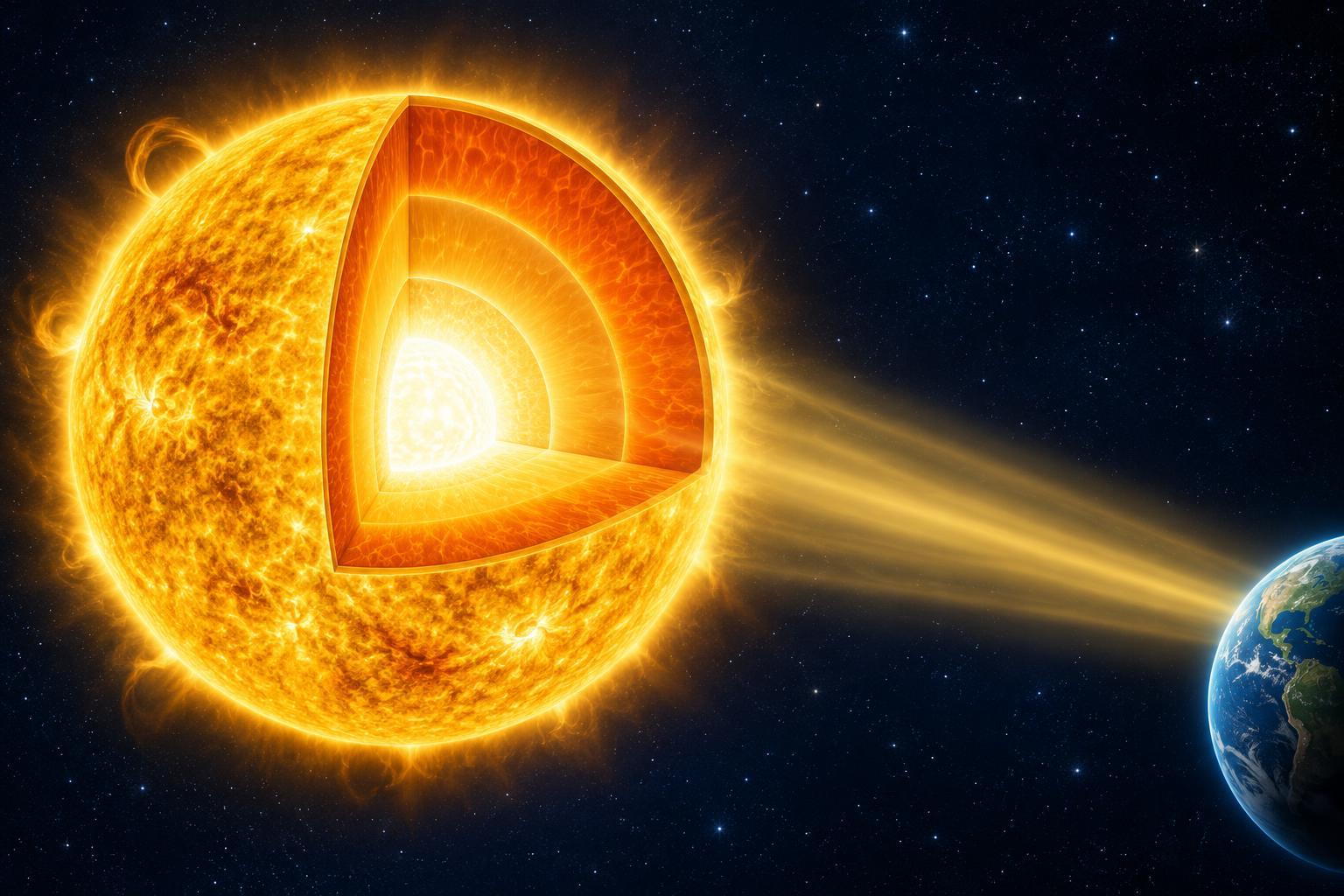
Fusion takes place deep inside a star, but the light we see comes from its surface. Energy produced in the core moves outward through surrounding material. In some regions, radiation carries much of it; in others, convection does, as warmer gas rises and cooler gas sinks. The pattern depends on the star and on conditions at different depths.
A ray of sunlight is not a core-produced photon that traveled straight to Earth. Within the star, radiation is repeatedly absorbed and re-emitted, exchanging energy with matter along the way. By the time energy reaches the surface and escapes into space, its form has changed. From there, sunlight crosses space to Earth, where it can warm a window, power photosynthesis or cast a shadow.
What happens when core hydrogen runs low
Fusion changes a star’s composition over time. As hydrogen in the core becomes scarce, the balance between pressure and gravity shifts. A Sun-like star can expand into a red giant, while its core contracts and heats. If the core becomes hot enough, helium nuclei can begin fusing into heavier elements, including carbon. These later stages differ from the long, relatively steady period of core hydrogen fusion.
A star’s eventual path depends largely on its mass. Stars with enough mass can reach the conditions needed to fuse progressively heavier elements. Such reactions do not provide an unlimited energy supply: fusing iron does not release energy in the way that fusing lighter nuclei does. The details of how a star ends vary, but the central story of its shining years is straightforward: gravity creates the conditions for fusion, and fusion supplies energy that pushes back against gravity.