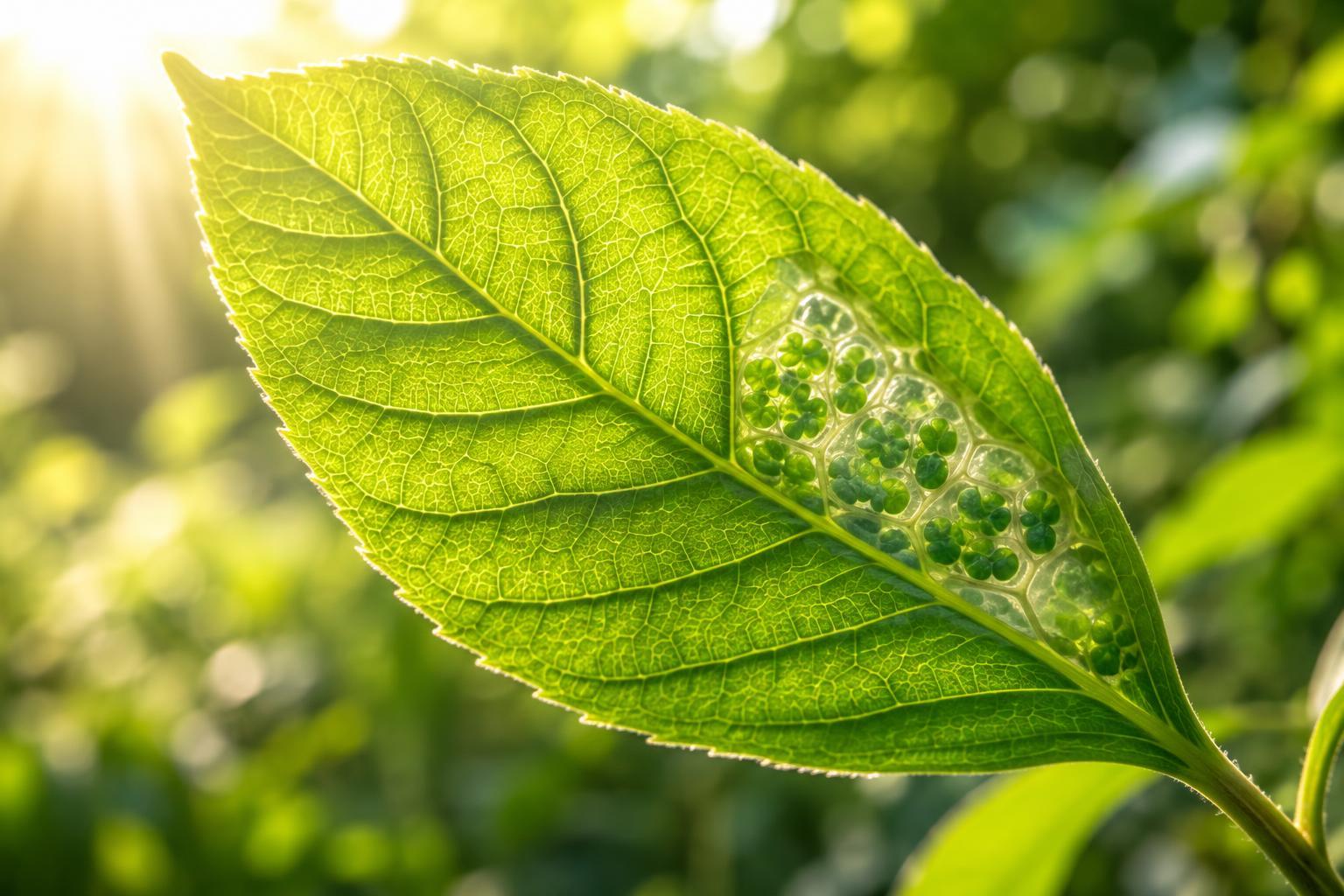
A leaf is a place for capturing light
A plant cannot use sunlight in the same way it uses sugar. Light arrives as photons, while the plant needs chemical energy to power work inside its cells and carbon-containing molecules to build new tissues. Photosynthesis connects the two: it captures some of the energy in light and uses it to help make molecules from carbon dioxide and water.
In most plants, much of this work takes place in chloroplasts, small structures found in the cells of leaves and other green parts. Inside each chloroplast are stacks of membrane sacs called thylakoids. Their membranes hold chlorophyll and other pigments that absorb light. Chlorophyll absorbs some colors more readily than green, which is why many leaves look green to our eyes. The fluid surrounding the thylakoids, called the stroma, is where another major part of photosynthesis takes place.
Light sets electrons in motion
When pigments in a thylakoid membrane absorb light, that energy is passed to a reaction center. There, an electron gains enough energy to move into a chain of molecules that can carry it onward. In a group of proteins called photosystem II, water supplies replacement electrons. Splitting water also releases hydrogen ions and oxygen. The oxygen can leave the leaf and enter the air.
As electrons travel through the membrane’s transport chain, their energy helps move hydrogen ions to one side of the thylakoid membrane. The resulting difference in ion concentration is a bit like water held behind a dam: it creates an opportunity for flow. Hydrogen ions pass back through an enzyme called ATP synthase, which uses that flow to make ATP. ATP is a molecule cells can use to drive energy-requiring reactions.
The electrons receive another boost of light energy in photosystem I. They ultimately help form NADPH, a molecule that carries high-energy electrons to the next stage. ATP and NADPH are useful products of the light-driven reactions, but they are not the main long-term store of energy made by photosynthesis. The plant uses them to help make carbon-containing molecules.
Carbon dioxide becomes plant material
In the stroma, a linked set of reactions known as the Calvin cycle takes in carbon dioxide. An enzyme called rubisco attaches carbon dioxide to an existing carbon-containing molecule. Through further reactions powered by ATP and supplied with electrons by NADPH, some of that carbon becomes a small sugar-related molecule called G3P. The cycle also regenerates the starting molecule so the process can continue.
G3P is a starting point, not a ready-made pile of glucose emerging directly from every turn of the cycle. Plants can use products of this pathway to make sugars and starch for energy storage, or to build cellulose and other materials. In this way, carbon that was in the air becomes part of a leaf, a root or a seed. The captured energy is stored in the chemical arrangement of the molecules the plant makes, ready to be transferred and used through later reactions.
Why water, air and conditions matter
Photosynthesis depends on more than bright light. Carbon dioxide usually enters a leaf through tiny openings called stomata. Opening them also allows water vapor to escape, so a plant facing dry conditions may close them and take in less carbon dioxide. Water is needed for the light-driven reactions, while temperature affects the enzymes that carry out the process. Too little light can limit the energy supply; more light cannot help indefinitely if another requirement becomes limiting.
Plants also use energy after the sun goes down. Like other living things, their cells break down some of the molecules they have made to release usable energy through cellular respiration. Photosynthesis and respiration therefore do different jobs: one helps capture energy and make carbon-rich material, while the other helps cells use that material to power everyday work.
The bigger picture inside a leaf
A useful way to follow photosynthesis is to track both energy and matter. Light supplies energy; water supplies electrons and is the source of the oxygen released; carbon dioxide supplies much of the carbon in the plant’s newly made organic molecules. None of these inputs acts alone. Chloroplasts coordinate light capture, electron flow and carbon fixation to turn a fleeting supply of sunlight into materials the plant can use later.
That process also helps explain an everyday observation: a plant can gain substantial mass while growing in soil without taking all of that new material from the soil. Soil supplies important water and minerals, but much of the carbon in new plant tissue entered through the air as carbon dioxide. A leaf is not simply soaking up sunshine; it is using sunlight to help assemble matter into living structure.


