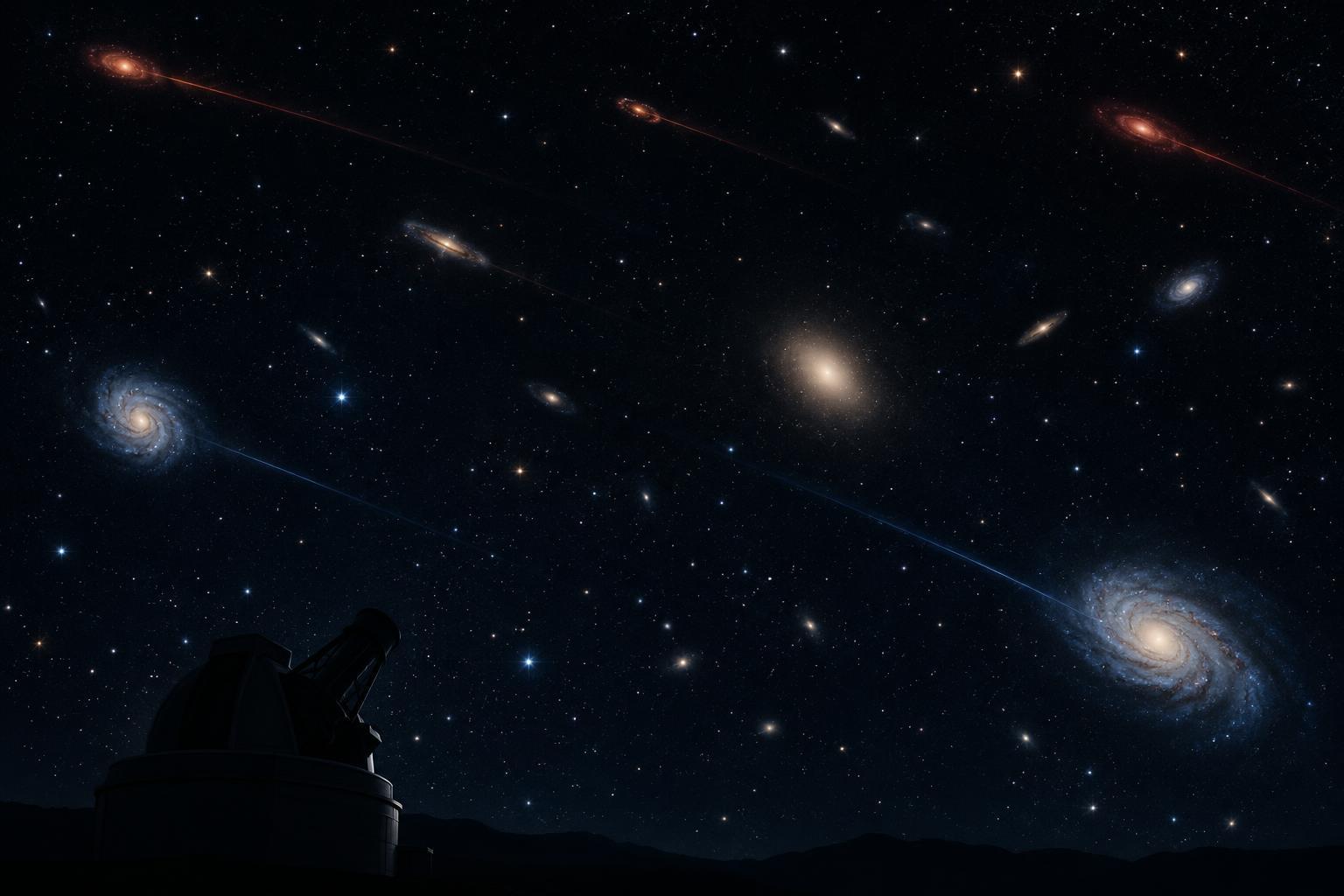
A recognizable pattern in stretched light
Imagine hearing a familiar tune played at a lower pitch. The notes have changed, but their pattern still lets you recognize the melody. Astronomers do something similar with light. When they spread a galaxy’s light into a spectrum, they look for patterns made by atoms and molecules. Certain wavelengths are absorbed or emitted more strongly than others, leaving distinctive lines that can be identified in laboratory measurements.
In the light from many distant galaxies, those lines appear at longer wavelengths than expected. This shift is called redshift because red light has a longer wavelength than blue light in the visible spectrum. The name applies even when the lines being measured lie outside the visible range. Astronomers compare a line’s observed wavelength with its known wavelength to calculate redshift. If the observed wavelength is twice the reference wavelength, for example, the redshift is 1. Checking several lines helps confirm that the whole pattern has shifted rather than one feature being misidentified.
Why expanding space stretches light
A redshift can have more than one cause. Motion away from an observer produces a Doppler shift, much as the pitch of a sound changes when its source moves away. Gravity can also shift light. For light that has traveled across much of the universe, however, the dominant explanation is usually cosmological expansion: the space between widely separated, unbound galaxies increases while the light is in transit.
As a light wave travels through expanding space, its wavelength grows along with the cosmic scale. The relationship is simple in principle: 1 plus the measured redshift equals the universe’s present scale factor divided by its scale factor when the light was emitted. A redshift of 1 therefore means the universe has doubled in scale since that light began its journey. This does not mean every object has doubled in size. Gravity and other forces hold galaxies, solar systems, planets and people together; cosmic expansion is most apparent across the vast gaps between galaxy groups.
From individual galaxies to a cosmic pattern
A single redshift does not demonstrate that the universe is expanding. A galaxy may also be moving toward or away from us relative to its neighbors. The broader pattern matters: galaxies at greater distances generally show greater redshifts. For relatively nearby galaxies, astronomers describe this trend with the Hubble–Lemaître relationship, which approximately links recession speed and distance.
This pattern makes sense in an expanding universe. Picture dots on a flexible sheet as the sheet is stretched: from any one dot, more distant dots generally separate faster because more stretching occurs between them. The picture is useful, but it has limits. The universe need not be expanding into an outside space, and galaxies are not necessarily sitting still on an underlying sheet. Their own motions add to, or subtract from, the redshift caused by expansion. Some nearby galaxies even show a blueshift because their motion toward us outweighs the effect of expansion.
What redshift tells us—and what it does not
Redshift tells astronomers how much the universe expanded while a particular beam of light was traveling. It also lets them arrange distant observations into a history: light with a higher cosmological redshift was emitted when the universe was smaller. Because light takes time to arrive, observing a distant galaxy means seeing it as it was when that light left it, not as it is today.
Redshift alone does not give a galaxy’s distance in a model-independent way. Converting it to a distance, a light-travel time or a recession speed requires care, especially far beyond the nearby universe where the expansion rate has changed over cosmic history. Astronomers combine redshift measurements with other kinds of observations, such as measurements of objects whose brightness or apparent size can help constrain distance. Those comparisons are also important when investigating how expansion has changed, rather than merely establishing that it occurs.
Reading the universe through its light
The power of redshift lies in turning an observable detail—a displaced pattern of spectral lines—into a clue about the path light has taken. The measurement begins with familiar atomic fingerprints, but its interpretation depends on context: a nearby object’s motion may matter greatly, while light from a very distant galaxy carries a strong imprint of cosmic expansion.
Together with independent ways of estimating distance, redshift reveals a consistent large-scale picture in which the space between distant galaxies has grown over time. It is not a complete cosmic history by itself. It is a practical starting point for asking when the light we see was emitted and how the universe changed during its journey to us.


