A small load can matter when it keeps returning
Bend a paper clip back and forth, and it eventually snaps. That familiar demonstration shows one form of metal fatigue: damage caused by repeated loading. Many working parts experience less dramatic cycles. A bicycle crank is loaded with each pedal stroke, a bridge flexes as vehicles pass, and a fan blade responds to forces as it turns. The loads may be too small to break a new part in one go, yet repetition can give a crack time to develop.
A load cycle is a change in force or stress followed by a return toward an earlier state. The force need not reverse direction completely. A part might repeatedly go from lightly loaded to heavily loaded, or from tension to compression. How large that change is, how often it occurs, and the condition of the part all affect its fatigue life. The paper clip is an extreme example because each bend is large; fatigue can also occur under much smaller changes repeated over far more cycles.
What happens inside the metal
Metal atoms are arranged in crystals, but real crystals contain imperfections. Under stress, defects called dislocations can move, allowing tiny regions to deform. With repeated loading, some deformation can become concentrated in narrow areas, particularly near a surface. Minute changes accumulate until a small crack forms. This does not mean the whole part has visibly bent out of shape. A component can look normal while local damage is developing.
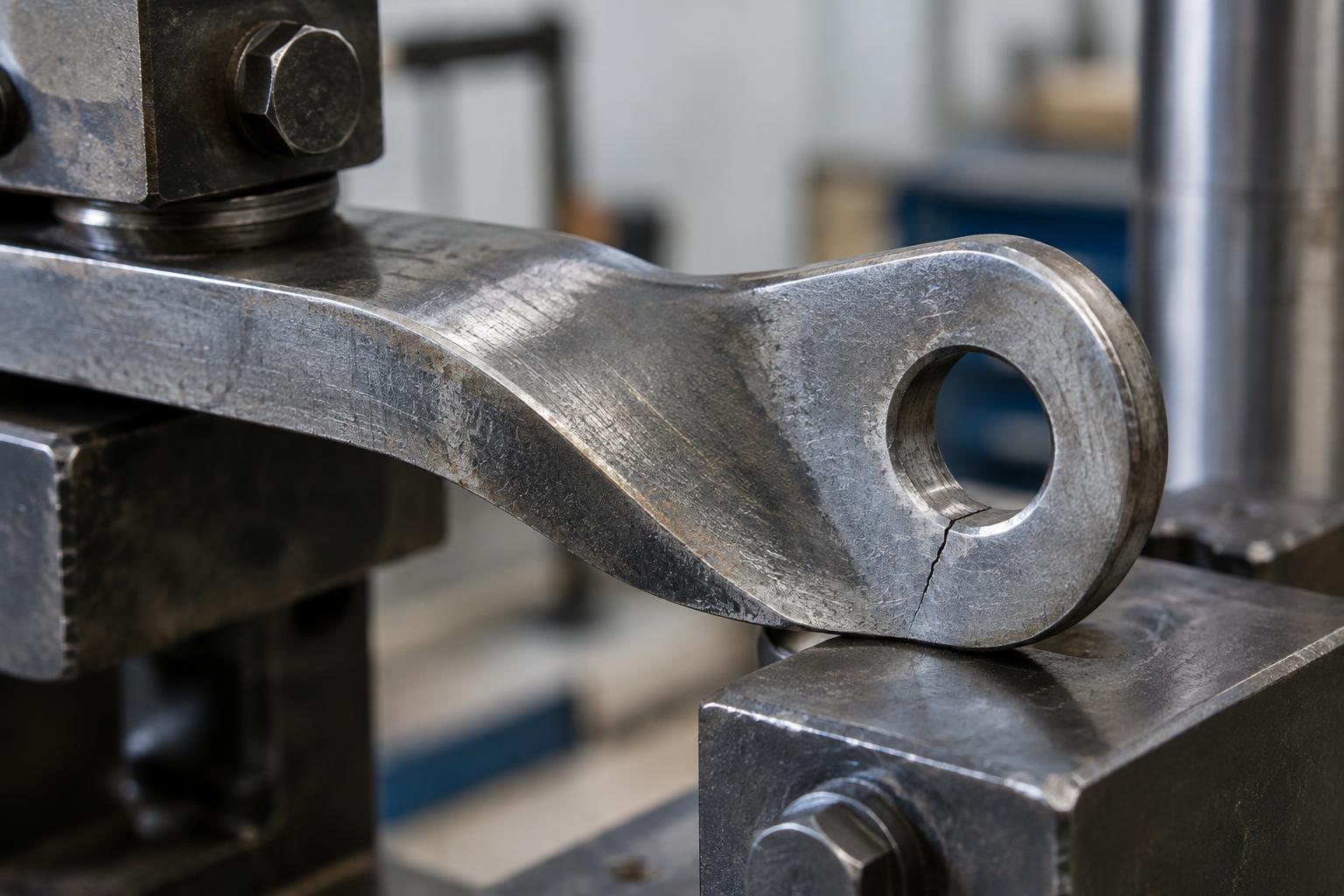
Cracks often begin where stress is concentrated. A hole, a sharp corner, a scratch, a weld detail, or a rough surface can make the local stress higher than the average stress calculated across the part. The effect is similar to starting a tear at a notch in paper: the notch gives damage a place to focus. Surface condition matters because the surface is exposed to both these geometric features and, sometimes, a corrosive environment.
From a tiny crack to a sudden break
Once a fatigue crack exists, each load cycle may open it slightly and extend its tip. At first, growth can be slow and difficult to detect. As the crack gets longer, less intact metal remains to carry the load, and stress near the crack tip increases. Eventually the remaining section cannot support the force, and a final fracture occurs. That last break may seem sudden even though much of the damage accumulated gradually.
The route from first loading to failure is not the same for every part. Crack growth depends on the material, the size and pattern of the loads, the component’s shape, and its surroundings. Moisture or corrosion can make conditions more severe for some metals and applications. A single unusually heavy load can also change the course of a developing crack. For these reasons, a fatigue failure cannot be understood from the number of cycles alone.
Why material strength is only part of the story
A material’s strength under one steadily increasing load does not, by itself, tell us how long a component will survive repeated loading. Engineers also study the relationship between cyclic stress and the number of cycles a test piece withstands. In general, reducing the stress range helps extend fatigue life, but test results must be interpreted alongside the part’s shape, manufacturing process, and working environment.
Some steels, under particular test conditions, can show a stress level below which fatigue failure is not observed within the tests’ limits. That is not a blanket promise that any steel part will last forever. Other metals, including many aluminum alloys, are commonly assessed by their expected life at a specified stress range rather than by assuming a clear endurance limit. In either case, a small notch or an unexpected load can make a real component behave differently from a smooth laboratory specimen.
Designing and caring for parts that cycle
Fatigue cannot always be eliminated, but its risks can be managed. Designers can avoid abrupt changes in shape, use smooth transitions around openings, and choose dimensions that keep cyclic stresses within suitable limits. Material selection, careful manufacturing, and appropriate surface finishes also matter. Depending on the part, a treatment that leaves the surface in compression may help resist the opening of small surface cracks.
Inspection provides another line of defense, especially when a component is expected to have a finite service life. Visible cracks, corrosion, loose connections, or unusual vibration can all warrant closer attention, although small cracks are not always visible to the naked eye. The central lesson is that a load need not be extraordinary to deserve consideration. When it returns again and again, its effects on a metal part can add up.