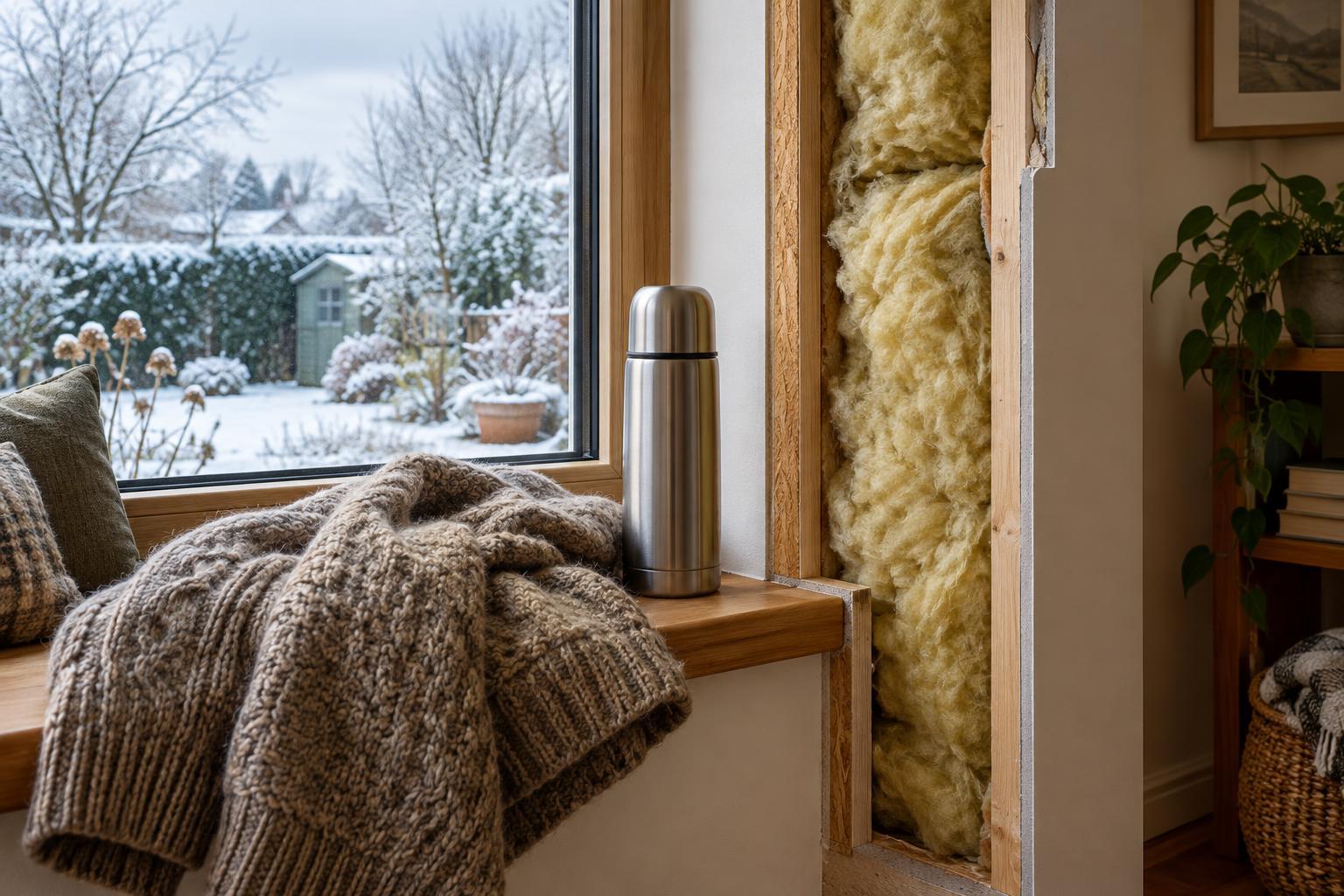
Heat moves when temperatures differ
Hold a warm mug on a cool day and the mug gradually loses heat to its surroundings. The heat has not vanished: energy has moved from a warmer place toward cooler places. Thermal insulation slows that transfer. It does not create warmth or stop heat flow completely, and the same material that helps keep a house warm in winter can help keep it cool in summer.
Heat travels in three main ways. Conduction passes energy through materials and between objects in contact. Convection carries energy as air or liquid moves. Radiation transfers energy as electromagnetic waves, so it does not need air. In everyday objects, these processes often happen together. A good insulating design works by slowing the paths that matter most in its particular setting.
Why trapped air is useful
Many insulating materials contain small pockets of air. Air conducts heat less readily than many solid materials, so replacing a continuous solid path with air pockets can slow conduction. Keeping those pockets small also limits convection: air cannot circulate freely through a tightly divided space.
A sweater shows the idea clearly. Its fibers hold a layer of air near your body, slowing heat loss to cooler air outside. The sweater does not produce the heat; your body does. A loose weave that lets wind pass through loses some of its advantage because moving air can carry warmth away. Adding a wind-resistant outer layer may help more than simply adding another airy layer.
The same principle appears in foam, fiberglass and other building insulation, though their structures and uses differ. Compressing a fluffy insulating layer can reduce its thickness and the space available to trap air. Wetting it may also reduce performance, since water can replace air in its pores and move heat more readily. The extent of these effects depends on the material.
Stopping air leaks is a separate job
Insulation inside a wall slows heat passing through the wall, but it cannot do much about warm indoor air escaping through an unsealed opening. Air leaks around doors, windows and other gaps allow convection on a larger scale: moving air carries energy with it. That is why a draft can make a room feel cold even when its walls contain insulation.
Sealing gaps and adding insulation solve related but different problems. Sealing limits unwanted airflow; insulation slows heat transfer through the surrounding surfaces. Neither goal means every building should be made airtight without thought. Indoor air still needs appropriate ventilation, and moisture needs to be managed so it does not build up where it can cause damage.
Radiation, reflections and thermal bridges
Some insulating designs also address radiation. A shiny, low-emissivity surface can reduce radiant heat transfer when it faces an air space. If that surface is pressed directly against another solid, heat can still cross the contact by conduction, so the reflective finish alone may offer little benefit. Its placement matters as much as its appearance.
A vacuum flask tackles several paths at once. A vacuum between its inner and outer walls greatly limits conduction and convection across that gap, while reflective surfaces reduce radiation. Heat can still travel through the lid and points where the walls connect. This illustrates a general rule: an insulating system is only as effective as its remaining routes for heat to move.
In buildings, a thermal bridge is a relatively easy route for heat through an assembly, such as a piece of framing that crosses an otherwise insulated wall. A thick insulating layer may perform less well overall if heat can bypass much of it through repeated bridges. Looking at the whole wall, roof or window is therefore more useful than judging one material in isolation.
Choosing insulation for the situation
An insulation rating, often expressed as an R-value, describes resistance to heat flow under specified conditions. A higher value generally means greater resistance, but it does not describe every aspect of real-world performance. Installation, thickness, air movement, moisture and thermal bridges can all affect the result. Different applications also place different demands on a material, including durability, space and exposure to water.
For a quick everyday test of the underlying idea, compare a bare cup of warm water with one wrapped in a thick, dry cloth. The cloth adds resistance to heat flow, although the open top still allows heat to escape. Add a lid, and you address another important route. Thermal insulation works in much the same way: it slows heat loss most effectively when the major routes—through solids, moving air and radiation—are considered together.


