Start with a chart made for your sky
A star chart is a map of where stars appear in the sky. A simple chart may show only the brightest stars and familiar constellations; a detailed one may include fainter stars and objects best seen with binoculars or a telescope. If you are learning your way around, start with the simpler version. Fewer markings make it easier to compare the page with what you can actually see.
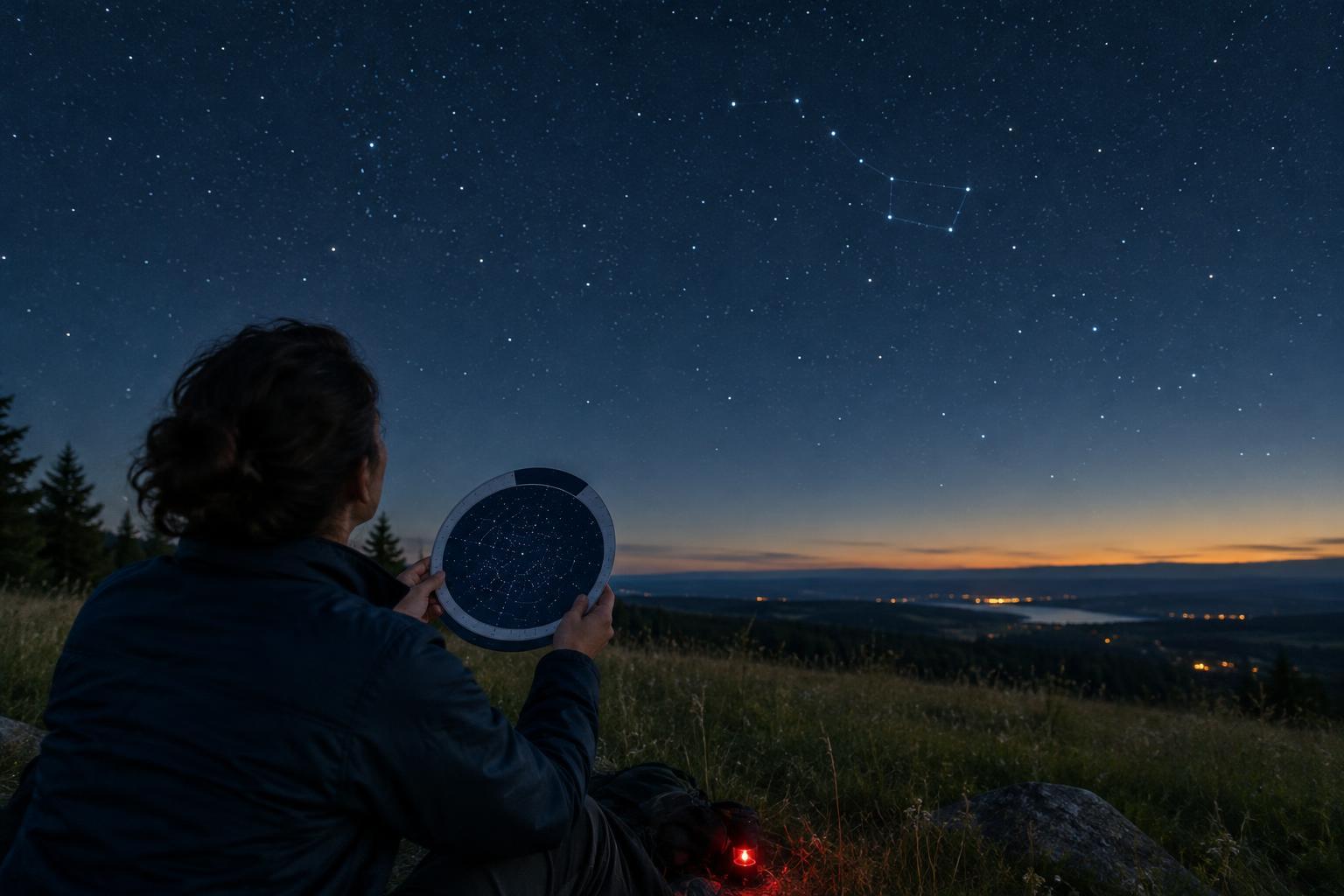
Choose a chart intended for your hemisphere and, if possible, your approximate latitude. A planisphere—a rotating star chart—lets you set a date and time to show which parts of the sky should be above the horizon. Follow its instructions for setting the time, especially if your clock uses daylight saving time. A printed chart for a particular month is less adjustable, but it can still guide you to prominent patterns on evenings around that month.
Understand what the map represents
Many whole-sky charts put the point directly overhead, called the zenith, near the center. The outer edge represents the horizon. Stars plotted near that edge appear low in the sky; stars nearer the center appear higher. Check the chart’s labels or key rather than assuming every chart uses the same layout.
The small dots are stars, and larger dots usually indicate brighter ones. Lines joining stars are guides to recognizable patterns, not physical connections in space. Stars that look close together from Earth can be separated by enormous distances. A chart may also label constellations and deep-sky objects, but you can ignore most of those labels on your first few outings.
Charts often mark north, south, east, and west around the edge. To use one outdoors, face a direction, then turn the chart so that direction is at the bottom, nearest you. Look from the chart’s center toward that edge to find what should be in front of you, from high overhead down toward the horizon. This may feel different from reading a street map, so take a moment to orient yourself before searching for individual stars.
Match the chart to a bright pattern
Begin with a pattern you can recognize without optical equipment. Depending on your location and season, that might be the Big Dipper, Orion’s three belt stars, or the Southern Cross. Compare the spacing and overall shape of its stars with the chart. Once you find a convincing match, look for one nearby bright star and check whether it also falls where the chart predicts.
Use the pattern as a stepping stone rather than trying to identify the entire sky at once. For example, you can trace a line through two stars on the chart, then look for the next bright star along that direction in the real sky. This practice, often called star hopping, works best when you move in short steps and verify each new pattern before continuing.
Apparent distances can be hard to judge. Hold your hand at arm’s length as a rough measuring tool: a fist spans about ten degrees of sky for many people, though hand sizes and arm lengths vary. You can also compare gaps between stars. If the chart shows your target about twice as far from one star as the distance between two stars you have already found, use that relationship as a guide.
Allow for time, location, and visibility
The sky appears to shift over the course of a night because Earth rotates. It also looks different from season to season because Earth moves around the Sun, changing which direction the nighttime side faces. If the stars no longer line up well with your planisphere, check its date and time settings before deciding that you have found the wrong pattern.
Your location matters too. Some stars visible from one latitude never rise above the horizon at another. Others stay above the horizon all night from certain locations. A chart designed for a different latitude may therefore show stars you cannot see, or omit ones that are familiar to you.
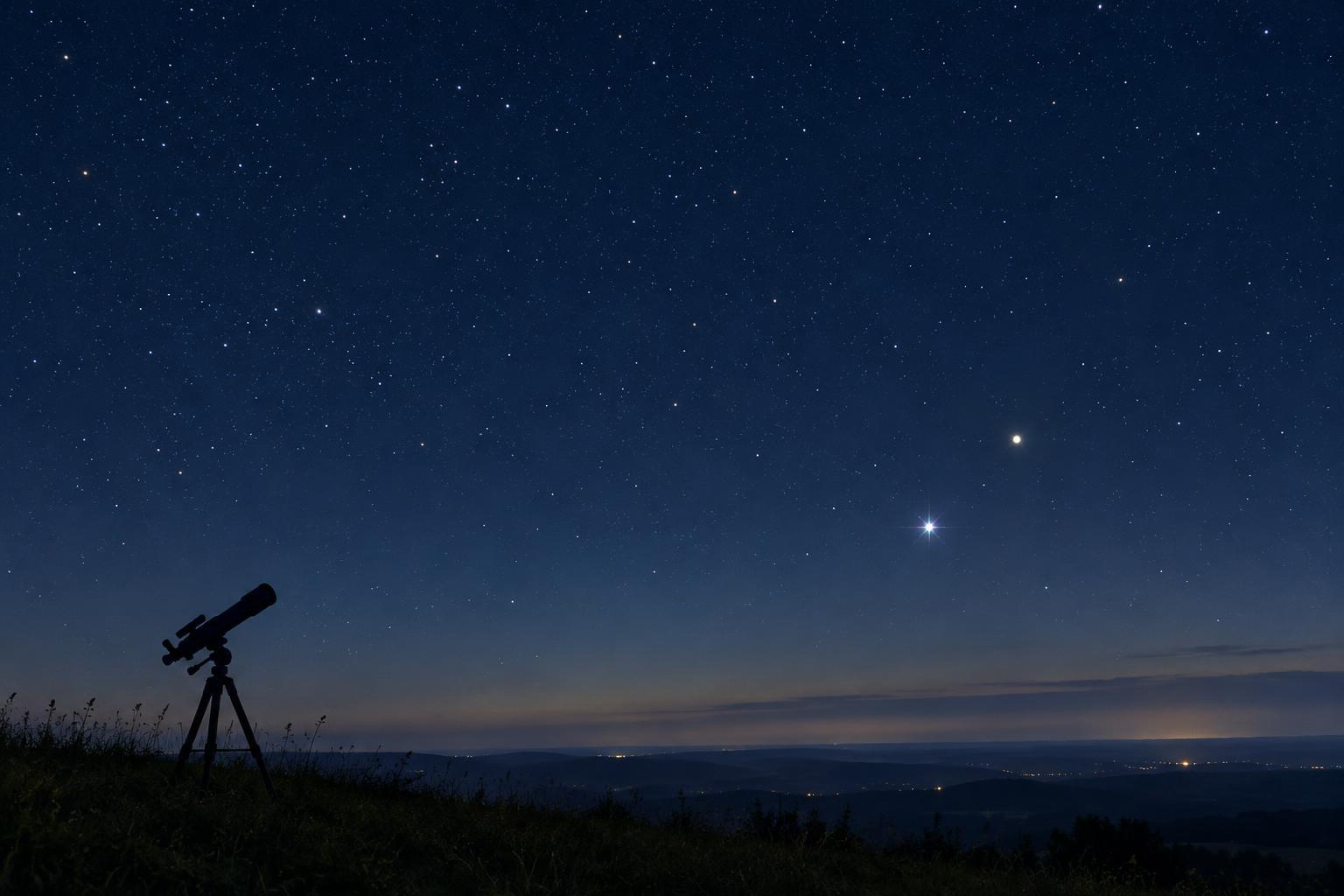
Weather, nearby lights, and a bright Moon can hide faint stars even when a chart says they are above the horizon. Let your eyes adjust to the darkness, and use only enough light to read the chart safely. If you use a phone, dimming its screen can make it easier to return your attention to the sky. Start with bright stars; save faint targets for clearer, darker conditions.
Know what a fixed-star chart cannot show
A basic star chart is primarily a guide to stars, whose patterns change very slowly from our perspective. Planets move against that background, so a printed chart may not show their positions for a given night. The Moon moves noticeably from night to night as well. A bright point that does not match your chart is not necessarily a mapping error; it may be a planet.
You do not need to name everything to make progress. Pick one familiar pattern, locate a neighboring one, and notice where both sit relative to the horizon. Repeating that small exercise on later evenings will help you recognize how the sky changes—and make the chart feel less like a puzzle and more like a map.