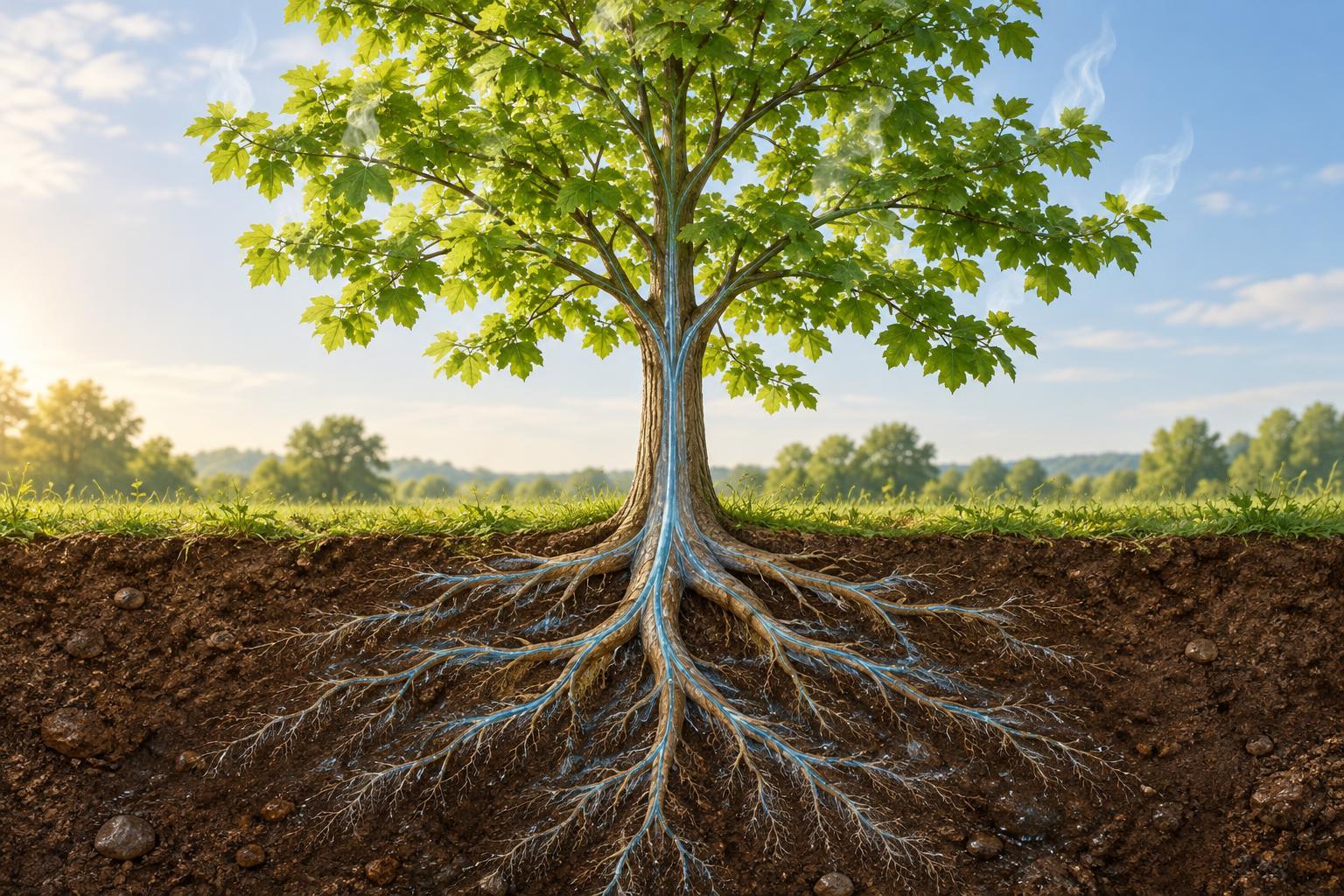
The journey begins in the soil
After rain or watering, some water remains in the small spaces between soil particles. Roots take up part of that water, especially through their fine, growing tips and root hairs. These tiny extensions increase the area of root in contact with the soil. Water does not enter simply because a root is nearby: its movement depends on conditions inside and outside the root, including the concentration of dissolved substances.
A useful way to picture the process is as movement along a water-potential gradient. Water tends to move from places where it is more available toward places where it is less available. Dissolved substances inside root cells help create that gradient, allowing water to cross cell membranes. As soil dries, however, water becomes harder to draw away from soil particles. A plant may then struggle to replace the water its leaves lose.
Roots guide water into a transport network
Water entering a root can pass through cell walls and spaces between cells, or cross the membranes of living cells. Farther in, it reaches a layer called the endodermis. A waterproof band in the walls of these cells blocks a continuous route through the walls, so water must cross a cell membrane before it can reach the root’s central transport tissue. This gives the root some control over what enters that tissue, although it is not a perfect filter.
The main upward route is xylem: a network of narrow tubes made largely from cells that are no longer living when mature. Their walls help resist collapse, and openings between adjoining cells allow water to travel through roots, stems and leaf veins. Xylem also carries dissolved minerals taken up from the soil. Unlike blood moving through an animal’s circulatory system, this flow has no central pump.
Leaves provide the pull
Inside a leaf, water moves from the xylem toward moist cell walls. Some of it evaporates into air spaces within the leaf and then leaves through small openings called stomata. This loss of water vapor is transpiration. Evaporation lowers the availability of water in the leaf, helping draw replacement water from the xylem. In turn, water farther down the stem and in the roots is pulled upward.
The pull works because water molecules attract one another, a property called cohesion. They also interact with the walls of the narrow xylem tubes. Together, these effects help maintain connected columns of water under tension. The familiar sight of a drink climbing a thin straw may suggest upward movement, but a plant is not sucking through a straw with a mouth: evaporation at many leaves helps generate the tension. In many plants, this leaf-driven pull is the main force carrying water upward.
A necessary loss with a cost
Why let water escape at all? Stomata open to admit carbon dioxide, which leaves need for photosynthesis. When they open, water vapor can escape through the same pores. Plants can adjust the openings with pairs of guard cells, responding to conditions such as light and water availability. They cannot usually take in carbon dioxide without some risk of losing water.
Transpiration can also help cool leaves as water evaporates. But rapid loss is dangerous if roots cannot keep up. In dry conditions, many plants partly close their stomata, conserving water while also limiting carbon dioxide intake. If tension in the xylem becomes too great, the water column may break and an air blockage can interrupt flow in a tube. Plants vary in how they avoid or cope with such blockages.
One pathway, changing conditions
Water transport is not equally fast all day. It generally increases when evaporation from leaves is strong and slows when stomata close or the surrounding air is humid. Root pressure, produced when roots accumulate dissolved substances and water enters, can sometimes push water upward, especially when transpiration is low. It does not, by itself, explain the usual movement of water to the tops of tall trees.
The next time a leafy plant wilts on a hot day, think of the whole pathway rather than just the leaves. Water must be available in the soil, enter the roots, remain connected through the xylem and reach leaf cells quickly enough to replace what evaporates. Wilting can mean that demand has temporarily outpaced supply; persistent water shortage can cause lasting damage. From underground root hairs to pores on a leaf’s surface, the journey depends on every link.