Balance is a team effort
Standing on one foot seems like a simple test of balance, but it requires constant adjustments. Your brain needs to know how your head is moving, where your body is positioned and what the surrounding world appears to be doing. It gets this information from the inner ear, the eyes, and sensors in muscles and joints. None of these systems works alone: the brain compares their signals and uses them to guide posture and eye movements.
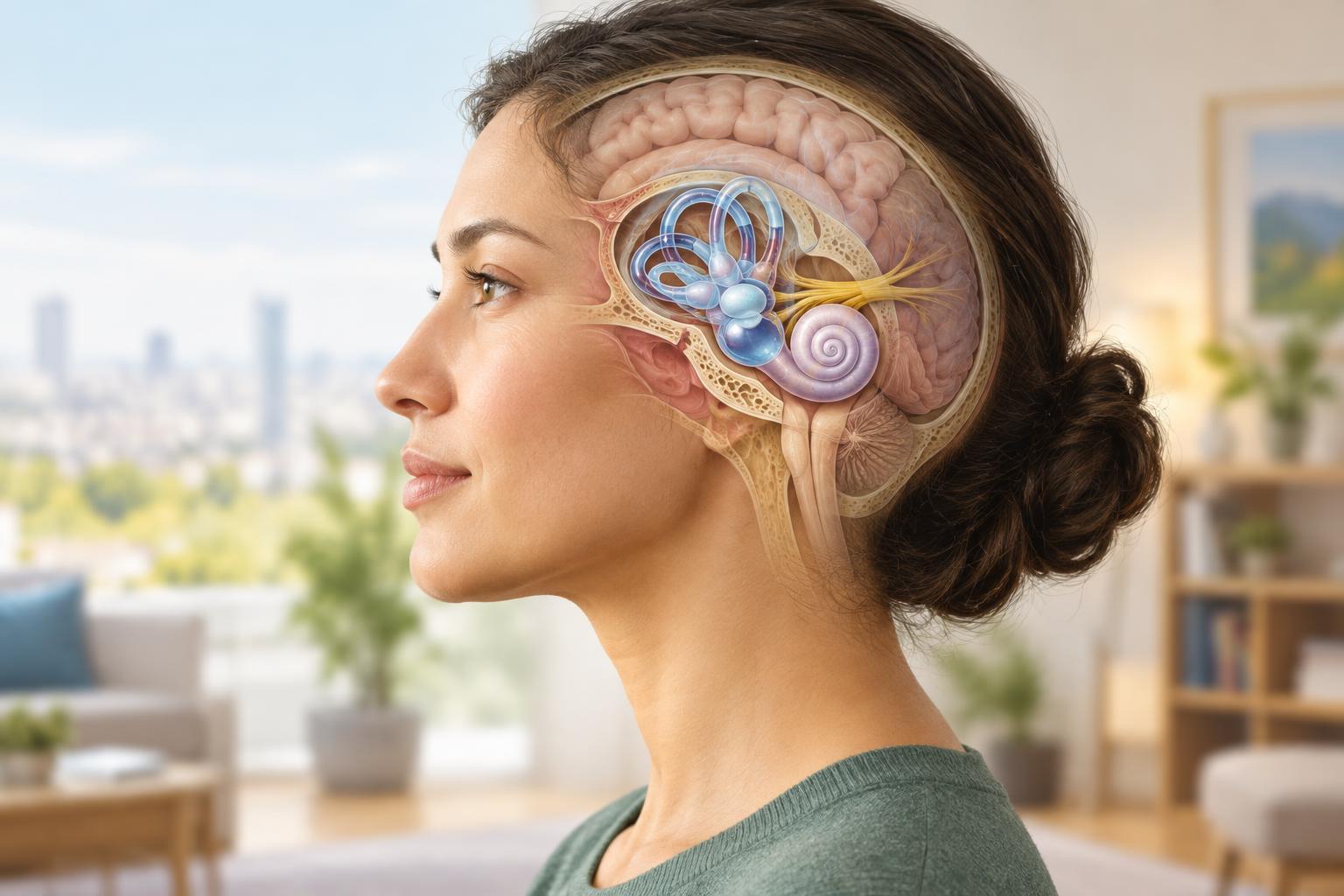
The balance-sensing part of the inner ear is called the vestibular system. It sits beside the structures used for hearing, but it has a different job. Rather than detecting sound, it responds to changes in head movement and orientation. Its signals do not tell the brain everything about your position in the world. They provide one set of clues that becomes especially useful when you turn quickly, walk in the dark or look away from your feet.
Three canals detect head turns
Each inner ear contains three semicircular canals arranged in different directions. Together, they can detect rotations of the head in several planes: turning left or right, nodding, and tilting an ear toward a shoulder. The canals contain fluid and specialized hair cells. These cells have tiny projections that bend when the fluid moves relative to the canal.
Imagine turning your head to look over your shoulder. The bony canal moves with your head, but its fluid initially lags behind because of inertia. That relative motion bends the hair cells’ projections, changing the signals sent along vestibular nerves. As the fluid catches up, the signal changes again. This makes the canals particularly suited to detecting changes in rotation, rather than serving as a simple gauge of which direction you are facing.
Tiny crystals help sense tilts and straight-line motion
The inner ear also contains two organs called the utricle and saccule. Like the canals, they use hair cells, but these cells are covered by a layer containing tiny mineral particles. The particles add weight. When your head tilts or moves in a straight line, the weighted layer shifts relative to the hair cells and bends their projections.
These organs help detect movements such as the initial acceleration of an elevator or the tilt of your head as you lean sideways. There is a complication: gravity and straight-line acceleration can produce similar effects on these sensors. A signal from the inner ear alone may therefore be ambiguous. Your brain uses other information, including what you see, to help interpret whether you have tilted or moved.
Why your eyes matter for balance
Vestibular signals help keep your view steady while your head moves. When you turn your head one way, a rapid reflex moves your eyes in the opposite direction. This vestibulo-ocular reflex helps an object remain in roughly the same place on your retinas. Without that coordination, reading a sign while walking would be much harder: each step would shift the image across your field of view.
Vision also gives the brain clues about motion and orientation. If the scene around you moves while you remain still, your eyes and inner ears may provide different impressions. Experiences such as feeling briefly in motion when a nearby vehicle starts moving illustrate how strongly visual information can influence your sense of movement. The brain generally resolves such differences by weighing the available signals, though the result is not always a perfect description of what happened.
A system that adjusts to changing conditions
Sensors in muscles, tendons and joints add another piece of the balance puzzle. They help your brain estimate where your limbs are and how your weight is distributed. On firm ground in good light, these body-position signals and visual cues are usually easy to use. On an uneven surface or with your eyes closed, some cues become less reliable, so maintaining balance may require more noticeable adjustments.
This cooperation explains why balance is not located in a single organ. The inner ear detects important features of head movement, but the brain must interpret those signals alongside sight and body position, then coordinate a response. The next time you turn your head while walking, notice that your surroundings remain fairly steady and your steps continue almost automatically. Behind that ordinary experience is a continuous exchange of information among several sensory systems.