The first challenge: keeping microbes out
We encounter microbes through the air, food, surfaces and contact with other living things. Most encounters do not lead to illness. Skin forms a physical barrier, while mucus helps trap particles in the airways. Tears, saliva and stomach acid also make some parts of the body less welcoming to microbes. These protections are part of innate immunity: defenses that are already in place or can respond quickly.
When a microbe crosses a barrier, the immune system must distinguish possible danger from the body’s own healthy tissue. It does not do this with a single alarm. Cells and molecules in different tissues respond to clues about damage and to features shared by groups of microbes. The result is a coordinated response whose form depends on where the infection is and what kind of threat is present.
Innate immunity responds quickly
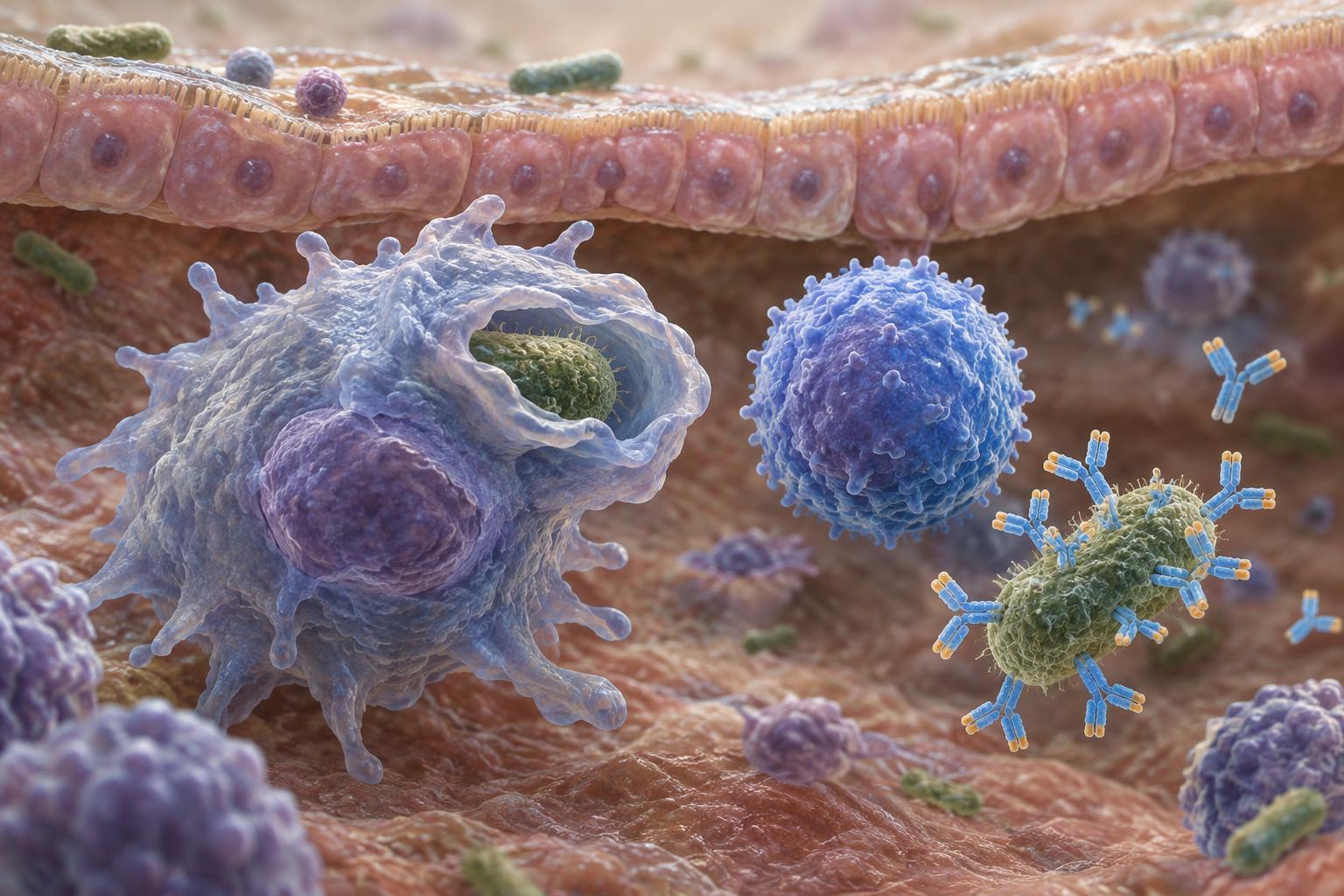
Innate immune cells can recognize broad patterns that are common among microbes. Macrophages, for example, can engulf material and help clear away microbes and damaged cells. Neutrophils are often recruited from the blood to sites of infection. Other defenses, including proteins known as the complement system, can help mark microbes for removal or contribute to their destruction. These responses do not require the body to have encountered that exact microbe before.
Inflammation is one visible result of this activity. Blood vessels near an affected area can become more permeable, allowing immune cells and proteins to enter tissue. That can produce warmth, swelling and tenderness. Inflammation helps concentrate defenses where they are needed, but it can also cause discomfort and, if excessive or prolonged, damage healthy tissue. Fever is another possible part of an immune response, though not every infection causes one.
Adaptive immunity targets particular threats
Adaptive immunity relies largely on two kinds of white blood cell: B cells and T cells. Each B or T cell carries receptors that recognize a particular molecular shape. When a suitable threat is detected and other activating signals are present, matching cells can multiply. Building this focused response generally takes more time than the initial innate response, especially during a first encounter.
Activated B cells can produce antibodies, proteins that bind to specific targets called antigens. Antibodies may block a microbe from entering cells or make it easier for other defenses to clear it. T cells have different jobs. Some help organize immune activity, while others can identify and kill the body’s cells that have become infected. These roles complement one another: a threat inside a cell presents a different challenge from one outside it.
The two systems work as a team
The labels “innate” and “adaptive” describe useful differences, not two independent armies. Innate defenses limit a threat early and send signals that help start an adaptive response. Certain immune cells collect material from microbes and present fragments of it to T cells. These cells also provide signals that influence how the later response develops.
Once adaptive immunity is active, it can strengthen the work of innate defenses. Antibodies, for instance, can coat microbes so that other immune cells recognize and engulf them more easily. Communication runs in both directions throughout an infection. Whether a person develops noticeable symptoms depends on many factors, including the microbe, the affected tissue and the immune response itself.
What immune memory changes
After an infection has been controlled, many of the cells that expanded during the response disappear. Some remain as memory B and T cells. On a later encounter with the same or a closely related target, these cells may help produce a faster, stronger response. Immune memory is also the principle behind vaccination: exposing the immune system to a carefully designed form of an antigen can help prepare it for a future encounter without requiring the disease itself.
Memory is not an all-or-nothing shield. Protection can vary with the microbe, changes in its antigens, the type of exposure and the person’s immune system. A previous response may reduce the chance or severity of illness without preventing every infection. The broader picture is a layered defense: barriers reduce exposure, innate immunity acts quickly, and adaptive immunity adds specificity and the potential for lasting memory.


