Two measurements, two questions
In everyday conversation, “mass” and “weight” often mean the same thing. Physics uses them to answer different questions. Mass describes how much an object resists a change in its motion. A loaded shopping cart, for example, is harder to start, stop or turn than an empty one. That resistance is called inertia. Mass is measured in kilograms.
Weight is the force of gravity acting on an object. It depends on both the object’s mass and the strength of the local gravitational field. In physics, force is measured in newtons, so weight is measured in newtons too. Near Earth’s surface, gravity gives each kilogram of mass a weight of about 9.8 newtons. A person with a mass of 60 kilograms therefore has a weight of about 590 newtons there.
Why your weight can change without changing you
Take that same 60-kilogram person to the Moon, and their mass remains 60 kilograms. They still have the same resistance to being pushed or stopped. But the Moon’s gravity is much weaker than Earth’s, so their weight would be roughly one-sixth as great: about 100 newtons. They could jump more easily, yet a heavy object would still resist being set in motion.
You do not need to travel to the Moon to find a change in weight. The strength of gravity varies slightly from place to place on Earth, including with altitude and latitude. These differences are usually too small to matter in daily life, but they illustrate the principle: mass belongs to the object, while weight depends on the object and its surroundings.
What does a bathroom scale actually measure?
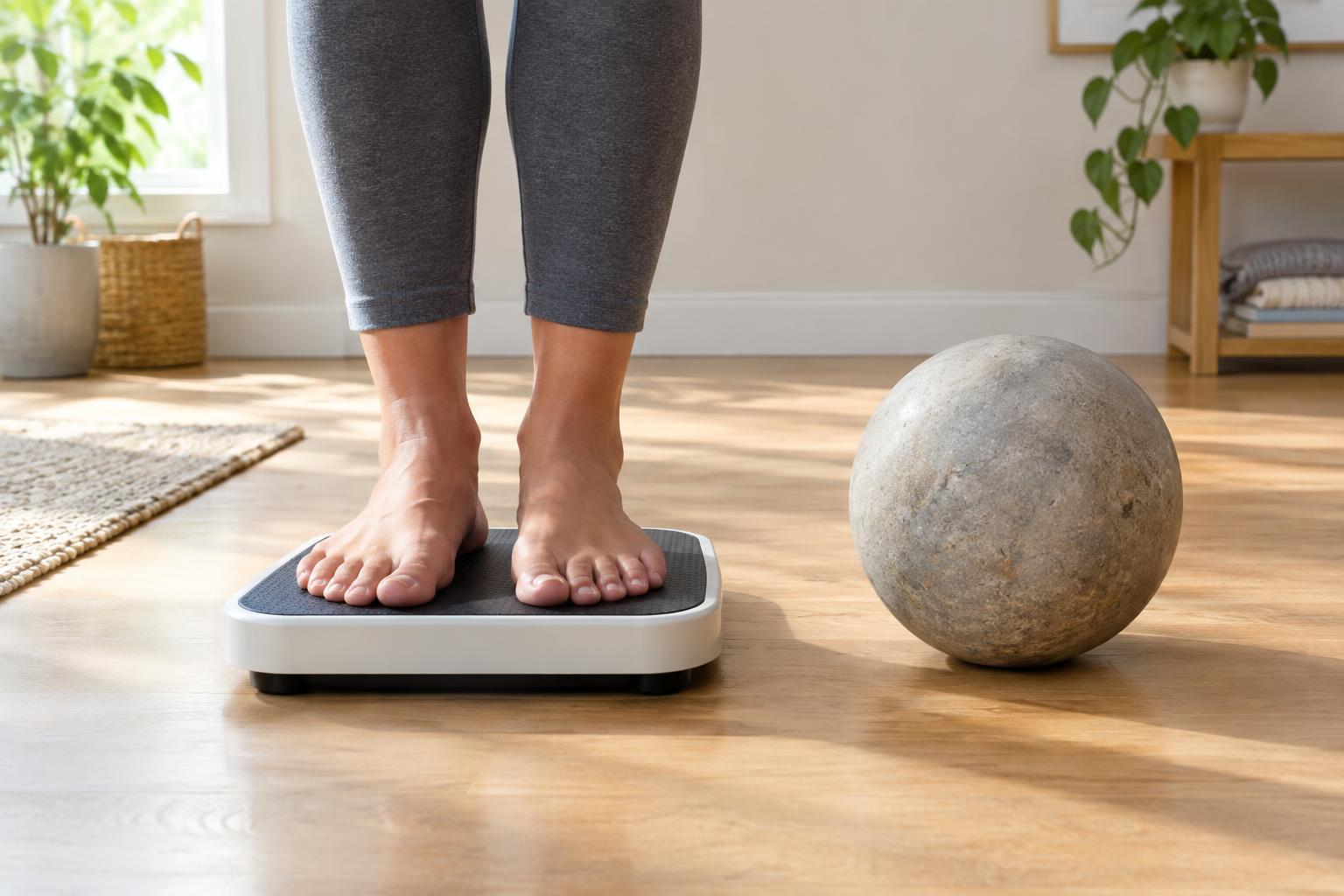
Most bathroom scales display kilograms, which makes them look like direct mass-measuring devices. In practice, a typical scale senses the force pressing down on it and converts that reading to kilograms using an assumed value for Earth’s gravity. Under ordinary conditions, that is a convenient way to report your mass. Move the same scale to the Moon without recalibrating it, though, and its kilogram display would be misleading.
A balance works differently. A traditional two-pan balance compares an object with known masses. If both sides are in the same gravitational field, gravity pulls on both in the same proportion, allowing their masses to be compared. This is one reason it helps to know what an instrument is actually measuring, rather than relying only on the unit shown on its display.
Feeling heavy, light or weightless
The force you feel through your feet is not always the same as your gravitational weight. In an elevator accelerating upward, the floor must push harder on you, so you feel heavier and a scale briefly reads higher. When the elevator accelerates downward, the floor pushes less and you feel lighter. Your mass has not changed, and Earth’s gravitational pull has changed very little; the scale reading reflects the changing support force.
This distinction also helps explain astronauts’ apparent weightlessness in orbit. Earth’s gravity still pulls strongly enough to keep a spacecraft moving around the planet. The spacecraft and everything inside it are continually falling together, so the floor does not provide the familiar upward support force. Astronauts float relative to their surroundings, even though gravity has not disappeared.
When the distinction is useful
Separating mass from weight makes many descriptions clearer. If you are packing a bag, its mass helps describe how difficult it will be to accelerate or carry around a corner. Its weight describes the gravitational force a shelf or hook must support. On Earth, the two usually rise and fall together, which is why ordinary speech can blur them without much trouble.
The difference becomes essential when gravity or motion is part of the question. A person can have the same mass on Earth, on the Moon and in an orbiting spacecraft while having a different weight or feeling a different support force in each setting. Asking “How much matter resists motion?” and “How strongly is gravity pulling?” is a simple way to keep the ideas straight.


