What makes an alloy different?
A pure metal consists primarily of one metallic element, such as copper, iron, or aluminum. An alloy combines a metal with one or more other elements. Those additions may be metals, as in copper-and-zinc brass, or nonmetals, as in iron-and-carbon steel. The goal is usually not to create a material halfway between its ingredients. It is to change how the material behaves.
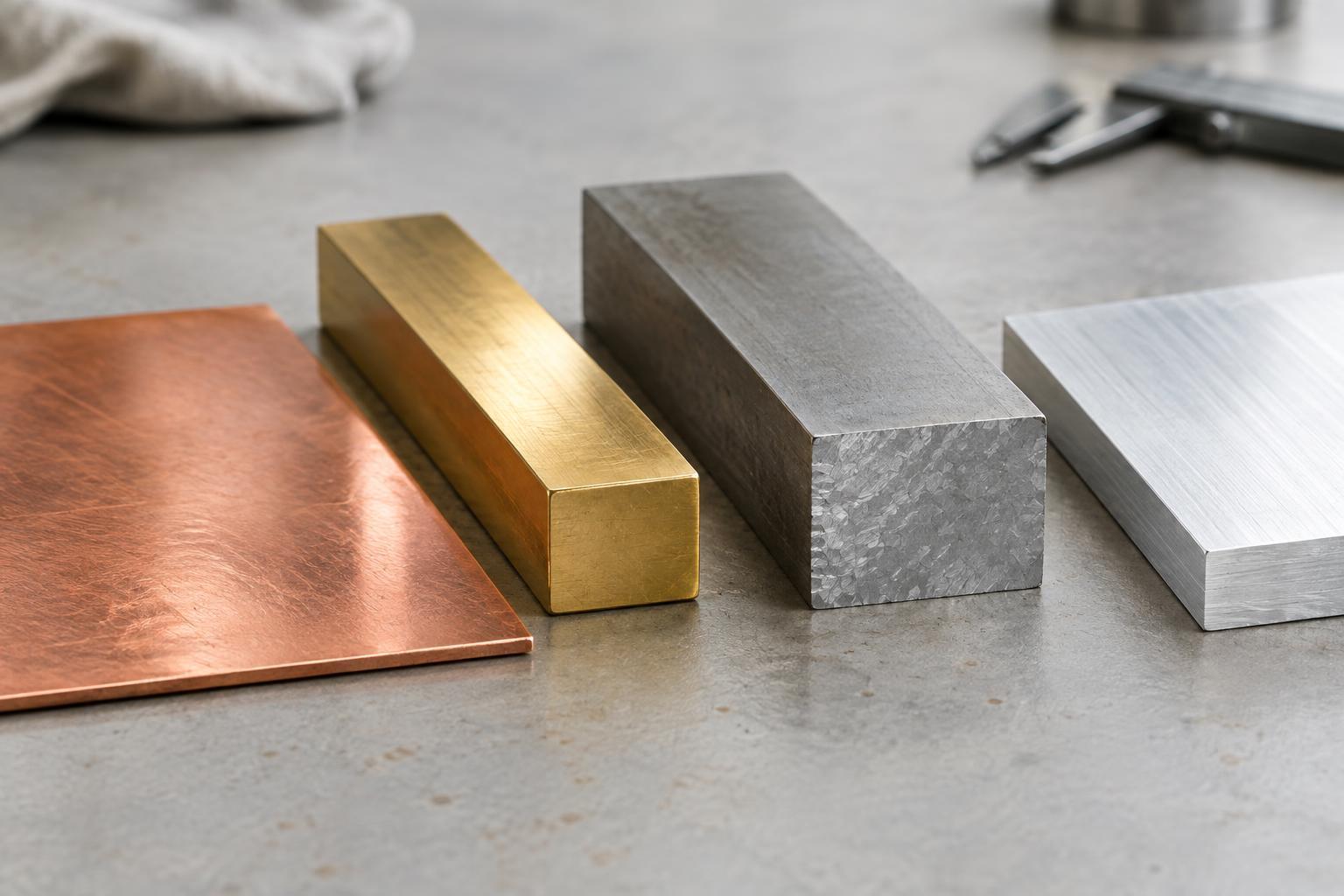
Consider copper. It conducts electricity well and can be shaped into wire. Brass, made mainly from copper and zinc, has different strength, color, and working properties that make it useful for items such as fittings and musical instruments. Neither material is better in every situation. A wire and a valve fitting have different jobs, so the properties worth preserving are different.
The small-scale reason properties change
In many solid metals, atoms occupy an orderly crystal structure. When a metal is bent or stretched, its atoms do not all move at once. Instead, defects called dislocations can move through the structure, allowing the metal to change shape without immediately breaking. If dislocations move easily, the metal is generally easier to form. If their movement is obstructed, greater force may be needed to deform it.
Alloying atoms can create some of those obstacles. An added atom may take the place of a host metal atom, or a small atom may fit into a gap between host atoms. Because the atoms differ in size or interact differently with their neighbors, they disturb the surrounding structure. This can make dislocation movement harder and increase strength. Carbon in steel is one familiar example of a small addition that can have a large effect, although steel’s final behavior also depends strongly on how it is processed.
Composition is only part of the recipe
Two pieces of an alloy can have similar ingredients yet perform differently. Metals are made of many tiny crystalline regions called grains, and their size and arrangement matter. Heating, cooling, rolling, and other manufacturing steps can change those grains or produce distinct structures within the metal. Some alloys can be heat-treated so that very small particles form inside them and hinder dislocation movement. In other cases, rapid cooling preserves a structure that would not form under slower cooling.
That is why a material label alone cannot tell the whole story. A steel part designed to resist wear may be processed differently from a steel part that needs to bend without cracking. Increasing hardness or strength can reduce ductility or toughness if the composition and processing are not balanced for the job. Engineers therefore specify not just an alloy family, but often a particular composition and treatment.
Strength is not the only reason to mix elements
Alloying can also change how a metal responds to its surroundings. Stainless steels contain enough chromium to form a thin, protective surface layer under suitable conditions. That layer helps slow further corrosion, but “stainless” does not mean immune: harsh environments or damage to the surface can still cause problems. Some aluminum alloys likewise need careful selection or surface treatment when corrosion is a concern.
Other priorities include weight, electrical conductivity, ease of casting, and the ability to join or machine a part. Additions that improve one property can make another less attractive. For example, pure copper is often preferred where high electrical conductivity matters, while a copper alloy may be chosen where greater strength or easier machining matters more. The useful question is not “Which metal is strongest?” but “Which combination of properties does this object need?”
How to think about an everyday material choice
Picture a bicycle frame, a kitchen sink, and an electrical cable. Each faces a different set of demands. A frame must carry repeated loads without unnecessary weight. A sink must tolerate water, cleaning, and everyday knocks. A cable must carry current while remaining practical to bend and install. An alloy suited to one of these tasks is not automatically suited to the others.
When comparing metals and alloys, start with the conditions of use: load, temperature, moisture, expected lifetime, and how the object will be made. Then consider the tradeoffs among strength, toughness, corrosion resistance, conductivity, cost, and repair or recycling needs. Mixing elements expands the choices available, but it does not eliminate compromises. The performance of a finished object comes from its ingredients, its internal structure, and the way it is put to work.