Why cells need two kinds of division
A cell cannot simply split its contents in half and hope each new cell receives the right instructions. Before division, it copies its DNA and organizes that DNA into chromosomes that can be separated. Mitosis and meiosis both solve this sorting problem, but they serve different purposes.
Mitosis produces cells used in growth and tissue repair. When skin replaces worn-out cells, for example, the new cells generally need the same set of genetic instructions as the cells they came from. Meiosis has a different job: it produces cells that can take part in sexual reproduction. In animals, those cells become eggs or sperm. The distinction is not just where the divisions happen. Mitosis preserves the usual chromosome count, while meiosis reduces it by half.
First, understand chromosome pairs
Most human body cells have 46 chromosomes arranged in 23 pairs. One chromosome in each pair came from each parent. The two members of a pair are called homologous chromosomes: they carry many of the same genes, although they may carry different versions of those genes. An egg or sperm has just one chromosome from each pair, for a total of 23. When egg and sperm join, the resulting cell has pairs again.
Before either mitosis or meiosis begins, a cell copies its DNA. Each copied chromosome then consists of two sister chromatids joined together. Sister chromatids are copies of the same chromosome; homologous chromosomes are the two corresponding chromosomes in a pair. Keeping those relationships straight makes the two processes easier to follow: mitosis separates sister chromatids, while meiosis first separates homologous chromosomes and later separates sister chromatids.
Mitosis: one division that maintains the count
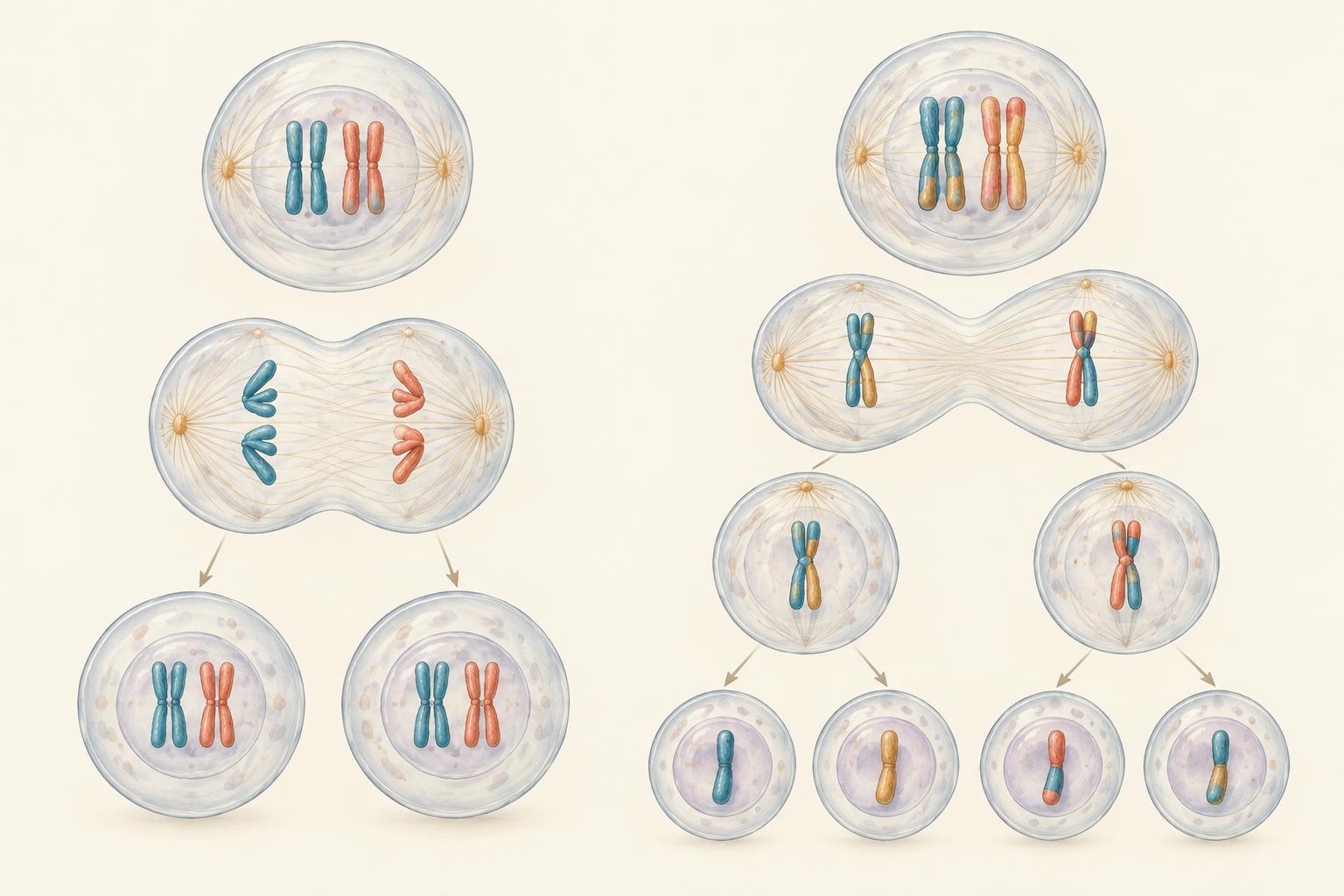
In mitosis, copied chromosomes line up and their sister chromatids are pulled toward opposite sides of the cell. The cell then divides, producing two daughter cells. Each receives a full set of chromosomes. If the starting cell is a typical human body cell with 46 chromosomes, each daughter cell normally has 46.
The daughter cells are generally genetically very similar to the original cell and to each other. They are not guaranteed to be perfect copies: DNA-copying errors or changes during division can occur. Still, preserving a complete set of instructions is the central aim. That is why mitosis is suited to making more cells for a growing body or replacing cells lost through ordinary wear.
Meiosis: two divisions that halve the count
Meiosis begins with one round of DNA copying, followed by two rounds of division. In the first division, homologous chromosomes pair up and are separated into different cells. This is the key step that reduces the chromosome count from two members of each pair to one. In the second division, sister chromatids separate. There is no second round of DNA copying between these divisions.
Starting from one cell with paired chromosomes, meiosis can produce four cells, each with half the starting chromosome count. In animals, the cells that ultimately become eggs or sperm follow this process, though their development does not always yield four functional gametes. Other organisms use meiosis in different parts of their life cycles, so it is more accurate to describe its core role as producing cells with a reduced chromosome set than to say it always directly makes eggs and sperm.
Where genetic variety comes from
Meiosis does more than reduce chromosome number. While homologous chromosomes are paired, they can exchange corresponding pieces of DNA in a process called crossing over. Also, the chromosome pairs line up independently of one another before they separate. As a result, cells produced by meiosis can receive different combinations of inherited genetic material.
A useful memory aid is to ask what must happen next. For growth and repair, a new cell needs the same number of chromosomes as its parent cell: that points to mitosis. For sexual reproduction, two cells may eventually combine their chromosome sets: meiosis first halves the number so that joining them restores the paired set. Both processes carefully distribute DNA, but they arrive at different outcomes because the cells have different jobs.