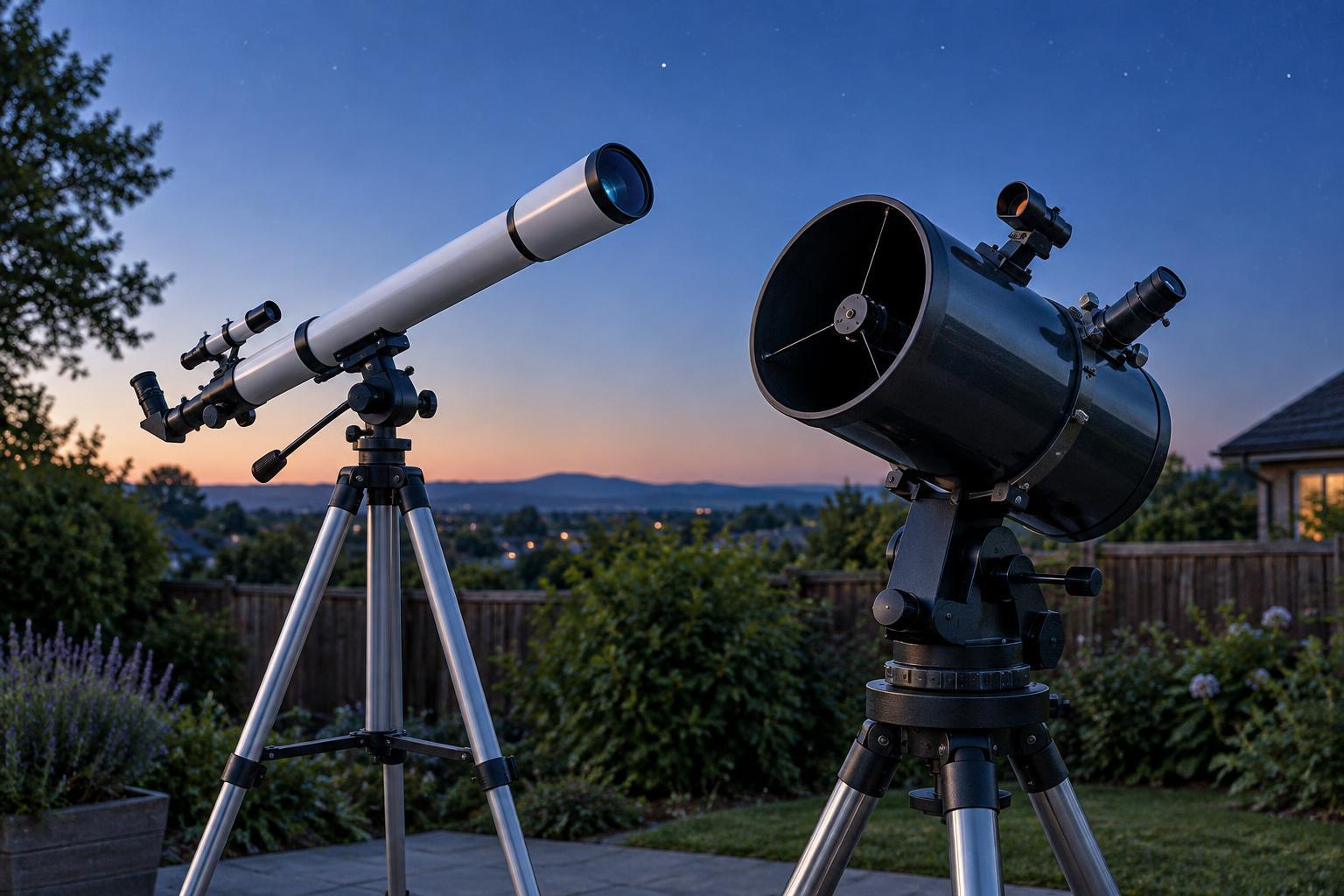
Two ways to bring distant light into focus
A telescope gathers light from a distant object and brings it to a focus, where an eyepiece lets you inspect the image. A refracting telescope does this with a large lens, called the objective, at the front of its tube. The lens bends incoming light toward a focal point at the back. A reflecting telescope instead uses a curved primary mirror to direct light toward a focus. Many beginner reflectors also have a smaller secondary mirror that sends the light to an eyepiece on the side of the tube.
Both designs can show the Moon’s craters, Jupiter’s larger moons and other sights, provided conditions are favorable. Neither makes a distant object look like a spacecraft photograph. What you see depends on the telescope’s size and quality, the steadiness and darkness of the sky, and your experience at the eyepiece.
What lenses and mirrors do differently
A simple lens bends different colors of light by slightly different amounts. If those colors do not come to the same focus, bright objects may show colored fringes, an effect called chromatic aberration. Many refractors use multiple lens elements to reduce it. More elaborate designs can control it further, though they often cost more. The effect is easiest to notice around high-contrast targets such as the Moon or bright planets.
A mirror does not split colors in the same way when it reflects them, so a reflector’s primary mirror does not produce that kind of color fringing. Reflectors have other compromises. The secondary mirror blocks a small part of the incoming light, and its supports may produce spikes around bright stars. Optical alignment also matters: if the mirrors are out of line, fine detail can look soft.
A well-made telescope of either type can give pleasing views. Its optical design explains some differences in the image, but it does not by itself tell you whether a particular telescope is better than another.
Aperture matters more than advertised magnification
Aperture is the diameter of the main lens or mirror. A larger aperture collects more light, making faint objects easier to see, and can reveal finer detail when viewing conditions allow. This is why a modestly priced reflector with a relatively large mirror can be appealing for observing faint star clusters and nebulae. Refractors with similarly large objectives tend to be more costly and can require a substantial mount.
Magnification is not a fixed power of the telescope: changing eyepieces changes it. Pushing magnification higher also spreads an object’s light over a larger apparent area and makes atmospheric blur more obvious. A steady, sharp view at moderate magnification is usually more useful than a large but fuzzy image. When comparing products, look first at aperture, a stable mount and credible optical construction rather than a prominent magnification number.
Everyday setup and upkeep
A typical beginner refractor has a fairly enclosed tube and usually needs little routine optical adjustment. That can make it convenient for short sessions: carry it outside, let its temperature settle if necessary, and begin observing. Its eyepiece is normally near the back, although its height can change noticeably as you point toward different parts of the sky.
A common beginner reflector, the Newtonian, offers generous aperture for its cost but may need occasional collimation—the adjustment that keeps its mirrors aligned. This is a learnable task, not necessarily a reason to avoid the design. Its open tube can also admit dust, so sensible storage matters. Some reflectors need time outdoors to approach the surrounding air temperature before they give their sharpest views.
The mount deserves as much attention as the tube. A telescope that shakes each time you touch the focuser can be frustrating regardless of its optics. Consider the weight and size of the complete setup, where you will store it, and whether you can comfortably move and operate it.
Choosing for the way you will observe
If you want a compact, straightforward instrument for casual views of the Moon, planets and brighter sky objects, a small refractor on a sturdy mount may suit you. If your priority is gathering more light while keeping costs manageable, a Newtonian reflector is worth considering. A simple tabletop or floor-standing reflector can work well, but check that you have a stable place to use it and enough space to transport it.
Before choosing, think about your observing site. A larger telescope cannot remove the glow of a bright sky, and a heavy one left indoors will show you nothing. The most useful first telescope is one you can set up comfortably and use often. Whichever design you choose, never point it at the Sun unless it has a purpose-made, securely fitted solar filter over the front of the telescope; looking through an unfiltered telescope at the Sun can cause permanent eye injury.


