One boundary, two possible paths
Look at a window after dark. You may see both your reflection and the room beyond it. Light reaching the glass can take two paths: some returns toward the room, while some enters the glass and continues through it. These paths illustrate reflection and refraction, two ways light can change direction at a boundary between materials.
Reflection is light returning into the material it came from. Refraction is a change in the direction of light as it passes into a material where it travels at a different speed. They can occur together, so the distinction is not always a choice between one effect and the other. It depends on which path the light takes.
Reflection: light turns back
For a smooth surface, such as a clean mirror, the direction of reflected light follows a simple rule. Imagine a line drawn perpendicular to the surface at the point where a ray arrives. This line is called the normal. The angle between the incoming ray and the normal equals the angle between the reflected ray and the normal. Both angles are measured on the same side of the boundary, in the material the light came from.
Why, then, can you see your face in a mirror but not usually in a painted wall? A mirror’s smooth surface directs light from each part of your face in an orderly way, preserving a recognizable image. A wall has tiny irregularities that send reflected light in many directions. This diffuse reflection lets you see the wall from different viewpoints, but it does not usually produce a clear image. The distinction is about how light is redirected, not whether the surface reflects at all.
Refraction: light crosses and bends
Light travels through different transparent materials at different speeds. When a ray enters one of these materials at an angle, the change in speed changes its direction. Moving from air into water or ordinary glass, it generally bends toward the normal. Moving back into air, it generally bends away from the normal. If it arrives straight along the normal, its speed can still change, but its direction does not bend.
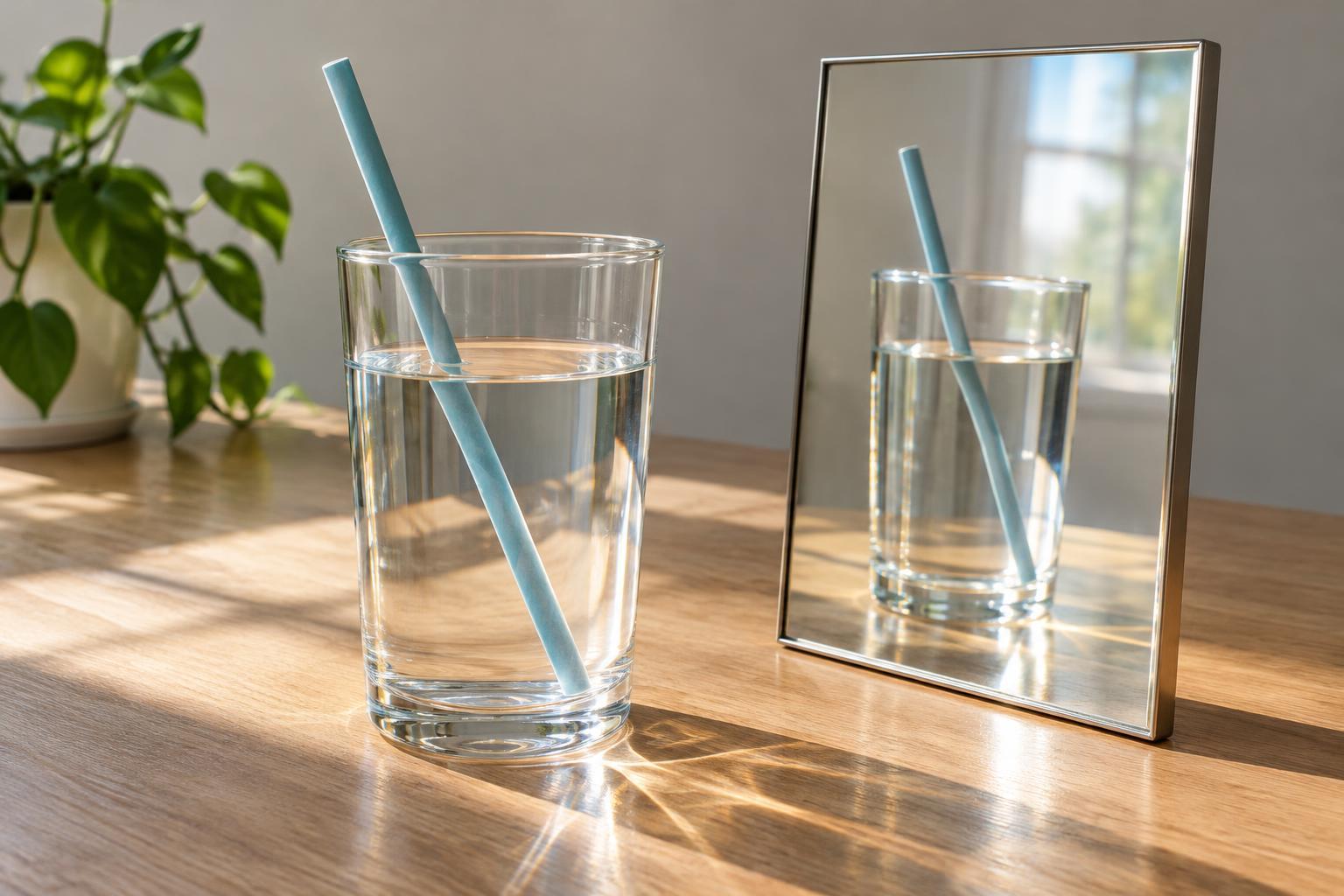
A straw in a glass of water shows the effect. Light from the submerged part of the straw changes direction as it leaves the water and enters the air. Your eyes receive that light along its new path, making the underwater part appear displaced from the part above the surface. The straw has not bent; its apparent position has changed. For similar reasons, the bottom of a pool can appear shallower than it is when viewed from above.
What controls the amount of bending?
The angle at which light meets a boundary matters. A ray crossing nearly straight through usually changes direction less than one arriving at a slant. The materials matter too. Scientists describe how light travels in a material using its refractive index. A greater difference between the refractive indices on either side of a boundary generally means more bending for a ray entering at an angle.
Refractive index can also vary with the light’s wavelength. That is why a prism can spread white light into colors: its faces refract different wavelengths by slightly different amounts. Refraction is also central to lenses. Their curved surfaces redirect light from different starting points so that it can come together to form an image, as in a camera or an eye.
Not every ray entering a transparent material passes through. At some boundaries, part of the light reflects and part refracts. In certain conditions, light traveling from a higher-index material toward a lower-index one can strike the boundary at an angle where no refracted ray passes through. This is called total internal reflection.
A practical way to tell them apart
To identify the effect, first look for the boundary the light encounters. Does the light return into the material it came from? That is reflection. Does it cross the boundary and change direction because it travels differently in the new material? That is refraction. A glass pane can do both, and light passing through it meets two boundaries: one on the way in and another on the way out.
This simple distinction explains a surprising range of sights. A face in a mirror depends on orderly reflection. A bent-looking straw and the focusing action of a lens depend on refraction. Once you start tracing where light goes at a surface, everyday optical effects become easier to understand.