Three useful labels, not three rigid boxes
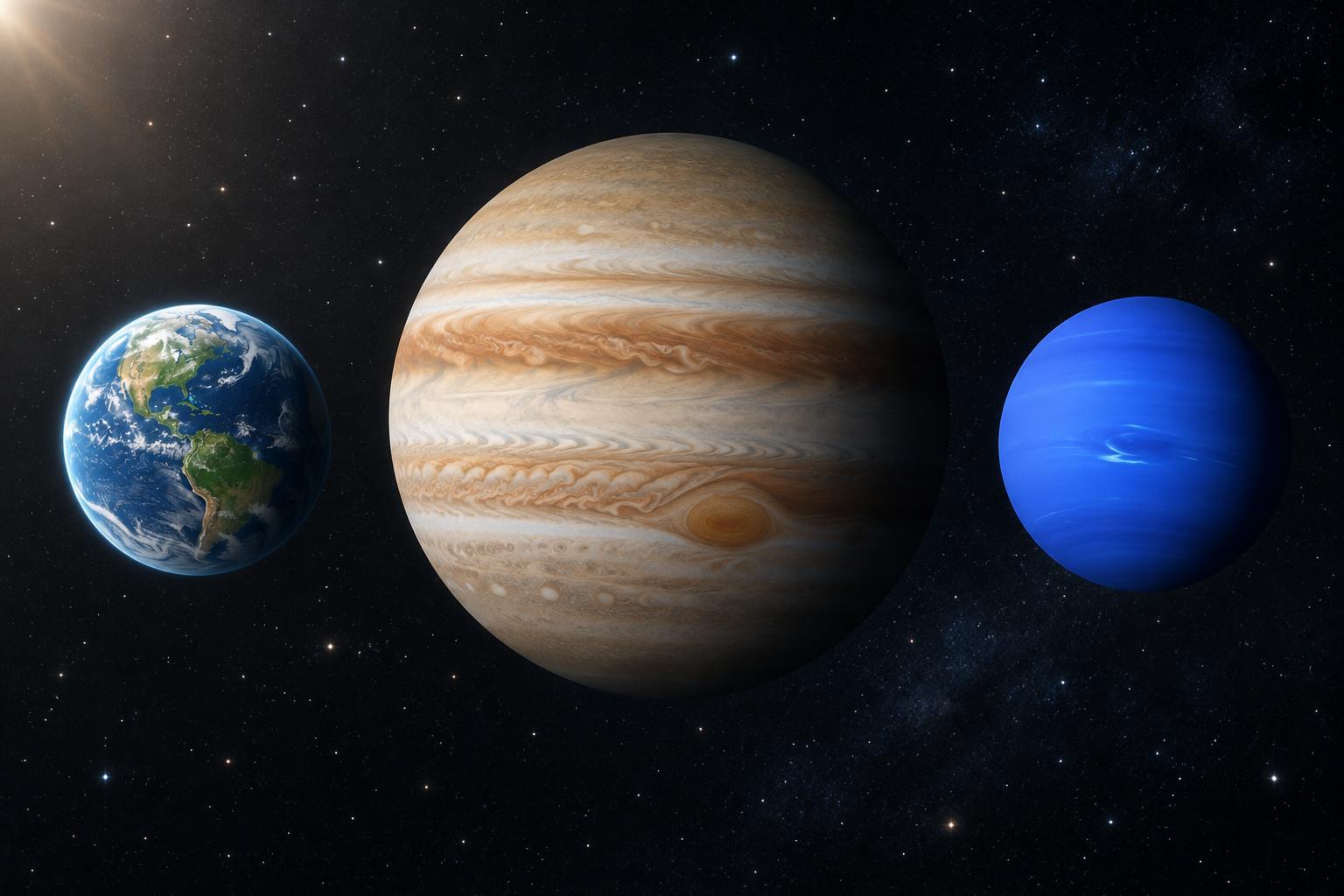
The planets in our solar system offer three broad examples of what a planet can be. Mercury, Venus, Earth and Mars are rocky planets. Jupiter and Saturn are gas giants. Uranus and Neptune are ice giants. These names help describe major differences in size and composition, but they are not a complete description of any planet—especially one orbiting another star.
One way to compare the groups is to ask what makes up most of a planet, rather than what its outermost layer looks like. Earth has an atmosphere, yet most of its mass is in rock and metal. Jupiter has clouds, but those visible clouds reveal only a thin part of a much deeper planet. Likewise, calling Neptune an ice giant does not mean it is a giant frozen snowball.
Rocky planets: solid outer surfaces
Rocky planets, also called terrestrial planets, are made largely of rock and metal. They have solid outer surfaces, so it makes sense to speak of mountains, plains, craters and places where a spacecraft could land. Their interiors are layered in different ways, typically including a rocky region and a metal-rich core.
Their atmospheres vary enormously. Mercury has almost no lasting atmosphere, while Venus has a thick one. Earth’s atmosphere supports liquid water at its surface, and Mars has a thin atmosphere that provides little protection from the cold. Being a rocky planet therefore tells you something important about the ground beneath you, but it does not tell you what the weather would be like—or whether the planet could support life.
The distinction between a surface and an atmosphere is easy to picture on Earth: air gives way to land or ocean. That sharp transition is a defining feature of a rocky planet, even when a thick atmosphere, as on Venus, hides the surface from view.
Gas giants: far more than clouds
Jupiter and Saturn are called gas giants because hydrogen and helium account for much of their bulk. Their visible bands and storms are features of their atmospheres, not patterns painted on a solid shell. Descending into either planet would bring increasing pressure and temperature rather than an Earth-like point where sky abruptly becomes ground.
The word “gas” can be misleading, too. Deep inside a giant planet, high pressure changes how matter behaves; much of its hydrogen is not an ordinary, thin gas like the air in a room. Scientists study these interiors using measurements such as gravity and magnetic fields, but the deepest layers cannot be observed directly. Models of their exact structure may differ.
Jupiter and Saturn also show why size matters. A massive planet can hold on to large amounts of light gases that a much smaller world may not retain as readily. That does not mean every large planet must resemble Jupiter: what materials were available as it formed, and what happened afterward, also matter.
Ice giants: a name inherited from chemistry
Uranus and Neptune have hydrogen- and helium-rich outer atmospheres, but a greater share of their interiors is thought to consist of heavier materials than in Jupiter or Saturn. Planetary scientists traditionally call substances such as water, ammonia and methane “ices” when discussing the materials from which planets formed. In this context, the term names ingredients, not necessarily their present physical state.
Under the extreme pressures and temperatures inside an ice giant, those materials are unlikely to resemble familiar ice cubes. They may exist in unusual fluid or other high-pressure forms. Their precise arrangement is still a subject of investigation. The practical distinction is that Uranus and Neptune are not simply smaller copies of Jupiter and Saturn: their overall compositions and interior structures appear different.
What the categories can—and cannot—tell us
Planetary labels are a starting point for questions, not a substitute for measurements. A planet’s size alone does not reveal whether it has a solid surface. Even density—the amount of mass packed into a given volume—needs context: different mixtures of materials and different internal pressures can produce similar broad measurements.
These cautions become especially useful when considering planets around other stars. Astronomers can sometimes estimate an exoplanet’s size and mass, but its surface and deep interior are much harder to determine. A world that falls between Earth and Neptune in size does not automatically fit neatly into any solar-system category.
The three familiar labels still offer a helpful mental map. Rocky planets put most of their mass in rock and metal and have solid outer surfaces. Gas giants contain vast amounts of hydrogen and helium. Ice giants appear richer in heavier substances, despite having gaseous outer layers. The more closely we look at a planet, the more useful it becomes to ask what evidence supports the label—and what the label leaves out.