One path or several?
Picture a battery connected to two bulbs by wires. For either bulb to light, there must be a complete conducting path from one battery terminal, through the circuit, and back to the other terminal. Electricity does not need to be “used up” as it passes through a bulb. Instead, the bulb transfers electrical energy into light and heat.
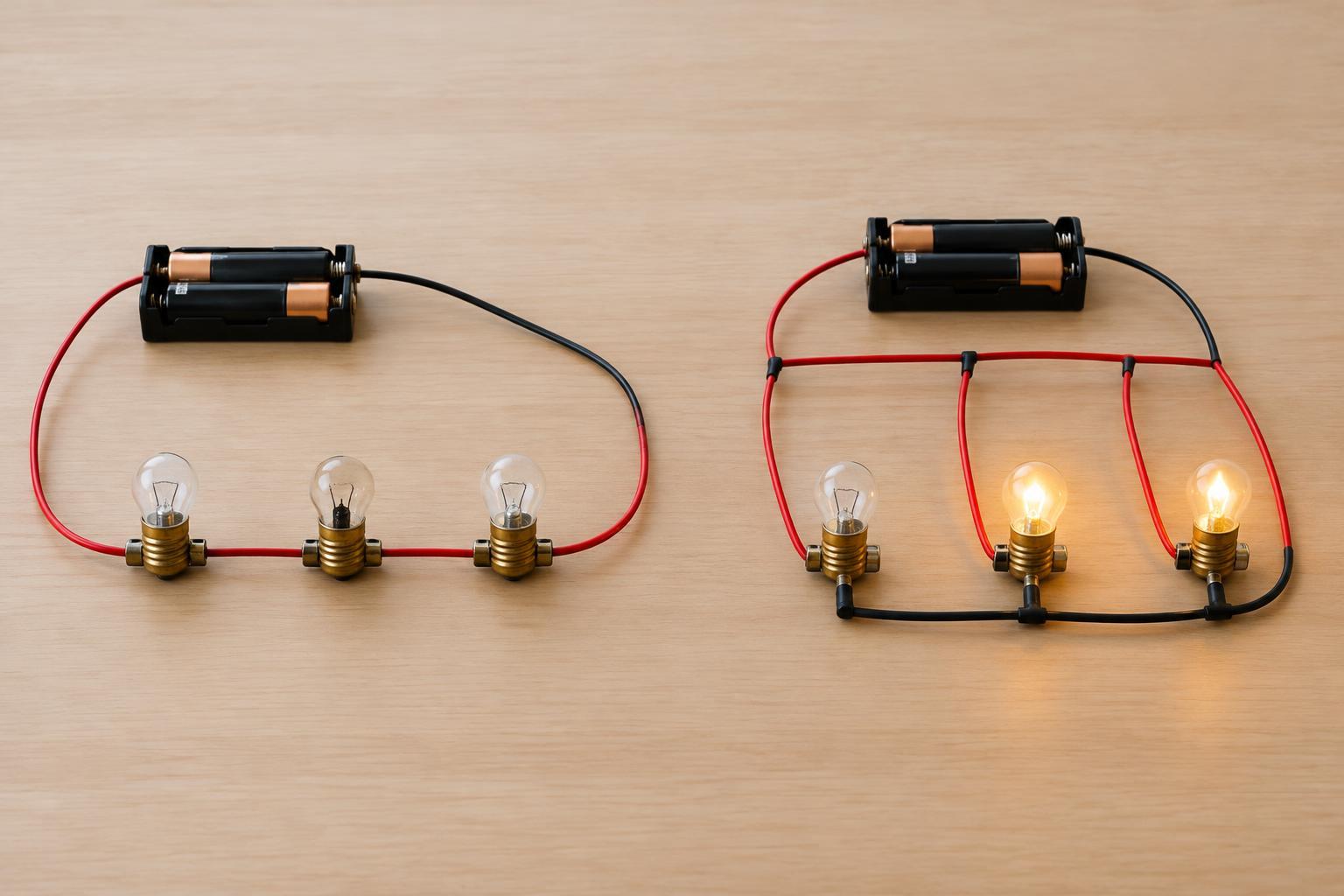
In a series circuit, the bulbs sit along one continuous path. The same current passes through each bulb in turn. In a parallel circuit, the wiring splits into separate branches, with a bulb on each branch. Current divides among the branches and joins again on the way back to the battery. That difference in available paths determines what usually happens when a bulb fails.
When a bulb fails in series
A common way for a traditional incandescent bulb to fail is for its thin filament to break. The break creates an open circuit: current can no longer flow through that point. If two such bulbs are connected in series, the broken filament interrupts their only shared path. Both bulbs go out, even though only one has failed.
Series wiring also changes how bulbs behave before anything breaks. Identical bulbs connected in series to one battery generally glow more dimly than a single identical bulb connected to that battery, because the bulbs share the battery’s voltage. The exact brightness depends on the bulbs and power source, but the useful rule is that adding a component in series changes the conditions for every component on that path.
A failed bulb does not always behave like a simple gap. Some lamp assemblies include a bypass that can preserve a path after a lamp element fails. Others may fail in a way that creates a short circuit instead. To predict the outcome reliably, you need to know both the wiring arrangement and how the particular component fails.
When a bulb fails in parallel
Now put each bulb on its own branch across the same battery. If one bulb’s filament breaks, only its branch becomes an open circuit. Current can still travel through the other branch, so the working bulb stays lit. This is the familiar advantage of parallel wiring: one failed branch need not interrupt the rest.
In a simple parallel circuit, each branch is connected across the same two points and therefore has the same voltage across it. Identical bulbs on separate branches can each glow much like a single bulb connected to the same battery. Adding branches increases the total current the source must supply, however. With a small or depleted battery, its voltage may drop under the heavier load, so real bulbs may not behave exactly like bulbs attached to an ideal, unchanging power source.
An open circuit in one branch can reduce that load. As a result, the remaining bulb might appear unchanged or, with some power sources, even slightly brighter. “Parallel means no effect at all” is therefore too strong; the dependable point is that the remaining branch still has a complete path.
Why real lights can surprise you
The series-versus-parallel rule describes the paths in a circuit, not necessarily the layout you can see from outside. A string of decorative lights may contain several groups with different wiring arrangements. Electronic controls, bypasses, and connectors can also affect what happens when one light stops working. The pattern of dark bulbs can be a clue, but it is not always enough to identify the fault.
LEDs add another wrinkle. An LED is an electronic component, not a tiny incandescent filament. It may stop emitting light because of a failed connection, a failed driver circuit, or a fault within the LED itself. Those faults need not interrupt current in the same way. To understand an LED lamp or light string, consider its supporting electronics as well as whether its light sources are arranged in series or parallel.
A useful way to predict the outcome
When faced with an unfamiliar circuit, trace each possible route from one power-source terminal back to the other. Imagine the failed bulb has become a gap. Does that gap block every route? If so, all the bulbs on those routes go out. Is there another complete branch? Bulbs on that branch can remain lit. This path-tracing approach works better than memorizing what a particular string of lights usually does.
A low-voltage battery and bulbs or LEDs in components designed for the battery are suitable for exploring these ideas, provided the components are used as intended. Avoid connecting the battery terminals directly with a wire, which can cause overheating. Leave household wiring and mains-powered lights intact: the same circuit principles apply, but their electrical hazards make them unsuitable for casual experiments.


