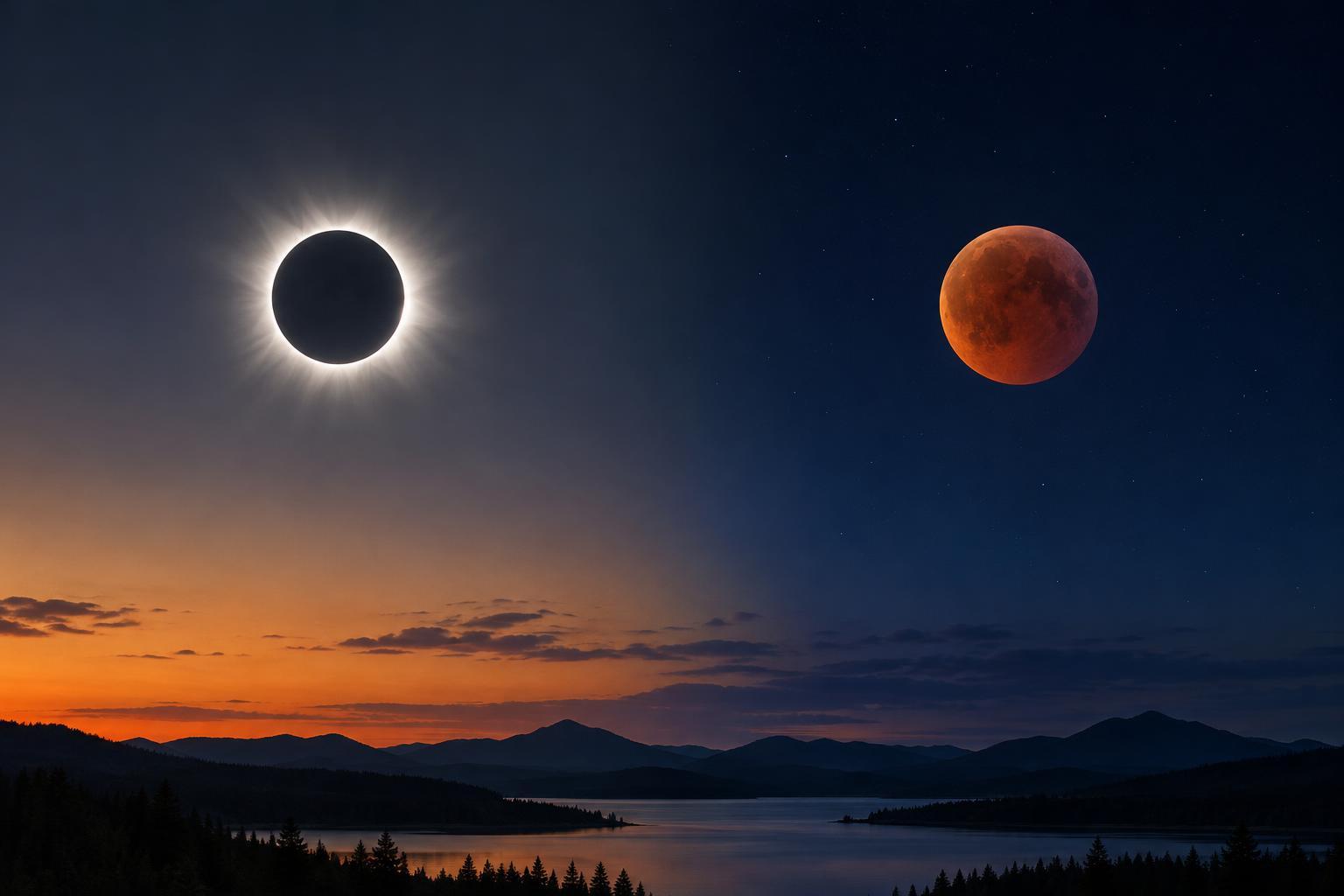
One alignment, two very different views
An eclipse happens when one celestial body blocks sunlight from reaching another, or blocks our view of the Sun. For the eclipses we see from Earth, the key players are the Sun, Earth and Moon. Their positions determine which object casts a shadow and where an observer must be to see it.
In a solar eclipse, the Moon passes between Earth and the Sun. It blocks sunlight from reaching a limited area of Earth, so observers in that area see the Sun partly or completely covered. In a lunar eclipse, Earth passes between the Sun and the Moon. Earth’s shadow falls on the Moon, changing its appearance for observers on Earth’s nighttime side. A quick way to remember the difference is to ask what looks eclipsed: the Sun in a solar eclipse, the Moon in a lunar eclipse.
What happens during a solar eclipse?
A solar eclipse can occur only around new moon, when the Moon is on the Sun-facing side of Earth. The Moon’s shadow has a darker central region, called the umbra, and a lighter outer region, called the penumbra. From the penumbra, the Sun appears partly covered: this is a partial solar eclipse. From the path of the umbra, the Moon can cover the Sun’s bright face completely, producing a total solar eclipse.
The Moon’s distance from Earth varies slightly. If it appears too small to cover the Sun fully during a central alignment, a bright ring of sunlight remains around it. This is an annular solar eclipse. In each case, the Moon—not Earth—is blocking sunlight. Because the Moon’s shadow covers only part of Earth at a time, people in different locations can see different views of the same event, or no eclipse at all.
What happens during a lunar eclipse?
A lunar eclipse can occur only around full moon, when Earth is between the Sun and Moon. As the Moon moves through Earth’s shadow, it may first enter the faint penumbra, making its surface subtly dimmer. If only part of the Moon enters the darker umbra, observers see a partial lunar eclipse. If the whole Moon enters it, they see a total lunar eclipse.
During totality, the Moon often looks coppery or reddish rather than disappearing. Some sunlight still reaches it after passing through Earth’s atmosphere. The atmosphere scatters shorter wavelengths of light more readily, while some red and orange light continues through and is bent into Earth’s shadow. The exact shade can vary with atmospheric conditions. Unlike a solar eclipse, a lunar eclipse can be seen from much of Earth’s nighttime side, wherever the Moon is above the horizon.
Why isn’t there an eclipse every month?
New moons and full moons happen regularly, but most pass without an eclipse. The Moon’s orbit is tilted relative to the plane of Earth’s orbit around the Sun. From our viewpoint, the Moon usually passes a little above or below the alignment needed to cast a shadow on Earth or move through Earth’s shadow.
Eclipses become possible when a new or full moon occurs near one of the two places where the Moon’s orbital path crosses that plane. These crossing points are called nodes. For a solar eclipse, the new Moon must pass close enough to a node for its shadow to reach Earth. For a lunar eclipse, the full Moon must pass close enough for Earth’s shadow to fall on it. Thinking in three dimensions helps: a phase tells you roughly which side of Earth the Moon is on, but not whether the three bodies line up closely enough for an eclipse.
Watching the light change safely
A lunar eclipse is safe to watch directly. You can follow its gradual changes with your eyes, and binoculars can help reveal the boundary of Earth’s shadow moving across the Moon.
A solar eclipse requires different precautions. Looking directly at the Sun can injure your eyes, even when most of it is covered. Use proper solar-viewing glasses or a solar viewer designed for direct observation; ordinary sunglasses are not adequate. A pinhole projector offers an indirect way to watch the changing shape of the Sun without looking at it. Never look through binoculars or a telescope pointed at the Sun unless they have a suitable solar filter fitted at the front. The contrast in viewing rules follows from the basic geometry: a lunar eclipse shows you the Moon in shadow, while a solar eclipse puts the bright Sun in your line of sight.