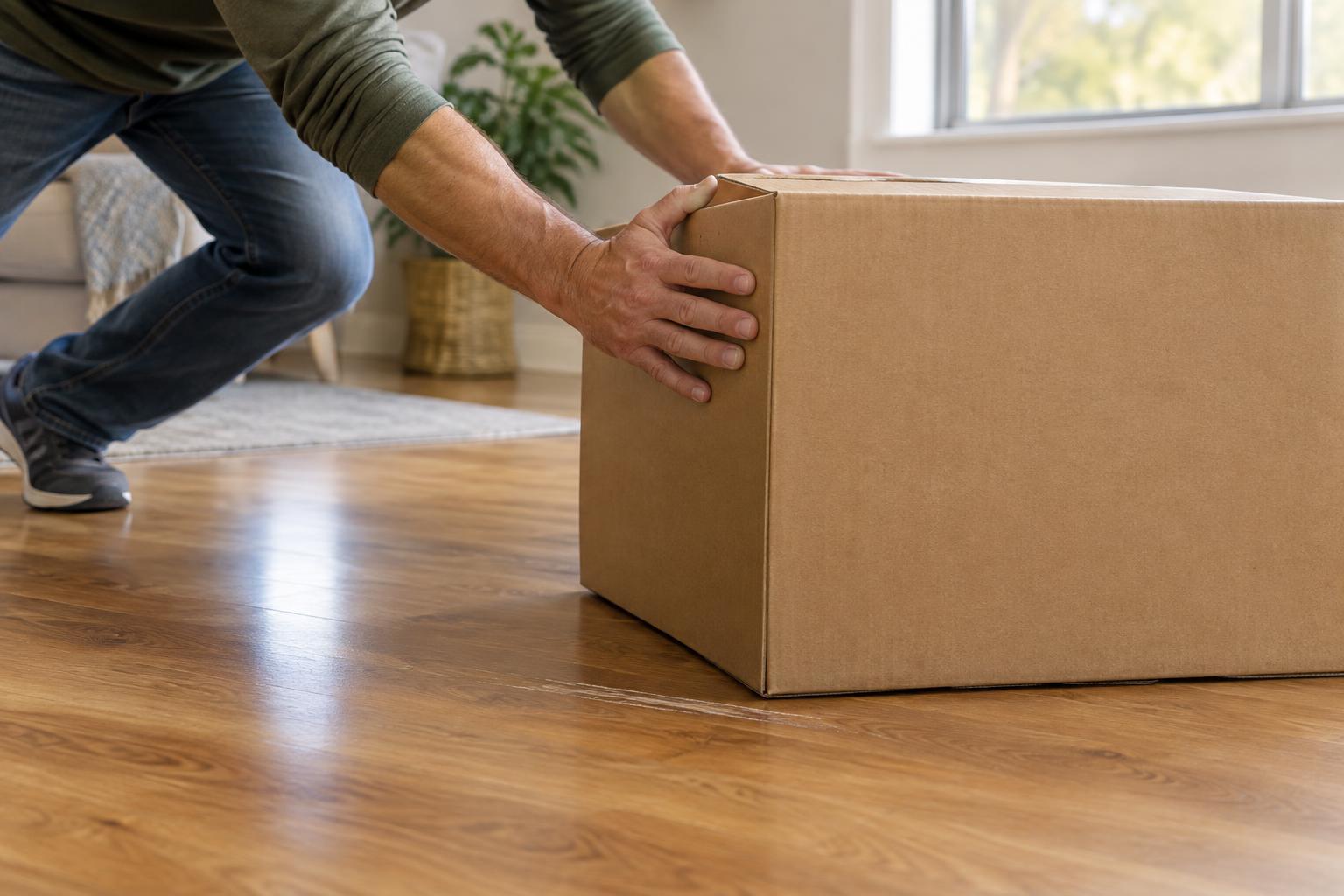
The first push and the steady push
Imagine pushing a heavy box across a floor. At first, you increase your push and nothing happens. Then the box begins to move, and you may find that a smaller, steady push keeps it sliding. The force resisting the box before it moves is static friction. Once the box slides against the floor, the resisting force is kinetic friction, also called sliding friction.
The important distinction is whether the two surfaces are sliding relative to each other. A box at rest on a floor has static friction available to oppose your push. A sliding box experiences kinetic friction. In many ordinary situations, the greatest static friction the contact can provide is higher than the kinetic friction during sliding. That is why getting started can feel harder than continuing.
Static friction adjusts to your push
Static friction is not a fixed force that acts at full strength whenever two surfaces touch. If you push gently on a box and it stays still, static friction pushes back with just enough force to balance your horizontal push. Push harder, and static friction can increase too. It does so only up to a limit. Beyond that limit, the box begins to slip.
In a simple model, that limit equals a coefficient of static friction multiplied by the normal force: the force pressing the surfaces together. On a level floor, the normal force is often close to the box’s weight, provided no other forces are lifting it or pressing it downward. A heavier box usually has a higher friction limit because the floor and box are pressed together more strongly.
Once the box is sliding, a similar model estimates kinetic friction using a kinetic-friction coefficient multiplied by the normal force. For many pairs of dry surfaces, that coefficient is lower than the static one. These equations are useful approximations, not universal laws: the actual behavior depends on the materials, their condition, and how they are moving.
What happens where surfaces meet
Even surfaces that look smooth have tiny bumps and valleys. When pressed together, they touch at many small spots rather than across their entire apparent area. Those spots can deform, catch on one another, and form short-lived bonds or other interactions. To start sliding, the applied force must overcome enough of those contacts for motion to begin.
During continuous sliding, contacts are repeatedly made and broken. They may have less time to settle into a strongly resisting arrangement. This helps explain why the maximum static friction often exceeds kinetic friction, but it is not the whole story for every material. Rubber, ice, lubricated surfaces, and soft or sticky materials can behave in ways that a simple picture of interlocking bumps does not capture.
Friction also changes energy into other forms, particularly heat. Rub your hands together and you can feel that effect. The warming does not mean all surfaces will behave alike: surface texture, contamination, moisture, temperature, and sliding speed can all influence the result.
Why a moving box can still slow down
If you stop pushing a sliding box, kinetic friction continues to oppose its motion, so the box slows and eventually stops. If you keep pushing with a force that balances kinetic friction, the box can move at roughly constant speed on a level floor. If your push is greater, it accelerates; if your push is smaller, it slows.
Notice that friction opposes relative motion, or the tendency toward relative motion, at the contact. It does not always point opposite an object’s overall travel. A walking shoe, for example, pushes backward on the ground. Static friction from the ground pushes the planted shoe forward, helping you walk without the sole sliding across the surface. A rolling wheel can likewise rely on static friction at its contact with the ground when it rolls without slipping.
A useful rule with real-world limits
You can explore the difference with a book on a tabletop. Push it slowly with one finger, increasing the force until it moves. Then try to keep it sliding at a steady pace. Depending on the surfaces, the second task may feel easier. Repeat with a different book cover or tabletop, and the result may change. Avoid using fragile objects or surfaces that could be scratched.
The familiar claim that starting to slide takes more force is a good guide for many common contacts, not a guarantee. Friction can vary as surfaces wear, warm up, become wet, or gain a layer of dust. Still, the static-versus-kinetic distinction explains a great deal: the resistance before slipping can build to a threshold, while resistance during sliding follows a different set of contacts. That small difference shapes everything from moving furniture to gripping the ground underfoot.


