The difference starts with polymer chains
Plastics are built from polymers: long molecules made of repeating units. Imagine a container of cooked spaghetti. The strands can tangle and resist being pulled apart, even though they are not permanently tied together at every crossing. Many thermoplastics work in a roughly similar way. Their polymer chains are held near one another by molecular attractions and entanglements, but the chains are not joined into one continuous, permanent network.
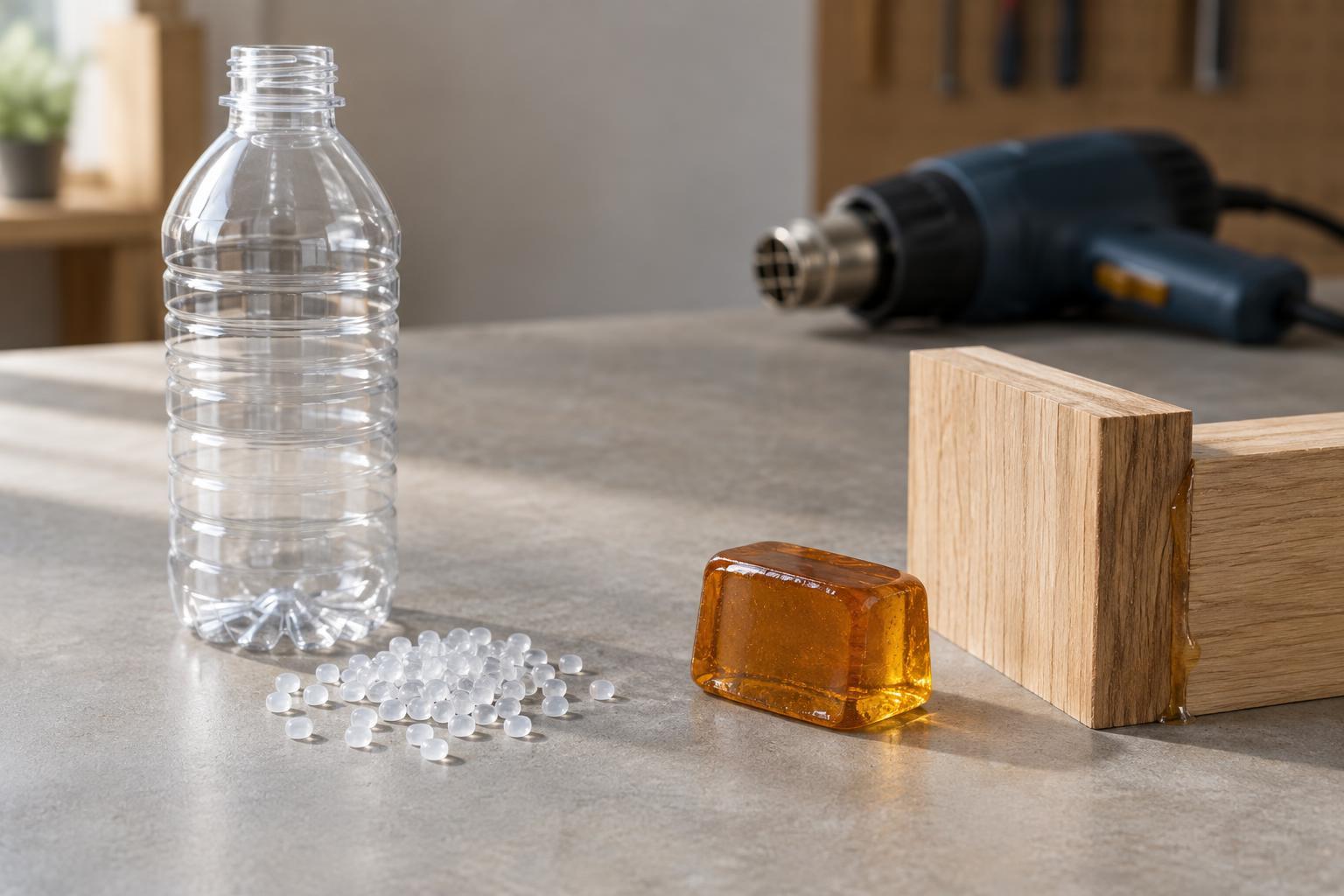
When a thermoplastic is heated enough, its chains gain mobility. The material softens and may flow, allowing it to be shaped in a mold or pushed through a die. Cooling limits that movement again, so the new shape holds. Polyethylene, polypropylene and polyethylene terephthalate, commonly called PET, are familiar thermoplastics found in items such as containers, packaging and textile fibers. Each has its own processing temperature and properties; “thermoplastic” describes a type of heat response, not a single material.
Why a thermoset does not melt back into shape
A thermoset begins as ingredients that react during a process called curing. That reaction forms chemical links between polymer chains, known as crosslinks. Instead of separate strands that can eventually slide past one another, the finished material contains a connected network. Epoxy adhesives and some electrical components are examples of thermoset applications.
Heating a cured thermoset can make parts of its network move more freely, and the material may expand or become less stiff. But its chains cannot flow past one another as an ordinary melt without breaking chemical bonds. With enough heat, a conventional thermoset is more likely to chemically degrade or char than to become a moldable liquid. This distinction matters in manufacturing: a thermoplastic can often be formed from pre-existing polymer pellets, while a thermoset takes its final network shape as it cures.
Softening and melting are not quite the same thing
The everyday word “melt” hides an important detail. Some thermoplastics contain ordered regions called crystals alongside less ordered, or amorphous, regions. Their crystals melt over a characteristic temperature range, after which the material can flow more readily. Other thermoplastics are largely amorphous. Rather than having a distinct crystal-melting step, they pass through a glass transition: a range where they change from hard and glassy to softer and more mobile. Further heating can make them workable.
That is why a plastic object left near a heat source might warp without turning into a puddle. Its ability to hold a shape depends on temperature, the forces acting on it and its particular polymer structure. A material can also contain fillers or reinforcing fibers that remain solid while the surrounding polymer softens. Knowing that something is a thermoplastic therefore does not, by itself, tell you how hot it must get or how it will behave in use.
What the distinction means for reuse and recycling
The ability to soften a thermoplastic makes mechanical recycling possible in principle: used material can be collected, sorted, cleaned, chopped, heated and formed into another product. In practice, repeated heating can alter some polymers, and contamination or mixtures of incompatible plastics can make the result less useful. Colorants, multilayer packaging and other additives may create further difficulties. “Can be remelted” is not the same as “will be recycled,” and a new product may require material with more consistent properties than a mixed waste stream can provide.
A conventional cured thermoset cannot usually be ground up and remelted into the same sort of part. It may sometimes be reused as a filler, or treated by processes designed to recover particular components, but those routes depend on the material and the available facilities. The choice between a thermoplastic and a thermoset is therefore not a simple contest between recyclable and unrecyclable. Designers also consider strength, heat resistance, durability, repairability and how long a product is expected to last.
A useful question to ask about any plastic
If two plastic objects feel equally hard at room temperature, their molecular structures may still be very different. One may be made of chains that can move again when heated; the other may be locked into a cured network. Even within those broad groups, formulations vary. Some materials blur the simple categories, and a product may combine several polymers with coatings, fibers or metal.
When considering how an object was made or what might happen at the end of its life, ask what connects its polymer chains and what else is mixed into the material. Those questions explain more than appearance alone. They also reveal why heat can be a useful shaping tool for one plastic but a cause of damage for another.


