A push that makes something turn
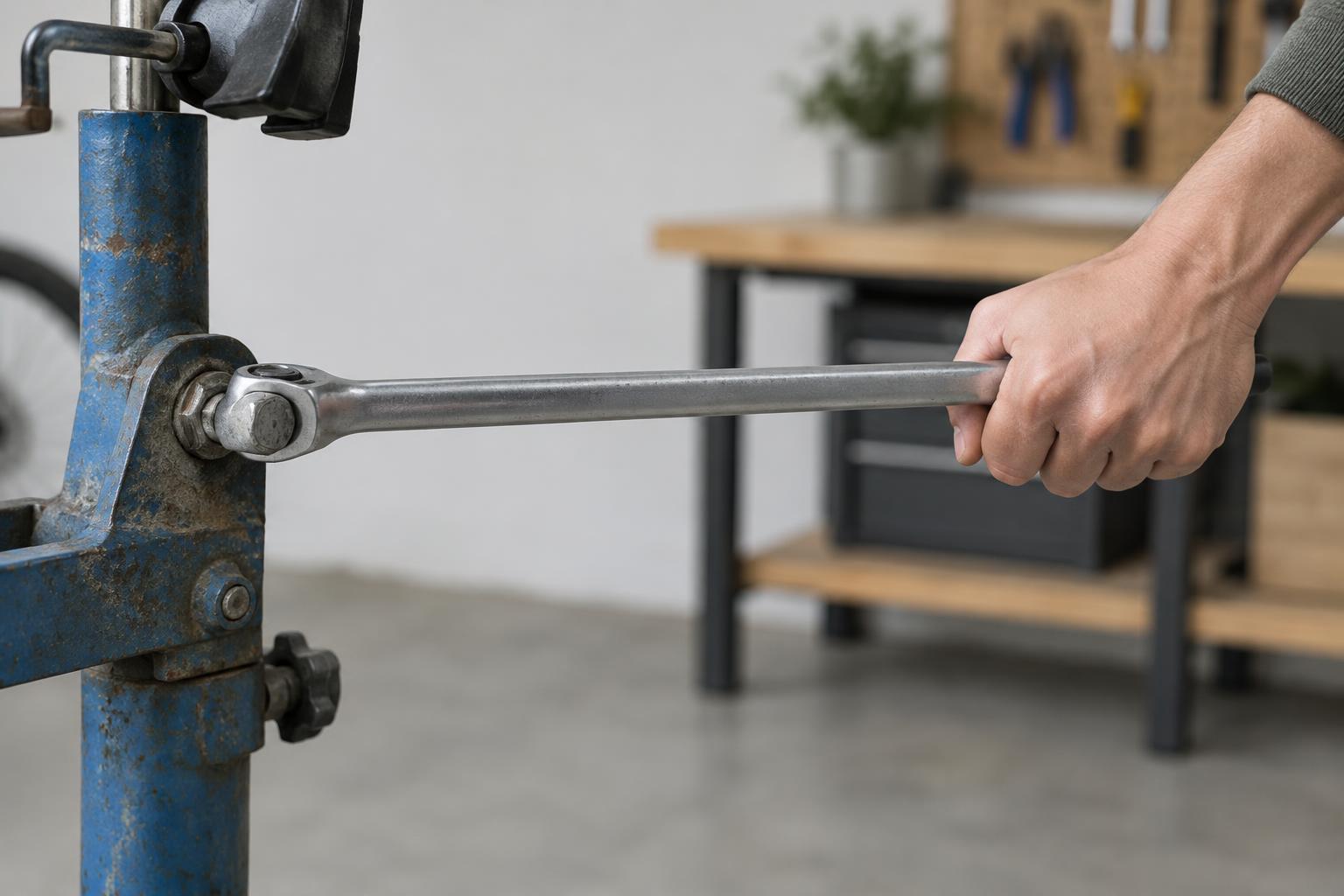
Imagine trying to loosen a tight bolt with a wrench. Pushing close to the bolt may accomplish little, while pushing with the same force at the far end of the handle may turn it. The difference is not that your hand has become stronger. It is that your push has gained leverage.
Physicists describe this turning effect as torque. Torque depends on the force applied, the distance from the axis of rotation, and the direction of the force. For a wrench, the axis runs through the bolt. The distance from that axis to where you push is called the lever arm. If you push at a right angle to the handle, doubling that distance doubles the torque produced by the same force.
This explains why a longer handle can make a task feel easier. If a bolt needs a particular torque to start moving, a longer lever arm lets you reach that torque with less force from your hand. It does not guarantee that every stuck bolt will come loose: threads can be damaged, and parts can bend or break before the bolt turns.
Direction matters as much as distance
A long handle helps most when the force acts across it, rather than along it. Picture a wrench handle pointing to the right. A push straight down at its end creates a strong turning effect. A push toward the bolt, along the handle, creates little torque, even if the push feels just as hard.
For a force applied at a single point, the relationship is often written as torque = distance × force × sin(angle), where the angle is between the handle and the direction of the force. You do not need the formula to use the idea: push roughly perpendicular to the handle, at a point as far from the pivot as is practical.
The relevant distance is not necessarily the full length of the tool. If you grip a long wrench halfway down its handle, your hand has a shorter lever arm. Likewise, if you pull at an awkward angle, only part of your force contributes to turning. That is why changing your stance or repositioning a tool can help even when you cannot change its length.
Why leverage does not provide free energy
It can seem as though a longer handle creates something from nothing: the same bolt turns, but your hand pushes less hard. The trade-off is distance. To rotate the bolt through the same angle, the end of a longer handle travels along a longer arc. Your hand applies less force, but over a greater distance.
In an idealized system without losses, the work put in—force applied over a distance—matches the work delivered to the turning object. Real tools also encounter friction and may flex, so the details are less tidy. The central point remains: leverage changes how much force you need and how far your hand must move. It does not eliminate the effort needed to overcome resistance.
A door offers a familiar example. Its hinges are the axis, so pushing near the outer edge is easier than pushing close to the hinges. But the outer edge also moves farther than a point near the hinges when the door opens through the same angle. The door handle is placed far from the hinges in part to make the required push more manageable.
Recognizing leverage in everyday tools
The same principle appears in a screwdriver, a faucet handle, a bicycle crank and a pair of pliers. A wider screwdriver grip gives your fingers more distance from the shaft’s axis. A bicycle crank lets a downward push on the pedal turn an axle. With pliers, the handles let your hand produce a larger force at the jaws, which move through a smaller distance.
Different tools arrange pivots, forces and loads in different ways, but the useful question is the same: where is the axis, and how far from it does the force act? Asking that question can clarify why one grip works better than another. It also helps explain why a tool designed for turning may have a broad grip or a long handle rather than simply being made heavier.
Use the advantage with care
More torque is not always better. A longer wrench can make it easier to exceed the torque a fastener, fitting or tool can withstand. A slipping wrench can also send your hand into nearby surfaces. Use a tool that fits the fastener securely, keep your balance, and follow any specified tightening procedure when one applies.
The key idea is simple: turning depends not just on how hard you push, but on where and in which direction you push. A longer handle increases the distance from the pivot, allowing a smaller force to create the same torque. Once you notice that relationship, the design of many everyday tools starts to make sense.