Three ways to describe a circuit
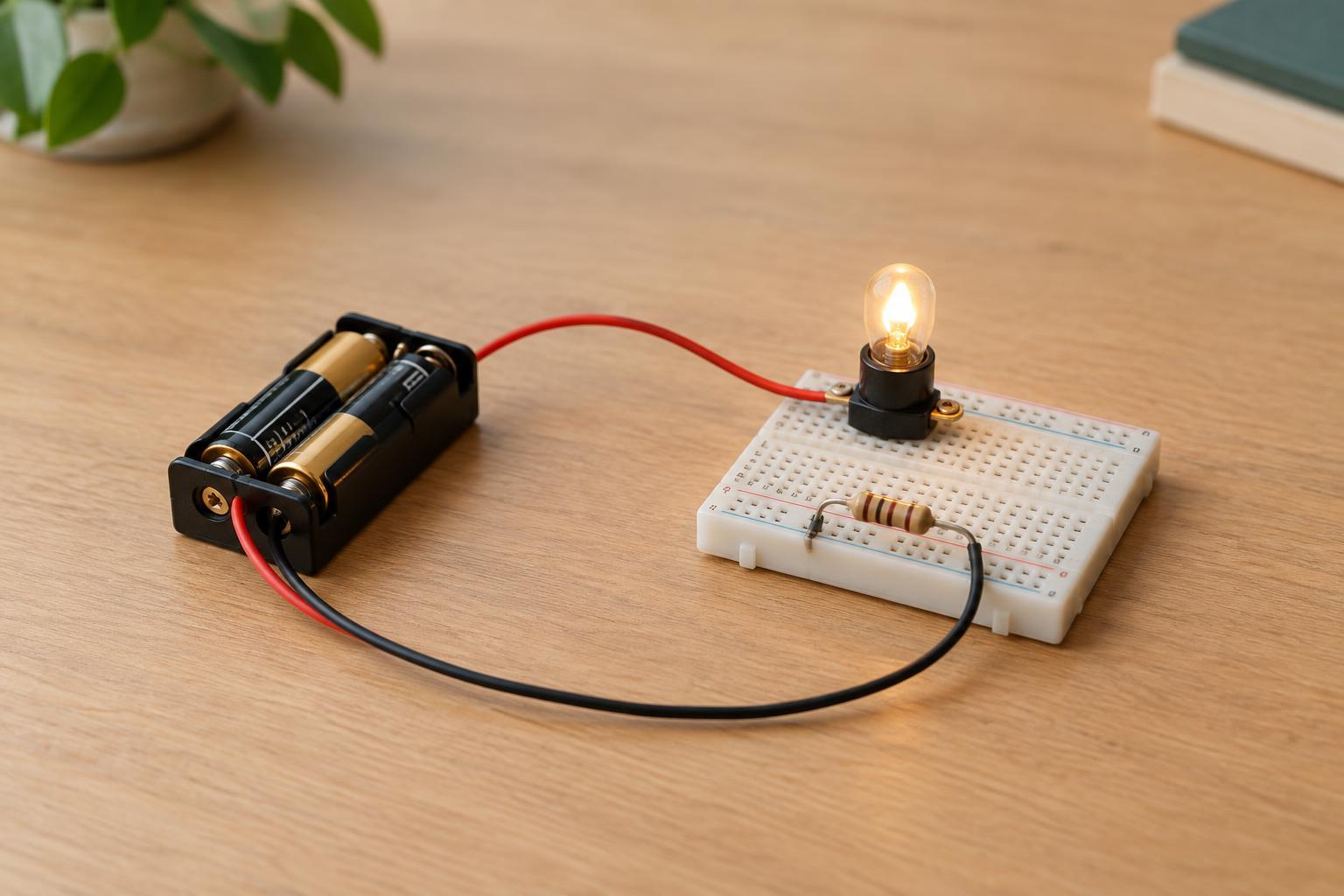
A flashlight works only when its battery, switch and bulb or LED form a complete path. Once that path is closed, electrical energy can be transferred from the battery to the light. Voltage, current and resistance describe different parts of this process. They are related, but they are not interchangeable.
Voltage is the difference in electric potential between two points: it describes how much energy per unit of charge is available to transfer. Current is the rate at which electric charge passes a point. Resistance describes how strongly a component opposes that flow under particular conditions. Their units are volts (V), amperes or amps (A), and ohms (Ω). Keeping those three meanings separate makes circuit diagrams and device labels much easier to read.
Voltage needs a path to produce current
A battery has a voltage across its terminals even when it is sitting unused on a table. With no complete external circuit, however, little or no current flows through a connected device. Closing a switch completes the path, allowing charge to move through the device and return to the battery. Voltage is therefore not a measure of how much current is flowing; it is a difference between two points that can drive current when a suitable path exists.
You may hear that current flows from a battery’s positive terminal to its negative terminal. That is the conventional direction used in circuit diagrams. In a metal wire, the mobile electrons move in the opposite direction. Both descriptions are useful as long as you know which one is being used. The circuit’s components behave the same either way.
What resistance changes
If the same voltage is applied across two suitable resistors, the one with greater resistance carries less current. That relationship is written as Ohm’s law: V = I × R, where V is voltage, I is current and R is resistance. For example, a 6 V source across a 3 Ω resistor would produce a current of 2 A in an idealized circuit. Rearranging the equation lets you calculate any one of the three quantities when you know the other two.
A water-pipe analogy can help: voltage is somewhat like a pressure difference, current like the rate of flow, and resistance like a restriction in the pipe. But it is only an analogy. Electric charge does not get used up as it travels around a simple circuit; energy is transferred to components along the way. Also, not every device has a fixed resistance. A filament’s resistance changes as it heats, and an LED does not behave like a simple resistor. Ohm’s law is most straightforward for components whose resistance stays approximately constant over the range being considered.
Series, parallel and the paths charge can take
In a series circuit, components sit along a single path. The same current passes through each one, while the total voltage difference is shared among them. Adding another resistor in series raises the total resistance and, for a fixed supply voltage, reduces the current. If the single path is broken, current stops throughout that circuit.
In a parallel circuit, components have separate paths between the same two points. Each branch has the same voltage across it, but the currents in the branches can differ. Adding a branch generally lowers the circuit’s overall resistance and increases the total current drawn from a fixed-voltage source. This distinction explains why adding components does not always reduce current: where you connect them matters as much as what they are.
From electrical quantities to useful energy
Voltage and current together tell you the rate at which electrical energy is transferred. Electrical power is P = V × I, measured in watts (W). A device drawing 2 A at 6 V receives 12 W of electrical power. That energy might become light, sound, motion or heat, depending on the device. A resistor, for instance, transfers electrical energy mainly into thermal energy.
These relationships are useful for understanding everyday observations, not just solving equations. A dimming battery-powered light may reflect a changing supply voltage, while an overloaded source may struggle to provide the current connected devices demand. Real batteries, wires and devices have limits and behaviors that simple examples leave out. For learning, start with low-voltage, purpose-built circuit kits rather than household wiring: the same basic ideas apply, without treating an introductory equation as a safety guide.


