A cell is more than a bag of chemicals
A cell is the smallest unit generally considered alive. It takes in materials, carries out chemical reactions and maintains an internal environment distinct from its surroundings. Many cells also grow and divide. To manage these tasks, cells organize their contents into structures with particular roles. Some of those structures are called organelles.
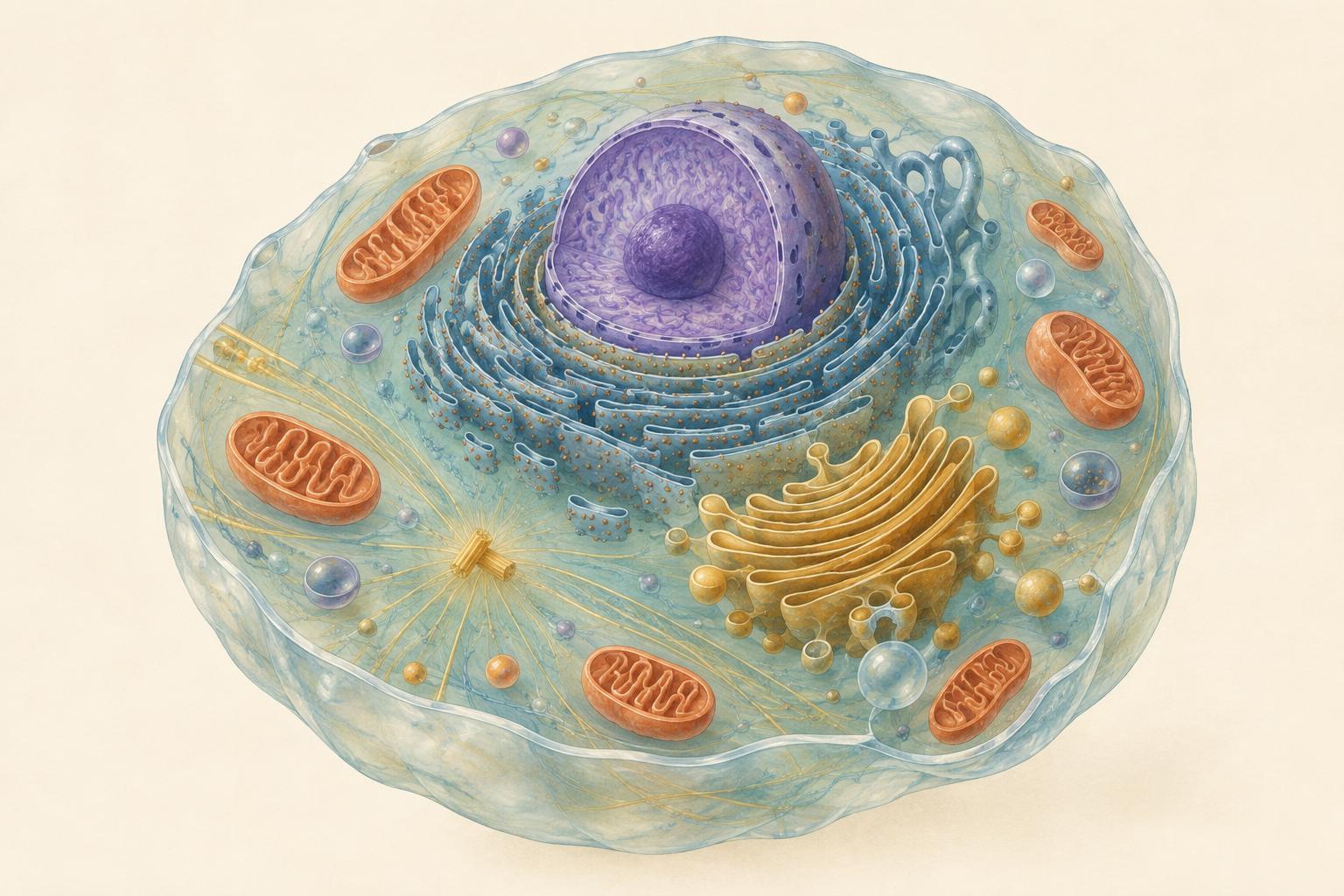
The word “organelle” is often used for membrane-enclosed compartments, such as the nucleus and mitochondria. It is sometimes used more broadly for structures such as ribosomes, which have no surrounding membrane. Not every cell has the same parts: animal and plant cells differ, and bacteria lack the membrane-enclosed organelles described in much of this guide. The structures below are common features of the complex cells found in plants and animals.
The boundary, the instructions and the builders
The cell membrane forms a flexible boundary around a cell. It helps control what enters and leaves, including nutrients, waste and signals from other cells. Inside is the cytoplasm, a region containing fluid and many cellular structures. The membrane does not simply seal everything in; its selective movement of materials helps the cell keep conditions suitable for its work.
In plant and animal cells, the nucleus houses most of the cell’s DNA. DNA contains instructions used to make proteins, but the nucleus does not build them directly. Cells make working copies of particular instructions, called messenger RNA, which travel to ribosomes. Ribosomes assemble amino acids into proteins. They may float in the cytoplasm or attach to the rough endoplasmic reticulum, a membrane network named for its ribosome-covered appearance.
Proteins have many jobs. Some provide structure, some speed up chemical reactions, and others help move substances or pass signals. Which proteins a cell makes depends in part on its role: a muscle cell and a leaf cell use much of the same basic machinery but perform very different work.
How cells process and deliver materials
The endoplasmic reticulum, or ER, helps cells prepare materials. The rough ER is involved in making and processing many proteins destined for membranes, compartments or export from the cell. The smooth ER lacks attached ribosomes and has roles that include making lipids. These jobs vary with the needs of the cell.
The Golgi apparatus receives many products from the ER, modifies or sorts them, and helps direct them toward their destinations. Small membrane-bound sacs called vesicles carry materials between compartments or to the cell membrane. This traffic matters because a useful molecule still has to reach the right place to do its job.
Cells also need ways to break down and reuse materials. In animal cells, lysosomes contain substances that help digest worn-out cell components and material taken in from outside. Vacuoles are storage compartments; a large central vacuole in a plant cell can hold water and dissolved substances and helps support the cell’s shape. These are examples of compartmentalization: separating activities that would be difficult to manage in one shared space.
Energy and structure
Mitochondria help release usable energy from food molecules through cellular respiration. Cells use that energy to make ATP, a molecule that can power many cellular processes. Calling mitochondria the cell’s “powerhouses” is a helpful shortcut, but they are not the only places where energy-related reactions happen. Even cells without mitochondria, such as bacteria, can obtain and use energy.
Plant cells have chloroplasts, which use light energy during photosynthesis to help make sugars from carbon dioxide and water. Plants also have mitochondria: making sugars and releasing usable energy from them are different tasks. Chloroplasts are found in photosynthetic plant cells, not in every plant cell.
Inside many cells, a network called the cytoskeleton helps maintain shape, organize contents and move materials. Outside a plant cell’s membrane, a rigid cell wall provides additional support. Animal cells do not have cell walls. These structural differences help explain why plant and animal cells can look and behave differently under a microscope.
The parts work as a system
An organelle’s name tells you something about its role, but no part works alone. A cell making a protein for export may copy a DNA instruction in the nucleus, assemble the protein at a ribosome on the rough ER, process and sort it through the ER and Golgi apparatus, then carry it in a vesicle to the cell membrane. Throughout that journey, the cell must supply energy and maintain suitable internal conditions.
The most useful way to picture a cell is not as a tiny factory with perfectly separate departments, but as a coordinated living system. Its structures divide up tasks while constantly exchanging materials and information. Understanding those connections makes it easier to see how something too small to notice on its own can carry out the basic work of life.