DNA damage is not always a mutation
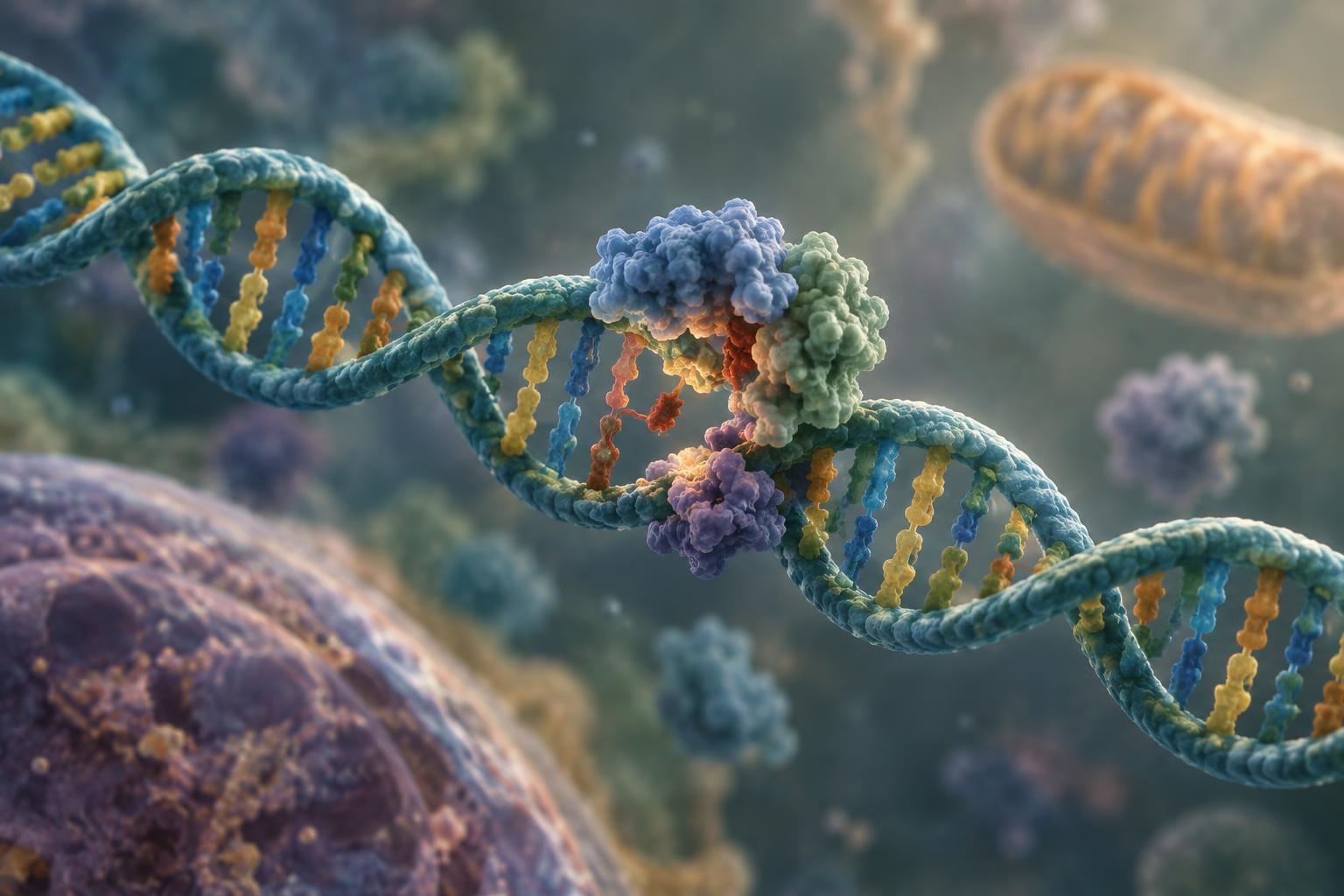
DNA is a long molecule whose sequence of chemical building blocks carries instructions that cells use to make proteins and regulate their activity. Before a cell divides, it copies that sequence. Copying is remarkably accurate, but an occasional wrong building block can be added. DNA can also be chemically altered by ordinary processes inside cells or by exposures such as ultraviolet light.
It helps to distinguish DNA damage from a mutation. Damage is a physical or chemical problem with DNA, such as an altered building block or a broken strand. A mutation is a lasting change in the DNA sequence. A cell may repair damage without changing the sequence. But if damage is copied incorrectly, or a copying error escapes correction, the resulting sequence change can persist in that cell and its descendants.
Where changes come from
Some potential mutations begin as copying mistakes. If the DNA-copying machinery places the wrong building block opposite one in the original strand, it may notice and replace the error immediately. If the mismatch remains after copying, another repair system may still correct it.
Other problems arise between rounds of copying. Normal chemical reactions in a cell can alter individual DNA building blocks, while ultraviolet light can cause neighboring building blocks to become linked in a way that obstructs copying. A chromosome can also suffer a break. These events do not all produce mutations: what matters is whether the original information can be recovered before the DNA is copied or repaired inaccurately.
How cells find and fix small problems
Cells use several repair pathways because DNA problems come in different forms. During copying, many DNA polymerases can proofread the building blocks they add. Afterward, mismatch repair can detect certain pairing errors and replace a stretch of the newly made strand. These systems reduce the chance that a copying error becomes permanent, though they do not catch every mistake.
For some chemically altered building blocks, base excision repair removes the affected building block and fills the gap using the opposite strand as a guide. Nucleotide excision repair removes a short stretch of DNA containing a bulky obstruction, such as damage caused by ultraviolet light, then fills it in. The intact strand is valuable in each case: it provides a template for restoring the sequence. Different kinds of damage call for different tools.
Repairing a broken chromosome
A break through both strands of a DNA molecule poses a particular challenge. A cell cannot simply read across the missing connection. One repair route, homologous recombination, uses a matching DNA copy as a guide. That can make repair relatively precise when an appropriate copy is available, such as after DNA has been duplicated ahead of cell division.
Another route, often called non-homologous end joining, reconnects the broken ends without relying on a matching copy in the same way. It can restore a continuous chromosome, but small pieces of DNA may be lost or added at the join. That trade-off illustrates why repair does not always return DNA to its original sequence. A cell must respond to a dangerous break even when the best template is unavailable.
Why a lasting mutation may matter—or not
The effect of a mutation depends on where it occurs and what it changes. Some sequence changes have little noticeable effect. Others alter a protein or affect when a gene is active. In a body cell, a mutation may be passed to daughter cells as that cell divides, but it is not ordinarily passed to children. Mutations in cells that give rise to eggs or sperm can be inherited.
DNA repair is therefore a continuing form of maintenance, not a promise of an unchanging genome. It helps preserve the instructions cells need, while occasional changes still slip through. Those lasting changes can contribute to disease in some circumstances; inherited changes also provide variation on which evolution can act. The key distinction is between a DNA problem that a cell can fix and a sequence change that remains after its opportunity to fix it has passed.